
Paul McElhinney: With its eternal values, the message of ‘Abide With Me’ stands the test of time
About nine miles from Wexford lies the village of Taghmon, the homeplace of Henry Lyte, the creator of the lyrics of the memorable hymn, ‘Abide with Me.’

Amplifying its historical associations, the townland is not far from the site of the first Norman invasion of Ireland in the 12th century, an area resonating with other important historical events.
Lyte’s early years were quite unsettled. He was born near Kelso in Scotland to English parents. His father, an army captain, was posted to the west of Ireland at the time of the 1798 rebellion. Forging a brief link with Ulster, the young Lyte was sent to Portora School in Enniskillen. It was after school there that he lost touch with his parents when his father left his mother. He was then taken in by a local clergyman in Wexford, Rev Burrows as a foster parent and continued to live in Taghmon.
After graduating as a stellar student from Trinity College, Dublin in 1814, Lyte was ordained in 1815 and served at St Munn’s church in the parish of Taghmon as a Church of Ireland curate from 1815 to 1818.
Suffering from ill health which required regular visits to the south of France, Lyte eventually moved from Ireland to settle in England in the early 1820s. There he served in parishes in Cornwall and Hampshire before finally settling in Brixham in Devon.
Lyte was responsible for writing the lyrics of the hymn which was meant originally to be read out as text. It was only after Lyte’s death in 1847 that the words were set to music by William Henry Monk in 1861.
Lyte sadly did not live to see his words formally published as he died from TB in Nice in September 1847 while travelling to Italy. Prior to this, Lyte had moved to a parish in Devon and some weeks before his death, had composed and delivered a sermon which contained the full text of ‘Abide with Me’. Delivered in much pain and exhaustion, it was to be his last sermon. He was only 54 when he died – redolent of the scourge of tuberculosis no matter a person’s age. At his funeral, his hymn was sung for the first time to a tune he had composed (the more famous William Henry Monk music had yet to be composed).
The hymn is so familiar to all in the Christian tradition, notably favoured for use during funerals and for the message it sends about the Christian conceptions of life and death. Renowned as a hymn in Anglophone countries, it has also had its adherents in Europe and beyond. The Hindu spiritual leader, Mahatma Gandhi, was even a devotee of the hymn.
What links the hymn even closer to Taghmon is the fact that the words of the hymn are said to have first been created there in 1820 by Lyte after he visited a dying friend nearby. The dying friend’s last words were’ abide with me’ after which Lyte set to writing a hymn that lay forgotten for many years. It was not until the time approaching his own death that he recalled the words of his earlier hymn and revived it. Central to the hymn was the gospel of Luke (24:29) which inspired Lyte to write shortly before his death in 1847.
According to the BBC’s ‘Songs of Praise’, it is "one of the most sung hymns at funerals: this is really a prayer to God to stay with Him in death as He did with us in life." Popular among the members of the Royal family, it was said to have been a particular favourite of King George V.
The hymn has also been used in many secular contexts. Shortly before kick-off at each English FA Cup Final, for example, two verses of the hymn are sung out, a tradition dating back to the 1920s. It is also traditionally sung out in advance of the Rugby League Challenge Cup Final, also at Wembley.
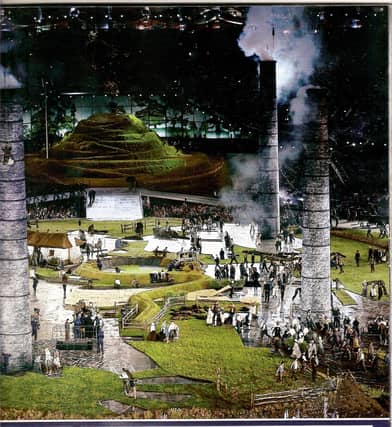
Further, the hymn was used as part of the official ceremonies for the 2012 Olympics in London, all reflecting its extension into the secular world.
The timing of Lyte’s death in 1847 was also significant. It was the same year as that of the Great Famine which so ravaged the Irish population and countryside, including Lyte’s own former parishioners in county Wexford.
Although then living in England, Lyte, whose ministry was strongly focused on pastoral activities including care and help to the ill and indigent, would have been deeply saddened by the tumultuous effects of the famine.
With all the attention on ‘Abide With Me’, it shouldn’t be forgotten that Lyte wrote a number of hymns, among which was the renowned ‘Praise My Soul the King of Heaven’.
Reading the words of ‘Abide with Me’ even today, a timeless message is conveyed in simple and evocative terms. Supported by the majestic, penetrating music, the hymn deserves its longevity and popularity in this more secular, less religious world than the 1840s.
It is a long way from a church in rural Wexford to the stands at Wembley stadium, but it is a testament to the longevity of the hymn’s eternal values.
Paul McElhinney is a full-time writer/journalist living in Wexford. Educated at St. Gerard’s School, Glenstal Abbey School and Trinity College Dublin, he joined the Irish Civil Service in 1980.
He was an official in the Department of the Taoiseach in the 1980s and a corporate executive with an international oil and gas company in London and Washington DC in the 1990s.
Among his publications are a biography of Air Marshal Sir George Beamish, ‘The Lion of the RAF’, and his main interests are in politics, history, sport and culture.