
Philip Smith: The unionist grassroots are worried about unionism and crying out for realignment and change
On behalf of Uniting UK I have made the case for realignment within unionism in this newspaper on many occasions as it makes sense politically, organisationally and for improving the health of the Union.

While I knew this view had support within the wider unionist community, I didn’t realise that it was an almost universal perspective.
A decisive 92% of grassroots unionists favour political realignment within unionism, according to a major new survey commissioned by our Northern Ireland-based pro-Union campaign group, Uniting UK.
The poll of 1,070 grassroots unionists, conducted by independent Great Britain-based researchers, reveals a clear mandate for change. Those who took part were representative of the wider unionist community and included voters of all three main unionist parties and we thank all those who contributed.
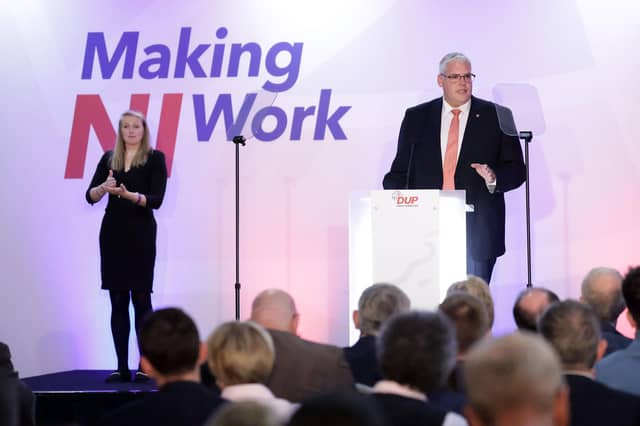
Realignment has become the new term favoured by unionist leaders to refer to any unionist unity that improves electoral performance. At the last DUP conference, Gavin Robinson said in his leader’s speech, “when unionism is divided, our opponents prosper”.
The outgoing UUP leader Mike Nesbitt has talked a lot about realignment within unionism, about a move towards creating a two-bloc approach, with one wing more traditional and the other more progressive. However, once unionism starts engaging on specifics around realignment then the wheels fall off. As Mike Nesbitt said ahead of his last party conference, “I could see the merits of that kind of realignment, but I don’t think it’s going to come. I think there’s a lot of self-interest within the various parties.”
The lack of willingness to put aside relatively minor differences between parties for the greater good of the Union and unionism has led to frustration and the demand for change which is highlighted within this survey. The results are clear:
• 92% are concerned about the health of political unionism including 52% who say it needs major surgery
• 60% think this poor state is due to unionism having too many parties, with a further 32% having concerns
• only 6% think the current three-party approach works well
• 76% think that the biggest barrier to improvement is the lack of appeal of unionist parties themselves
• support for realignment is universal: 98% of DUP voters, 92% of UUP voters, 90% of TUV voters
Survey respondents are a cross-section of the wider unionist community: 28% are members of a political party, 36% are members of the loyal orders, 14% are in a marching band, and the largest group of 38% are not members of any organisation. The survey included voters of the DUP, UUP and TUV and covered all demographics.
These are remarkable figures which show a unionist grassroots crying out for change. They are giving a mandate to unionist leaders to take bold, strategic action to revolutionise how unionism is organised and portrays itself. The survey also shows that this change needs to be rooted in positivity to grow the unionist vote and deliver real outputs for the people of NI. If unionism is ever to retake the first minister post, win back largest designation status in the assembly and grow its Westminster representation then transformation is essential.
When asked why they supported realignment, the most popular reason (41%) was to change the ‘vibes’ around unionism to create new energy, confidence and enthusiasm. A further 27% say it would produce a party more capable of competing against Sinn Fein and 22% thought it would deliver more unionist seats.
When asked, what should be the main goal of that change respondents prioritised promoting the Union to those who currently don’t vote unionist. This was followed by raising the spirits of the unionist community to create confidence and thirdly to focus on improving life for ordinary people.
Finally, when asked how unionism should realign, 49% preferred a single unionist party, closely followed by 43% who favour a DUP/UUP merger. With only 8% wanting to keep the political status quo, grassroots unionists are clear that the three-party model is no longer viable; unionism must become fit for the future.
This super majority for change should be a wake-up call for political unionism. The unionist grassroots demand action from the three main parties to realign for the greater good. How that process will develop is up to the leadership of the political parties but any realignment must make unionism more attractive, grow the vote and instil confidence within the unionist community. The survey results show that unionists want to see outreach, a more positive unionism and one that delivers better government for the people of Northern Ireland.
Unionist leaders have long preached realignment from conference stages, but their words rarely align with practical action. This data amplifies the voice of grassroots unionism who are united in saying that it is time for change. Unionist leaders can now confidently act in the knowledge that they have a clear mandate from their grassroots.
Political unionism needs to listen as the results of this survey are crystal clear. Unionist voters will not tolerate a status quo that is driven by self-interest and more of the same is not an option. We are less than 18 months from the next election and this is evidence that unionists want to see action that is for the greater good. At a minimum, the three parties must immediately agree to promote inter-unionist vote transfers to maximise the number of unionist seats and launch a joint ‘get out the vote’ campaign.
Uniting UK calls on political unionism to come together with other pro-Union organisations, develop a plan of action, and create the change that grassroots unionists demand. A commitment is needed from all parties to begin a political transformation capable of securing our place within the Union for generations to come. This survey shows that the unionist people are ready to play their part.
Can their leaders take the action and decisions needed to drive the change they demand?
• Philip Smith is an Ulster Unionist councillor in North Down & Ards and a former MLA