
Roamer: An intriguing A to Z of strange and curious Ulster stories
Today’s page features Banbridge author Doreen McBride’s latest book ‘The A-Z of Curious Northern Ireland’ subtitled ‘Strange Stories of Mysteries, Crimes and Eccentrics’.


With up to five topics per letter, today’s are A-M with N-Z next Saturday.
‘A’ opens with writer, poet and “world’s worst novelist” Amanda McKitterick Ros from Ballynahinch. Next under ‘A’ is a selection of American Presidents with Northern Ireland ancestry and the final ‘A’ is the Armada, in particular the Girona which sank near Dunluce Castle in 1588.
‘B’ has two listings - the Belfast Natural History and Philosophical Society, still operating over two centuries after it was formed in 1821, followed by the mysterious Black Pig’s Dyke, an ancient and extensive ‘ditch’ across our countryside.
‘C’ is another trio - Cloughmore Stone, a 50-ton+ granite boulder in the Mourne Mountains above Rostrevor; Lough Erne’s historic cots (shallow-draft boats), including the famous 1856 cot race, and the monastic Culdees sect, purportedly sent to Ireland by Joseph of Arimathea.
‘D’ is for Daphne Bell MBE (1926 - 2006), founder and Honorary Director of the Ulster College of Music - “one of the most amazing people I have ever had the privilege of counting as a friend” writes Doreen.
‘E’ is the “swashbuckling, hard-drinking, womanising” Errol Flynn, whose dad was Professor of Zoology at QUB from 1931 to 1948. The Professor discovered a new species of sub-tropical fish which he named gibbonsia erroli after his son.
‘F’ encompasses enormously contrasting topics - Fairies, the Great Famine, Fintona Railway and the Fermanagh Geopark, famed worldwide for the Marble Arch Caves.
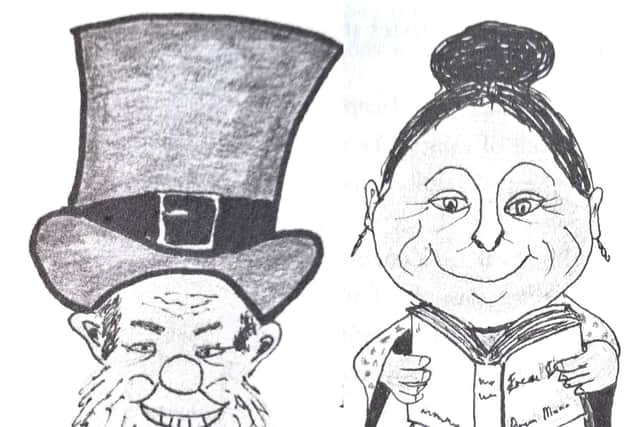
According to Doreen our globally acclaimed Irish fairies - leprechauns - are recognised by the EU as an endangered species in the vicinity of Slieve Foy, County Louth, where they’re protected by the EU Habitats Directive. “If you don’t believe me,” she challenges her readers “look it up!”
She highlight’s Ireland’s various famines without ducking the social and moral issues of the era, focussing particularly on the Great Famine from 1845 to 1847.
Other snippets from ‘F’ include the late great Barney McCool (Tom McDevitte) who watched from his carriage as a butterfly overtook the notoriously lethargic Fintona train! For details of Fermanagh Geopark’s indigenous elephants - look under ‘F’!
‘G’ focuses on ghosts, which could fill “several books” explains Doreen, offering “a couple of my favourites” which haunt Hillsborough Castle and Killeavy Old Church Graveyard.
‘H’ starts with Killyleagh-born Hans Sloane (1660 - 1753) who wrote in 1707 “I had from my youth been much pleased with the study of plants and other parts of nature.” His lifetime’s specimen collection “formed the basis of the British Museum.”
‘H’ continues with hugely contrasting topics - Hellfire Clubs, Holy Wells, Highwaymen and Hungry Grass. Doreen recounts seriously hair-raising tales about local Hellfire Club members; she discusses Half-Hung McNaughton and other regional ruffians and robbers; she chooses several of her favourite Holy Wells and shares a friend’s harrowing encounter with Hungry Grass - “said to be a place where someone died of starvation, probably during a time of famine.”
After that disturbing account readers might need a tonic, such as an Irish Coffee, prescribed in some detail under ‘I’, including ‘inventor’ Joe Sheridan, born in 1909 in Bridgetown near Castlederg. Alternatively under ‘I’, a visit to Irvinestown’s Garden of Celtic Saints might settle readers’ nerves, with its biblical sculptures veiled by fir trees - “a place of beauty, hope, reflection and prayer” Doreen muses.
‘J’ introduces an old Irish myth and a County Londonderry Presbyterian Minister’s son.The myth is the very mean ‘Stingy’ Jack O’Lantern who apparently devised carved-out Halloween turnips. The minister’s son was the “famous or infamous, depending on your viewpoint” John Mitchell (1815-1875) journalist, political activist and much more!
‘K’ is for Kelvin House in Belfast with two blue plaques, one commemorating eminent 19th century scientist Lord Kelvin (1824 - 1907) and the other celebrating Presbyterian Robert Shipboy McAdam (1805 - 1895) “a major commissioner and collector of the Irish language.”
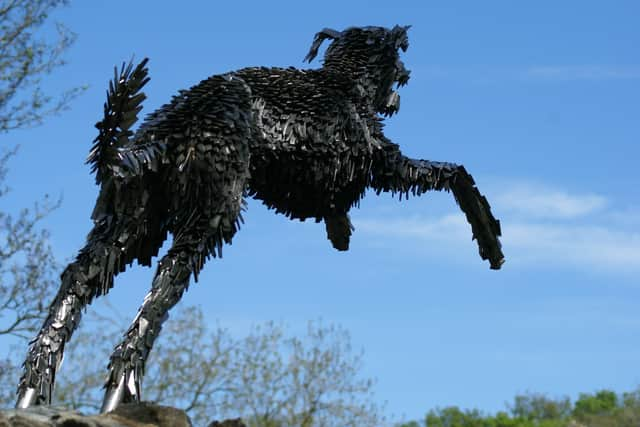
‘L’ has multiple entries, from Lambeg Drums via Limavady’s Leap of the Dog to the Linen Hall Library and Lissan House. Then the first half of Doreen’s remarkable Northern Ireland alphabet ends with ‘M’ for Matchmakers, Marriage and Mountainy Folk. N-Z continues here next Saturday.