
Roamer: Commemorating victory over Japan and the end of WWII
Several months ago we marked VE Day 80 with a host of public commemorations and celebrations, recalling Winston Churchill’s broadcast from Downing Street on 8 May 1945 when he said, “we may allow ourselves a brief period of rejoicing but let us not forget for a moment the toils and efforts that lie ahead”.

The war in Europe was over but Japan still wasn’t defeated. “There is another foe who occupies large portions of the British Empire,” Churchill emphasised “a foe stained with cruelty and greed - the Japanese.”
So while most of the world celebrated VE Day in 1945, ferocious fighting continued in the Pacific and the Far East between the Allies and Japan, from Hawaii to North East India. Britain’s and the Commonwealth’s principle fighting force, the Fourteenth Army, was one of the most diverse in history sharing over 40 languages and made up of most of the world’s major nationalities and religions.
But the Japanese military persisted, surrendering only after the Allies dropped two atomic bombs, on Hiroshima on 6 August and on Nagasaki on 9 August.
Victory over Japan - VJ Day - was celebrated on 15 August 1945, although the formally signed surrender didn’t happen until 2 September, on board the battleship USS Missouri in Tokyo Bay.
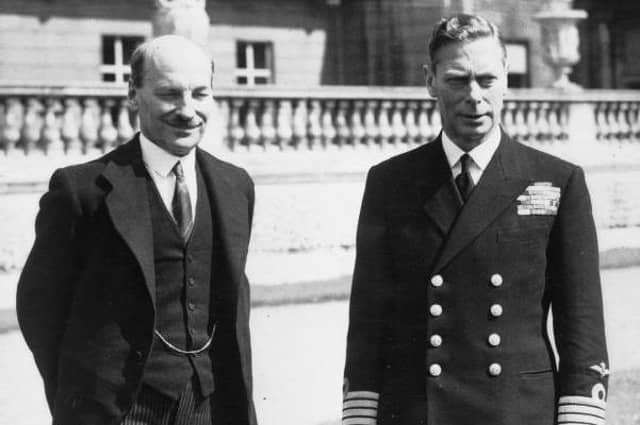
United States President Harry S Truman made an announcement from the White House at 7pm on 14 August followed by Britain’s new prime minister Clement Atlee’s announcement at midnight “the last of our enemies is laid low.”
The next day Japan’s Emperor Hirohito surrendered and the 15 August 1945 officially became the UK’s Victory in Japan Day. WWII was over, at last.
Amazingly, there were more than a few ‘hold outs’ - Japanese soldiers who continued ‘in action’ after the surrender. For instance, Sergeant Shōichi Yokoi was discovered in Guam on 24 January 1972, almost 28 years after the Allies had regained control of the island in 1944.
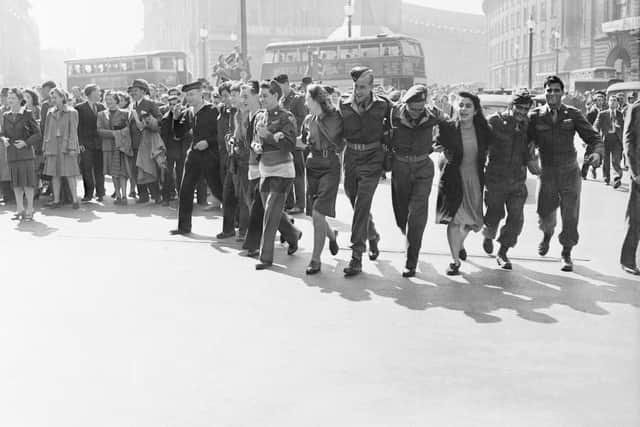
VJ Day, like VE Day, brought spontaneous street celebrations in the UK and around the globe, hailing the end of six years of war.
The BBC’s Wynford Vaughan-Thomas reported from London’s Piccadilly Circus where celebrations continued late into the night, with bonfires, conga dancing, singing, fireworks and joyful revellers scaling the Statue of Eros!
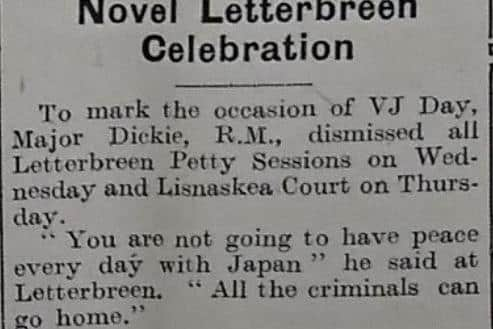
“To mark the occasion of VJ Day,” the Fermanagh Times reported “Major Dickie RM dismissed all Letterbreen Petty Sessions on Wednesday and Lisnaskea Court on Thursday. “You are not going to have peace every day with Japan,” he said in Letterbreen, “all the criminals can go home’”.
In Washington, D.C. enormous crowds tried to enter the White House grounds calling “We want Harry (Truman).”
In San Francisco naked women dived into a Civic Centre pond while soldiers cheered. The largest crowd in the history of New York City’s Times Square celebrated tirelessly.
French soldiers cheered on the streets of Paris, Australians danced in the centre of Sydney and there were street parties in Belfast, where a conga line snaked to the City Hall.
“Never were scenes of so much enthusiasm witnessed in Fivemiletown when VJ Day was celebrated,” the local newspaper reported “The villagers and people from the surrounding districts gave themselves up to a whole day’s jubilation and there was a never a night like it in the history of Fivemiletown.”
But there was great sadness too, here and globally. From substantially more than 50 million dead in WWII an estimated 71,000 soldiers from Britain and the Commonwealth died in the war against Japan, including more than 12,000 POWs who perished in Japanese prison camps.
Around 214,000 Japanese citizens died beneath Hiroshima’s and Nagasaki’s deadly mushroom clouds, followed by many more as radiation sickness progressed mercilessly though their bodies.
The UK’s VJ Day celebrations during two days of national holiday were joyous, boisterous and ebullient, overshadowed with grief.
“Our hearts are full to overflowing, as are your own,” said King George VI, broadcasting from Buckingham Palace at 9pm on 15 August 1945 “yet there is not one of us who has experienced this terrible war who does not realise that we shall feel its inevitable consequences long after we have all forgotten our rejoicings today.”
There are countless commemorative and memorial events on and around the 15th here, across the UK and around the world, and there’ll be more memories and accounts of the Allied victory over Japan on this page as the 80th anniversary of VJ Day approaches.