
Roamer: From merry Yuletide horses’ skulls to half-goats and demons
Several weeks ago Martin Evans shared a grisly photo here of what he described as “a rather long-deceased horse”.

He encountered its skeletal remains (emitting an “appalling stench”) on a hike through the Black Mountains of Wales and its skull reminded him of the Mari Lwyd, pronounced ‘marry lu-id’.
The star of an ancient Welsh Yuletide tradition, Mari Lwyd still dresses up in a white gown and horse’s skull, knocks on the doors of unsuspecting countryfolk and “with a clatter and a creak”, Martin told us, “it’s skeletal jaw jerks open and the ‘thing’ starts to sing at you!”
Having been introduced to Wales’s Mari Lwyd, Caiomhe from Newtownabbey thought it’s quite a tame Christmas visitor compared with Austria’s Krampus, and offered Roamer some very convincing evidence. Encyclopaedia Britannica states “Krampus is a central European mythical half-goat, half-demon monster that punishes misbehaving children at Christmas. He is the devilish companion of St. Nicholas with a name derived from the German word ‘krampen’, meaning ‘claw’.”
Offering further fearsome facts, Wikipedia asserts: “Krampus is a horned anthropomorphic figure who, in Central and Eastern Alpine folklore, is said to accompany Saint Nicholas on visits to children...Saint Nicholas rewards well-behaved children with small gifts, while Krampus punishes badly behaved ones with birch rods and condemns extremely naughty children to imprisonment in hell.”
The ever-faithful History Website describes Krampus as “the half-man, half-goat Christmas devil who punishes naughty children and maybe even drags them to hell.” And Krampus isn’t confined to the Alps. Last week BBC North Yorkshire News reported “a celebration of festive folklore is set to take over Whitby for the 10th annual Krampus run.”
And numerous versions of Krampus paraded in Orlando as recently as last Sunday (with live music from Bad Santa and The Angry Elves) at the ninth annual Krampusfest and Krampuslauf parade.
As well as making appearances in Florida, the Alps and Yorkshire, Krampus is popular in Bosnia and Herzegovina, Croatia, the Czech Republic, Hungary, Romania and Slovakia.
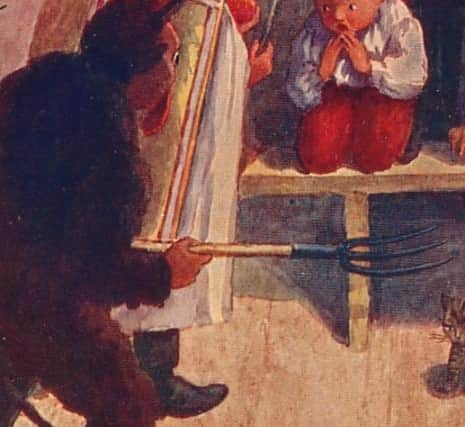
The date of his debut is uncertain but some folklorists and anthropologists have postulated that Krampus may have pre-Christian origins.
International travel writer Jennifer Billock describes Austria’s “1,500 year-old pagan ritual to disperse the ghosts of winter” where Krampus has “a mangled, deranged face with bloodshot eyes...giant horns curl up from his head displaying his half-goat, half-demon lineage.”
Along with its Christmas markets, horse-drawn sleigh-rides and Apfelstrudel baking demonstrations, Salzburg’s tourism bosses offer Christmas breaks featuring Krampus “a devil-like creature who accompanies Saint Nicholas on 6 December.
In contrast to St. Nick’s gift bearers, Krampus comes along with chains looking for children who weren’t as good as they ought to have been in the past year.
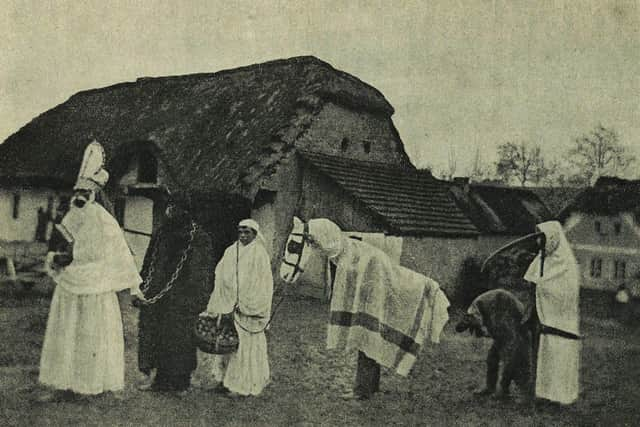
The Krampus tradition existed throughout the Habsburg Empire and in neighbouring regions.” (On their lengthy list of significant European empires, the Habsburgs ruled Austria from 1282 until 1918).
In its probable birthplace in the European Alps the tradition of Krampusnacht is still popular.
The 6th of December marks the feast day of Saint Nicholas, a 3rd-century Greek bishop who became the patron saint of children and is the real-life origin of the Father Christmas legend.
The day is marked by the giving of gifts to well-behaved kids. The night before, though, is an altogether darker and more terrifying occasion - Krampus Night.
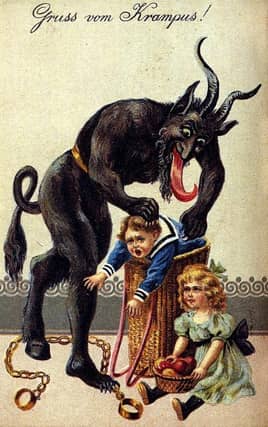
Folklore in this part of Europe tells of a demonic half-man, half-goat, depicted with a huge waggling tongue, dark fur, horns and wild eyes who beats naughty children with rods of birch, or if they’re particularly badly behaved, carries them straight to hell in a basket strapped to his back.
Most historians and folklorists agree that Krampus was probably a non-Christian legend that’s been absorbed into the Christmas tradition.
Nowadays, the night of 5 December sees the Krampuslauf (Krampus Run), with townsfolk and villagers across the Alpine regions donning Krampus masks and costumes, drinking enormous quantities schnapps (Krampus’s favourite tipple) and ringing bells to drive away evil spirits.
None of that happens here…yet... but it’s getting closer! Krampus books, greetings cards, animations, games, TV shows and films are easily sourced on the internet and just over 300 miles away, as mentioned previously, the Yorkshire fishing town of Whitby held its ninth annual Krampus Run last weekend though plans were somewhat amended by Storm Darragh.
Most events were brought indoors but around 50 weather-beaten Krampuses braved the elements in a grand parade.