
Roamer: In commemoration of two cities flattened in a blinding flash
Exactly 80 years will have passed next Friday, August 15 - VJ Day - since Japan surrendered in 1945 and WWII ended.
Meanwhile, two of history’s unimaginably indescribably darkest days occurred this week, eight decades ago.
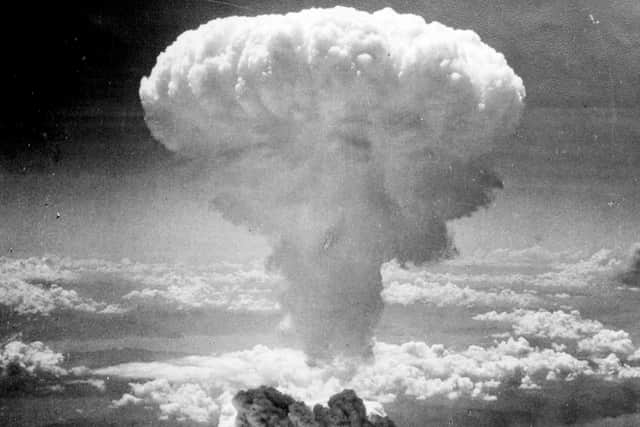

Early on 6 August 1945 a B-29 Superfortress, nicknamed ‘Enola Gay’, took off on a highly classified mission from Tinian island’s US base in the Pacific Ocean.
Piloted by mission-leader Colonel Paul Tibbets, the B-29 carried the first atomic bomb intended for use as a weapon of war, nicknamed ‘Little Boy’, set to deliver the equivalent of around 12.5 kilotons of TNT on Hiroshima.
Just over 1,500 miles north of Tinian, the densely populated city of Hiroshima was a main supply depot for Japan’s army. The bomb was dropped at 8.15 am and after 43 seconds it exploded at an altitude of about 1,800 feet.
Hiroshima was destroyed in a blinding flash.
With the temperature of the bomb’s ‘burst-point’ hotter than the sun, a nuclear shockwave tore through the city. The explosion reduced five square miles of Hiroshima to ashes, instantly vaporising many inhabitants - 80,000 men, women and children died in a moment and tens of thousands were wounded, disfigured and poisoned by radiation.
The B-29’s navigator watched through his darkened goggles – “it was like a photographer’s flash going off in your face” he said later.
“The whole plane lit up with a white light,” remembered another crew member, who “watched this churning on the ground. And this cloud started building up, rising, rising, rising. It was awesome.”
The navigator stared in amazement. “It was already up to, oh God, 25,000 feet and going up rapidly. Anything and everything had been kicked up by that bomb.”
“Fellows,” Colonel Tibbets reportedly radioed his crew, “you have just dropped the first atomic bomb in history.”
Hiroshima had “a black boiling mess hanging over the city”, Tibbets recalled later.
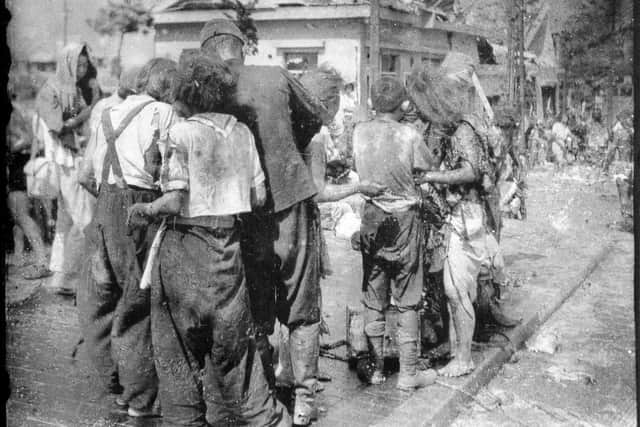
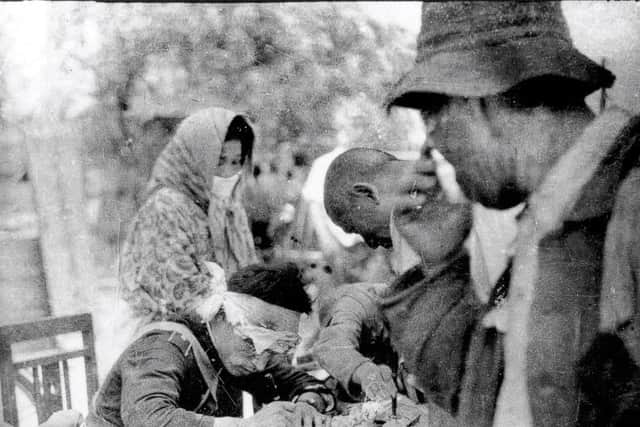
Five black and white photographs are thought to be the first and probably the only record of the immediate destruction of Hiroshima.
Yoshito Matsushige, a 32-year-old local newspaper photographer, miraculously survived the bomb even though he was at home, less than two miles from its epicentre.
His five printable photographs from seven that he shot are thought to be the only, first-hand, photographic account of the immediate after effects.
He was interviewed for a documentary several years before he died in 2005 and explained that he’d just finished breakfast and was getting ready to go to his newspaper “when the world around me turned bright white…immediately after that, the blast came…it felt like hundreds of needles were stabbing me all at once.”
He salvaged his camera from the debris of his house and went out to where a street used to be.
“It was really a terrible scene. It was just like something out of hell. Amongst the hundreds of injured people you could not tell the difference between male and female. There were children screaming - ‘it’s hot, it’s hot’ - they were crying over the body of their mother who appeared to be already dead. I finally managed to press the shutter.”
His five harrowing photographs include a bandaged policeman dealing with traumatised survivors; the demolished street outside his obliterated lounge window, and haunting images of terrified citizens in tattered, partially incinerated clothes.
Yoshito Matsushige admitted in the documentary “I clearly remember how the view finder was clouded over with my tears.”
Three days later, just after 11 am on the morning on 9 August 1945 - exactly 80 years ago today - a second nuclear bomb was dropped on Nagasaki from another B-29 Superfortress nicknamed Bockscar.
Nagasaki was one of the largest seaports in southern Japan. The second bomb, christened ‘Fat Man’, was more powerful than ‘Little Boy’, but it ‘only’ pulverised two square miles of the city, less than at Hiroshima due to the nature of the terrain.
In one of the most bizarre coincidences of WWII the bomb detonated almost directly over the factory that had manufactured the torpedoes used in the Japanese attack on Pearl Harbor, which led to the USA declaring war on Japan and entering World War II.
‘Fat Man’ killed almost 40,000 people instantly and at least another 40,000 were to perish from injuries and radiation sickness.
Six days later, on 15 August, devastated by two nuclear attacks as well as an overwhelming Soviet invasion of Japanese-occupied Manchuria, Japan finally surrendered.