
Roamer: Memories of working in one of our finest historic buildings
The stalled 'Tribeca' redevelopment scheme in Belfast’s Cathedral Quarter embraces the former Exchange and Assembly Rooms on Waring Street, which later served as the Belfast Bank’s Head Office.
Northern Bank (now Danske Bank) - a previous owner of the building - shortly celebrates the 200th anniversary of becoming Ireland’s first ‘joint stock bank’ (public company).
History Hub Ulster’s Chair, Gavin Bamford, a retired assistant bank manager, discovered an article written in 1977 in The Link staff magazine by former Northern Bank official, J.J. Holland.
The rest of this page is a compilation of just some of Mr Holland’s eloquent recollections of working in the old Waring Street building:
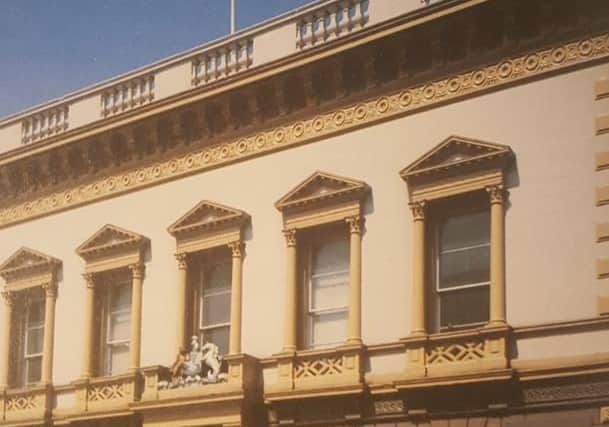

When I first stepped inside as a junior clerk, I had no idea whatsoever of its architectural merit or its historic significance.
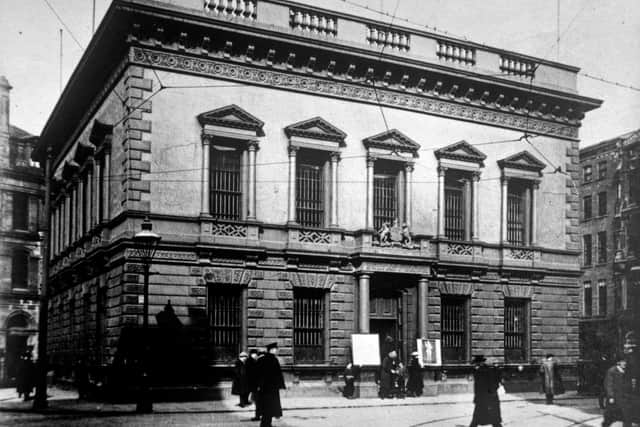
Indeed, it might be true to say that the front had been enhanced by the disappearance of the tramway standards and overhead-cables, and the cramping effect of the taller adjacent buildings had been wiped out in a single night during the blitz.
The bank was not unscathed as the rearward part of the office on North Street had been demolished.
Only one floor was at that time occupied by the bank with other floors let to other businesses.
An incendiary bomb had made a direct hit on the roof of the main building, piercing the slates and coming to rest in the roof space above the high Banking Hall.
Fortunately it failed to explode and having been rendered harmless it became a paperweight for the directors.
The exterior of the premises has not altered greatly, painted a drab, gun-metal grey.
In the 60s, it was painted chocolate brown with white flashings which won it the 1969 ‘Best-Kept Large Building in Belfast’ prize.
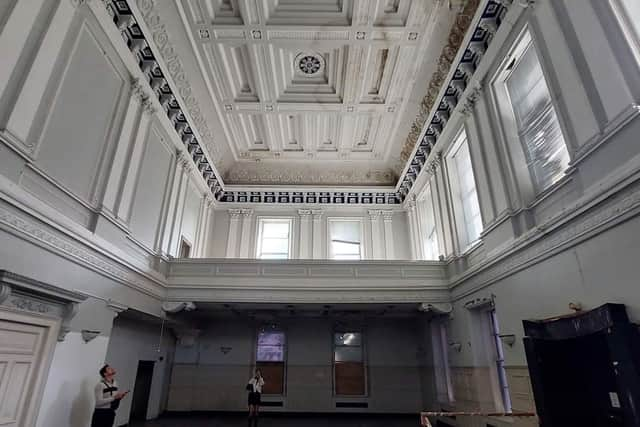
The interior decoration was a very delicate shade that also adorned the Banking Hall’s marvellously richly-ornamented high ceiling.
The Banking Hall with its J-shaped counter is largely as it was between the wars.
In contrast to present day policy the tellers were men of considerable service and seniority and as there was no closure for lunch, they could, on a busy day, be feeling the pressure as mid-day approached.
On the North Street side of the Banking Hall there was a stained-glass partition of about seven feet in height behind which was the Director’s Room with direct access from the Banking Hall.
It seems that ‘open plan’ design was not unknown even then.
Much of the sophisticated office furniture and machinery, common to-day, had not then been invented.
A single telephone served several offices and the limited number of typewriters had ribbons heavily coated in copying ink.
Most letters were hand-written in green ink and were copied in an old-fashioned copying press.
With no Sellotape, outgoing letters to other branches, bulky with bundles of cheques, were sealed with wax.
An electrically-heated pot about nine inches in diameter containing broken sticks of red wax was kept boiling for the last hour or so of the day.
There was no lunch break as such, or canteen, or staff lunch room or any other facilities.
Lunching-out wasn’t feasible for juniors on £8 6s. 8d per month, with ‘digs’ costing about £6 per month, so they brought sandwiches and flasks of tea to work.
The head porter occupied a flat at the extreme rear of the building on the Donegall Street side and his wife provided a cup of tea or a glass of milk daily for 1/- per week, Saturdays excluded.
This was so popular her kitchen was usually crowded to suffocation.
Those who could not afford to visit what country-folk termed ‘eating houses’ had to put up with sandwiches, munched at the desk or at the cloakroom window.
Possibly in an attempt to draw attention to this state of affairs one ex-serviceman Great War official who, it was said, feared no man and few women (there were only about six females on the staff at Waring Street at the time) provided himself one day with a spirit stove and a frying pan and proceeded to fry sausages at his desk which was on the gallery directly opposite to the Director’s Room.
Whether this had effect beyond sending the directors hurrying to their club for lunch when the aroma floated down to them cannot be said with certainty but a lunch-room was subsequently provided at the very top of the building close to the roof space.