
Roamer: Peeking into the past and presence of some of Ulster’s prefabs
With the 80th anniversary of Victory in Europe Day (VE Day) approaching in May, your wartime memories and accounts, first-hand or handed-down, are being shared here.


(Keep sending them to the mailbox address at the end of the page.) Today’s and next Saturday’s focus is on that quintessential legacy of WWII - the ‘prefab’!
When war ended, local authorities undertook to tackle slum housing and, in Belfast, family homes were needed by folk left homeless by the German air raids of 1941.
Many people were living in cramped conditions with friends and relatives.

Consequently, the need for temporary housing resulted in two approaches.
Whilst Nissen huts in former military camps were converted into residential accommodation, prefabricated bungalows were also erected under the auspices of the Ministry of Health and Local Government - a total of 4,000 units across Northern Ireland.
Between 1946 and 1947, 2,000 Arcon V detached bungalows were constructed, with 1,000 in the Belfast County Borough area and a further 235 at Whitehouse and Ballybeen.
From 1949 to 1951, 2,000 Hawksley semi-detached bungalows were built, with 802 in the Belfast County Borough area, 40 at Whiteabbey, and 20 in Monkstown.
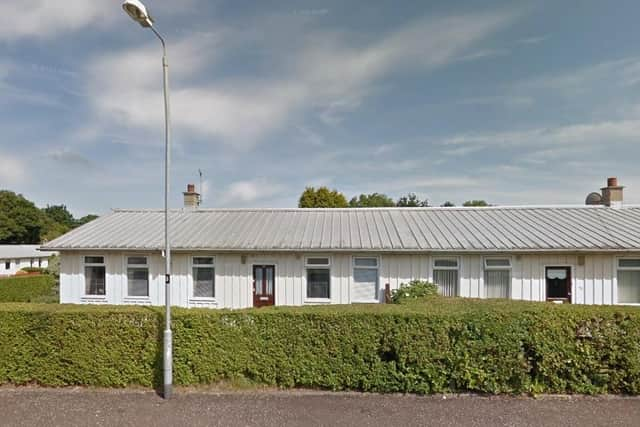
Nigel Henderson of History Hub Ulster has been researching the histories of these ‘Ministry prefabs’ and delving into the stories of some of the families who lived in them.
Nigel explained: “During my research, I have been surprised by the longevity of the prefabs, by their facilities, and by the length of time that some families lived in a prefab. Arcon prefabs, erected to provide temporary accommodation for 10 to 15 years, were still occupied 30 years later.
"Whilst none of the Arcon V type remain as residential units today, over 1,000 of the Hawksley prefabs continue to provide residential housing, albeit with significant improvements, in Northern Ireland.”
The Arcon V had a floor to ceiling height of seven feet six inches and a floor area of 650 square feet.
Each unit boasted a living room, two bedrooms, kitchen, bathroom, lavatory, and outside coal shed.
Intriguingly, the coal sheds were made from recycled Anderson air raid shelters and often multi-tasked as store rooms, garden huts and bicycle sheds!
The kitchen had a refrigerator (mostly electric but some gas), a cooker, a washing boiler, and an immersion heater.
The Hawskley semi-detached prefab bungalow had an aluminium exterior, with a fibre-glass ‘blanket’ between the outer panels and the interior lining.
Much of the raw material for the aluminium sections was recycled from crashed or scrapped aircraft!
Each dwelling had a floor area of 912.5 square feet.
The bungalow had a living room (216 square feet), two bedrooms (216 square feet), a third bedroom of (84 square feet), a kitchen, and a bathroom with a water closet toilet.
The fire in the living room fire provided convection heating to the three bedrooms.
As with the Arcon prefab, the kitchen in the Hawksley type was fitted with a cooker, refrigerator, washer, and immersion heater.
The dismantling of the Arcon prefabs began in the early 1960s and continued throughout the 1970s.
All of the Hawksley prefabs erected in Belfast were dismantled, but the bungalows at Whiteabbey and Monkstown remain to this day.
In Londonderry, the Hawksley prefabs in the Creggan were dismantled whilst those in the Glen Estate remain.
In Ballymena, the Hawksley prefabs at Brooke Park were dismantled but Hawksley bungalows are still providing residential accommodation in many towns across Northern Ireland.
Nigel Henderson added: “I have come across situations where families lived in the same prefab for over 30 years, like Thomas Cush, who resided in 10 Westrock Parade from 1951 to 1986. I have also sourced numerous accounts of ‘prefab families’, some which will be shared on this page next Saturday.”
The former prefab residents who Nigel will be writing about include a Boer War veteran who lived in Belfast’s Westland Bungalows and was still attending Royal Ulster Regiment Association events in his 90s.
Nigel will also be mentioning the world motorcycle champion who came from a prefab, and the army vehicle that had a blowout in one of its tyres and veered off the road, taking a prefab’s gable wall with it!
Nigel Henderson will be delivering an illustrated talk about the prefab houses at the Public Records Office for Northern Ireland at 1pm on April 8. Please register for the entrance-free event here: https://www.eventbrite.co.uk/.../post-war-housing-huts