
Roamer: Revisiting top civil servant’s remarkable stories shared here
This page isn’t renowned for bestowing botanical insights but the lightly scented wild Irish Rose - rosa Hibernica - was hailed here in November 2018 for its deep-pink, single-bloomed flowers with golden, pollen-rich stamens. It’s also called ‘Templeton’s Rose’, discovered by John Templeton in 1795 in Holywood, County Down.


It was highlighted here by Robin Masefield, from a book he helped write and compile called Holywood People, one his numerous projects which featured regularly on this page down the years.
A month ago, on 22 June, Robin’s family posted a message on his Facebook - “we are sorry to share the sad news of his death after a short illness. He was a dedicated civil servant, a tireless local historian and community champion, and a much-loved husband, father and grandad. He will be greatly missed.”
The message, from his wife Rosemary, daughters Anna and Sarah and son, Johnny, ended with a request - “the family would welcome any reflections or fond memories.”
The large number of warm, heartfelt notes from friends, colleagues and acquaintances that followed included references to Robin’s work on the Irish in East Asia; his historical research on Gray Point (Helen's Bay’s early 20th century coastal defence battery); his book on the Bangor railway line; his role in education and his tireless enthusiasm for local sport, church history, drama, charity, the arts, and a commendation repeated by politicians and public servants in newspaper obituaries locally and nationally, that Robin Masefield CBE was “one of the finest of Northern Ireland’s civil servants.”
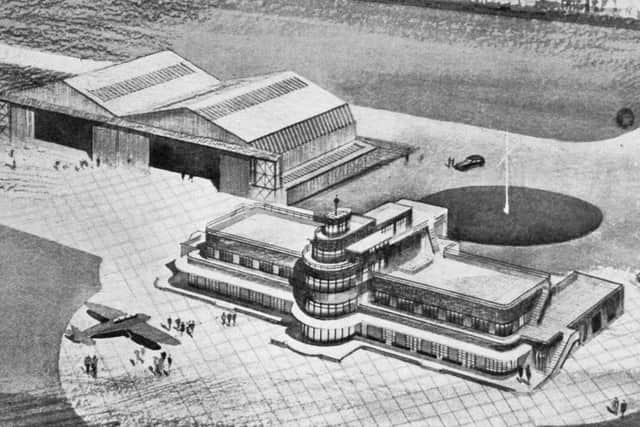
In commemoration, some of Robin’s remarkable contributions to this page will be revisited today and in the near future, including his innovative local history display on safety hoardings around a construction site; the 1938 official opening of Belfast Harbour Airport; the Campbell family (of Campbell College!) who turned Newtownabbey’s Mossley Mill into ‘a philanthropic model of Victorian socialism’ with a school and leisure facilities for the workforce, and the man from Maguiresbridge who made a massive mark on medicine and mountaineering in Japan!
Ending today’s page is Robin’s article in Roamer’s mailbox after the recent worldwide pandemic subsided. “With regard to responding to Covid-19, little is new,” he explained, and continued, “over 100 years ago, Emily Daly, an Irish doctor's wife, wrote (a letter) about the precautions in Newchang town after an outbreak of plague in Manchuria.”
He explained that the rare and deadly infection was mostly confined to China’s North-Eastern provinces, though cases were reported sporadically throughout the empire, in Tianjin, Beijing and along the Beijing-Hankou railway line stretching down into central China, reflecting the scale of the epidemic.

Robin reckoned that the death toll was never accurately calculated but existing reports from the time suggest that between 50,000 and 60,000 people died, with an unprecedented mortality rate of 100 per cent. Emily Daly was an Irish missionary nurse in the district around Newchang town - she was a writer, traveller and younger sister of Percy French, author of ‘Are ye right there, Michael’!
From 1888 Emily ran a hospital for women in Ningbo, one of China’s oldest cities, where she met and married the surgeon, Charles de Burgh Daly, ex Portora Royal School and TCD. In her letter Emily vividly described the ‘lockdown’ in Newchang during Manchuria’s ‘Great Pneumonic Plague of 1910.’
“They segregated some 4,000 Chinese in railway carriages, threw a cordon round them, kept suspects separate, and thus saved the town. The Commissioner and his staff, Europeans and Chinese, lived inside a large compound. When the epidemic was at its height, no one was allowed to leave this compound.”
‘They’ at the start of Emily’s letter were the authorities - “an interesting mix of Chinese, Russians and Europeans working together in a time of considerable international tension,” Robin explained.
Emily’s letter also included a graphic description of the medical attire worn by the doctors and their helpers. “White overalls, with the peaked cowl (large loose hood) rubber gloves and top-boots, and a mask and respirator. When actually attending plague patients or suspicious cases, doctors and nurses also wore goggles and a cotton-wool plug on either side of the nose….the infection is chiefly from inhalation, so we all go about wearing respirators.”
Robin also sourced a faded image of Manchurian medical workers in their old-fashioned PPE and noted that the medics’ efforts and full-scale lockdown largely spared Newchang the horrors of a plague.