
Roamer: Sneak photo of first Olympic flame airlifted to its stadium
In celebration of our recent Olympic triumphs there’s some Olympian nostalgia here today, not from Paris, but from a mountain in Greece.
First - a few ‘loose ends’ from Roamer’s mailbox.
Back in May several readers shared stories on consecutive Saturdays about Hollywood megastar Clark Gable’s short stay in Bangor, County Down, during WWII.
Then Bangor’s links with screen icons widened to include Star Trek’s Montgomery ‘Scotty’ Scott, whose parents hailed from Bangor.

Various other local connections with film stars were highlighted which will be followed up here very soon and then a note arrived from Dr Chrystopher J Spicer, Cultural Historian and Senior Research Fellow at James Cook University in Cairns, Queensland.
Because he’d written two books about Clark Gable, Dr Spicer was alerted to the film star’s Bangor connection by a News Letter reader. Chrystopher shared some of Gable’s wartime heroics here and told us that his next book is about the famous Australian author Louis Becke (1855-1913), the internationally renowned late-19th century writer about the South Pacific.
Favourably compared with Robert Louis Stevenson and Rudyard Kipling, Becke lived for several years in the early 1900s in Greenore, County Louth, where he wrote the introduction to Herman Melville’s Moby Dick.
“That's how significant he was at the time,” explained Dr Spicer, who asked Roamer-readers for more information about Becke’s sojourn beside Carlingford Lough.
“I thought you might like to know that there was an interesting response,” Chrystopher emailed recently, “but unexpectedly from the other side of the pond in the USA.”
Someone in America working “for a major database company looked up Louis Becke and located some document scans I had never seen,” said Chrystopher, adding “not about Ireland, but information nonetheless.”
He still hopes “something Irish turns up but in the meantime if anyone wants to pick up on Mr Gable, just pose me a question and I'll see if I can answer it.”
There’s an offer we can’t refuse - from a world authority on Gable!
Send your queries to Roamer’s mailbox below and they’ll be forwarded directly to Dr Spicer.
From Gone with the Wind’s leading man to some Olympian nostalgia, and a letter 12 years ago from Mr G Robinson from Fivemiletown containing a faded but wonderfully exotic old photograph. The London 2012 Summer Olympics were in full swing.
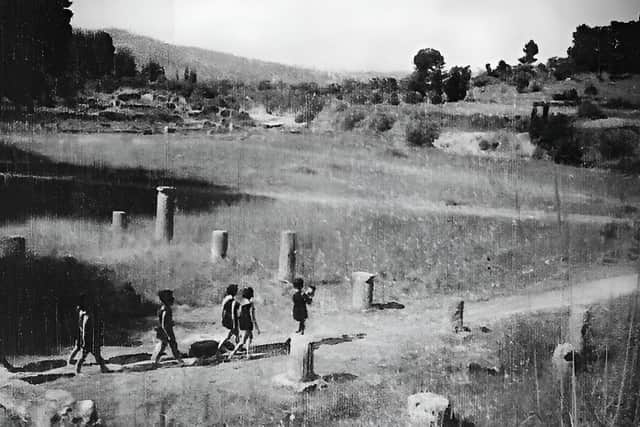
It was just about possible to distinguish seven girls and some ancient stone ruins in Mr Robinson’s black and white photo.
He’d snapped the picture in 1952, on shore-leave from a Royal Navy minesweeper.
It was the morning of 25th June, near the Temple of Hera on Mount Olympus in Greece and the seven girls were part of an historic event.
“A coach took us to see the Olympic flame on its way to the start of the 1952 games,” Mr Robinson’s letter explained “and the seven Greek girls went north from Mount Olympus, seven more went south, and seven went east and west.”
Relayed by a total of 3,372 runners, riders, cyclists, canoeists and sailors the flame was brought to Helsinki.
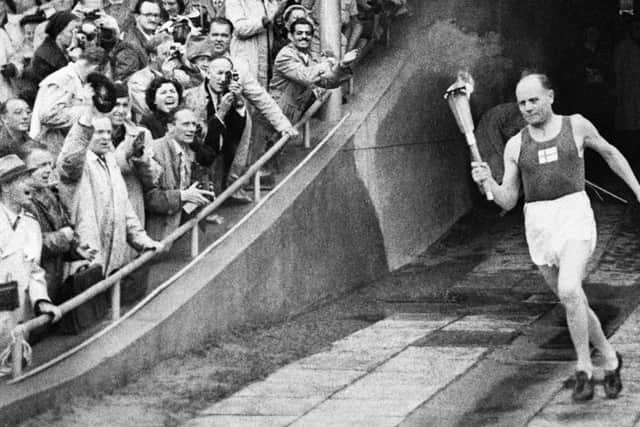
Finally, on 19 July 1952, the torch was carried into the Olympic stadium by Paavo Nurmi, the ‘Flying Finn’, a famous local runner who held nine Olympic gold and three silver medals.
He lit a small two-metre-high cauldron; four Helsinki footballers took the flame to the top of the stadium’s tower where Hannes Kolehmainen, another famous Finnish runner with multiple Olympic medals, then lit the main cauldron.
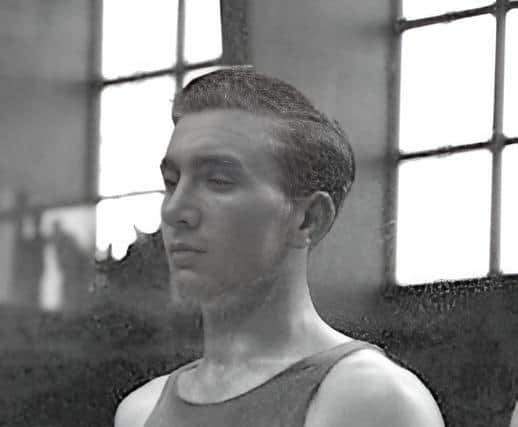
It burned brightly as Ireland's first Olympic boxing medallist, 19-year-old John McNally from Belfast, claimed his bantamweight silver medal on 2nd August 1952.
When he took the photo Mr Robinson didn’t know that the Olympic flame carried by seven Greek girls would be the first ever flown by aircraft - to Aalborg in Denmark - during its 13-day 7,870 km journey.
With the flame in a miner’s lamp the plane departed Athens on 27 June at 9.30 am and arrived at Aalborg that night at 8.45pm with short ceremonial stopovers in Munich and Dusseldorf.
“The flame was kindled on Olympia by the Greek maiden Rea Michalopoulov from the sun’s rays with a burning-glass,” stated the Official Report of the Organising Committee of the Helsinki 1952 Games.
“From the torch thus kindled,” the Official Report continued, “the flame was transferred to an asbestos bowl and borne by brown-clad women gymnasts.”
“I was there!” wrote Mr Robinson from Fivemiletown.