
Roamer: Ulster’s own underground was ready for a nuclear attack
During World War One teams of civilian volunteers scanned the skies over south-east England for marauding German zeppelins.

They became the Royal Observer Corps (ROC) in 1941 following their remarkable contribution to defence during the Battle of Britain and in the early 1950s, with increasing incursions by Soviet warplanes, they transitioned into a cold war nuclear detection, reporting and monitoring organisation.
Former Coleraine Chronicle editor Hugh McGrattan, a ROC member for 34 years, reminisced here recently about the organisation’s work in Northern Ireland and Bushmills artist, author and broadcaster Brian Willis shared memories of his dad’s ROC duties in Dorset during World War Two.
Hugh explained how Ulster’s ROC unit, No. 31 Group, was formed and organised, and how one of its many abandoned bunkers, near Portadown, has been fully restored.

I visited it on European Heritage Open Day several weekends ago, before it shut down for the winter.
It was an absolutely intriguing subterranean experience and as there’s far too much to recount on one page, there’ll be more here next Saturday.
Just off a little country road near the M1, close to Portadown, a short path leads through a small, neatly-tended, fenced-off field to three hefty concrete steps aside a substantial, square, concrete hatch.
Several metal tubes and something that looks like a large, slatted air-vent protrude from the grass nearby.
“This is Portadown Nuclear Monitoring Post,” said Alistair McCann, who regards himself as its ‘curator’.
He has every right to - it was back in 2009 that he started renovating and equipping it, restoring the bunker to what it was like 70 years ago when it was built and officially christened ‘Belfast 45 Post’.
“There were 58 of these all over Northern Ireland,” Alistair continued, “and 1,600 of them in the UK.”
I wondered about membership of the ROC.
“Over here, roughly around 800 but it changed all the time,” Alistair explained, “a post could have 12 members, a post could have four members and there were 100 people in the Group HQ in Thiepval Barracks in Lisburn.”
Alistair’s grandfather joined the ROC while training to be a vet in Edinburgh during WWII and “witnessed the very first Luftwaffe bombing raid of the war, over the Firth of Forth.”
When he came home he served on the Lurgan ROC post “situated in the field behind the house that I grew up in” Alistair reminisced, adding, “it was through that that I said, ‘I am going to restore a post in his memory.’”
After he passed his driving test Alistair visited “every single one of them that was still remaining all around Northern Ireland.”
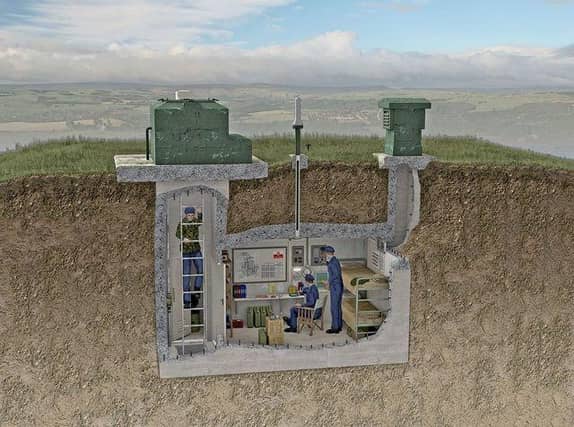
He chose Portadown’s to renovate. There’s a vividly illustrated cross- section of the bunker on a display panel in the field, which Alistair referred to before I ventured underground.
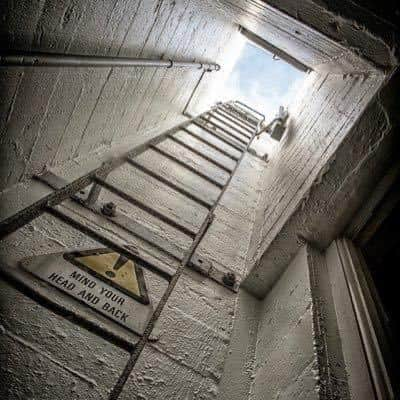
“From ground level to the base of the bunker is about 15 feet,” he detailed, “and there’s just one central metal ladder from an access hatch on the surface, in a concrete block.
"You climb down into the bunker and there’s a sump at the bottom to collect any rainwater just in case you leave the hatch open.”
As Alistair listed its facts and figures it became clear that this was no mean construction – and there was a very good reason.
“The walls are probably a foot to two feet thick of precast, poured concrete, bitumen tanked.
"There’s a brick layer around that which has more bitumen tanking and then there’s gravel and soil on that as well.
"That would give a pretty reasonable protection factor for any of the observers down there from nuclear blast and also from the radioactive fall-out.
"Altogether, there’s one large room, a toilet and the ladder which is the only way in and the only way out. The room is about 17 feet at its longest point, its width is about 9 to 10 feet and it’s about 7 feet high. It’s compact and bijoux would be the best words to describe it.”
“The moment you’d hear the rumble,” said Colin Woods, pointing to what looked like a clock on the wall, “that needle there measures the bomb’s pressure wave going over the top and that needle would go up.”
Colin was Leading Observer in the Portadown ROC underground bunker from 1983 to 1991 and next Saturday he’ll be describing what it was like working there during the cold war.
The bunker reopens next April. See facebook.com/nibunker