
Ruth Dudley Edwards: By hanging on, John Hume ensured that Sinn Fein would replace the SDLP
When international news seems so overwhelming as to be beyond understanding, local news can bring us back to earth.

Donald Trump may be appearing to stride the world like a colossus, but he is just a man. Leaders are mortal: they rise and fall.
There were reminders this month of two Northern Irish men of international significance.
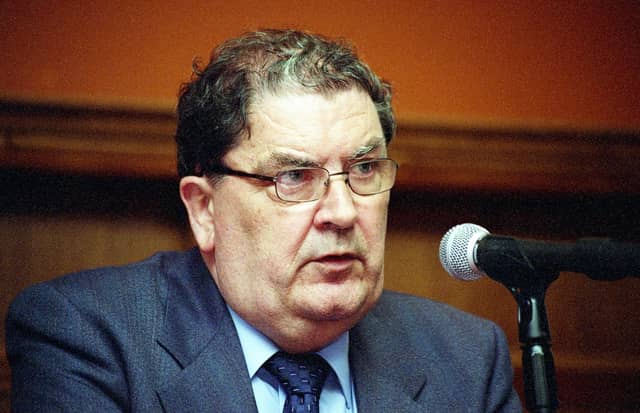
One was the unveiling in Twinbrook of an unrecognisable statue of Bobby Sands: the other the release of a 2000 memorandum from the British ambassador to Dublin, Sir Ivor Roberts, to prime minister Tony Blair, about his disturbing meeting with SDLP leader John Hume.
Twinbrook had been planned by well-meaning civil servants to be a model community where Catholics and Protestants would be contented neighbours.
The Troubles, the escalation in sectarianism, ethnic cleansing and colonisation by squatters destroyed such aspirations.
Fifteen-year-old Bobby Sands, an apprentice coach builder in 1969 with friends from both communities, was radicalised into violence by loyalist bullies and IRA recruiters who fed his appetite for stories of dying for Ireland.
He would end up starving himself to death, encouraging others to join him in his suicide mission and becoming an international icon for wannabe terrorists and martyrs.
The unveiling starred Pat Sheehan MLA, who survived the 1981 hunger strike and lived to enjoy some of the baubles of office bestowed by Sinn Féin.
Gerry Adams (“I was never in the IRA”) and Michelle O’Neill (“I will be first minister for all”) were in the audience.
Sheehan’s speech was standard party guff telling the old, old story of the Irish as the most oppressed people ever (mope) until raised from slavery by the IRA.
He assured the modest crowd that all the suffering had set in motion what “will carry us forward to the realisation of an Irish national democracy, a Republic where the rights and identity of all our people of whatever persuasion or background will be accommodated and cherished.”
So that’s all right, then. The 3,600 or so victims will not have died in vain.
Towards the turn of the century, having seen John Hume in public and private mostly repeating himself, collecting international awards and courting adulation, I asked David Trimble how he thought he was.
“Brain dead”, he said.
As Joe Biden would, Hume held on and on. But the seeds of the SDLP’s destruction had been years earlier.
Ken Bloomfield, then head of the Northern Ireland Civil Service, wrote of a conference we both attended in Virginia in 1985.
There I had seen terrible divisions in the party caused by Hume’s craven refusal to run a candidate against Bobby Sands - thus opening the door wide to Sinn Fein.
In the US, said Bloomfield, Hume “is widely regarded as a cross between Charles Stewart Parnell and Mother Theresa”.
On this occasion “he gave a chilling impression of political bankruptcy”.
Hume’s iron control over Irish and British politicians and diplomats saved his reputation and his career, but he was always a one-man band who never learned how to make his party work, and by hanging on ensured Sinn Fein would replace the SDLP.
Sinn Fein seems politically bankrupt now, just mostly old people clinging on for dear life.
Maybe the SDLP may have the last laugh.
Ruth Dudley Edwards is the author of ‘The Faithful Tribe: an intimate portrait of the loyal institutions’ and 'Aftermath: The Omagh Bombing and the Families’ Pursuit of Justice.’