
Ruth Dudley Edwards: Why Peter Mandelson remains a hero to victims of the Real IRA's Omagh bomb in 1998
“I went for dinner with Peter Mandelson – he’s blind to people of lower status”, was a headline in the Daily Telegraph this week.

In arranging to meet the journalist Suzanne Moore for dinner during a party conference when he was secretary of state for Northern Ireland, she reported, Mandelson had said he didn’t want to make a fuss.
“But then sent his three security guys in to sweep the small Brighton restaurant we were going to while startled journalists looked on.
"Then he made a dramatic entrance. Of course he did.”
After a jolly dinner apparently he made a fuss about the sticky toffee pudding taking so long to prepare.
“In that moment, it was clear what he wanted mattered most, and these people serving him were nothing to him.
"Why would they be?
"They were little people in a provincial bistro.
"They were of no use.”
Moore is an honourable journalist, but this was grossly unfair.
I can’t help with the sticky toffee pudding issue, but I do know that Mandelson in the autumn of 2000 was a prime target for terrorists not least because — unlike his predecessor Mo Mowlam — he was resisting pressure from Tony Blair to give Sinn Féin more concessions on what was politely known as “normalisation” but is more accurately called appeasement.
Alastair Campbell recorded crossly in his diary that Mandelson was “too pro-unionist” and “too anti-Sinn Féin” and believed Blair “was too prone to buying the line from Adams”.
He had tried to make the Patten report more police friendly and had the George Cross awarded to the RUC in recognition of their heroism and suffering.
The Provisionals were theoretically no longer killing people, but they had their proxies and the Real IRA were still in business.
It was as a consequence of months of pressure from Mandelson that the United States department of state would designate the Real Irish Republican Army as a foreign terrorist organisation.
In 2000 he had written to me to praise an angry piece I had written about the treatment of the Omagh victims saying such articles “which highlight the human damage terrorism does, play an important part in changing the environment in which terrorists operate”.
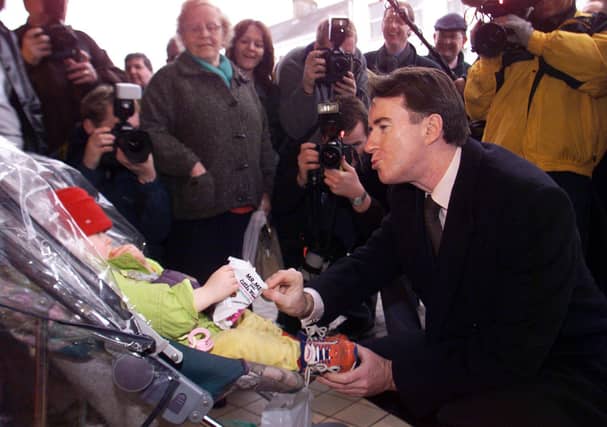
His deep concern for victims had become clear when against the opposition of the Northern Ireland Office he went to Omagh to visit victim support groups, broke down after seeing the artwork of some of the victims’ children, and promised the Omagh victims’ group that he would give them all the help he could and never let them down.
Even though he was fired shortly afterwards after what was later admitted to be an unjust accusation, he kept his word.
Without his constant support and his pressure on government to grant legal aid the successful Omagh civil case against the bombers could not have happened.
Before hastening to pour fuel on Mandelson’s funeral pyre, look him up in my book and you will understand why he became and remains a hero to a group of ordinary Northern Irish people who couldn’t even give him a vote.
He may enjoy the company of the rich, but he cares passionately about the vulnerable.
l Ruth Dudley Edwards is the author of Aftermath: The Omagh Bombing and the Families’ Pursuit of Justice, and also The Faithful Tribe: an intimate portrait of the loyal institutions.