
Steve Aiken: Wars in Israel and Ukraine show why we need to invest heavily in our defence and security, or we can have no control over events
The date of October 7, 2023 marked a watershed in our already turbulent century. The barbarity shown, coupled with the obvious failures in intelligence and security from one of the most technological and security conscious states, have created a fearful dynamic shift in how we must all consider our lives.
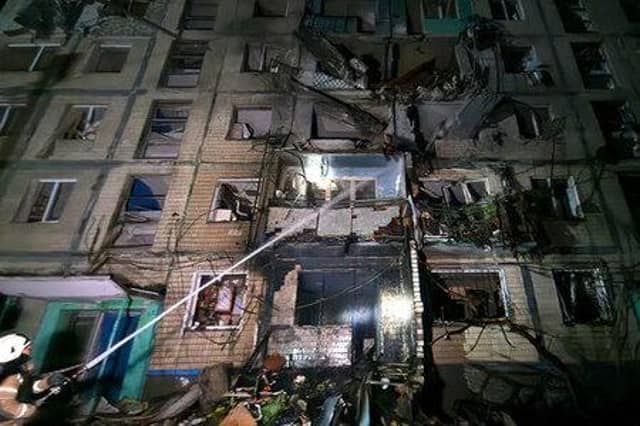

However, the war in and around the Ukraine, with its resultant breakdown of the international systems of checks and balances, has also fundamentally driven changes in how nations and alliances now need to defend themselves.
Who amongst us, even at the beginning of this century, would have believed that major war in Europe and a regional war in the Middle East that could lead to nuclear conflict, isn’t horrified about the direction of travel we appear to be heading in?
A direction of travel where there seems to be little appetite by global leaders to intervene and try and control it. It feels, for those who study history, that the inability to manage the wars of today, is making a wider, global conflict, much more likely. However, we should take some hope that we are not at that point - yet
What’s missing, especially amongst the leaders of the Western world, is a proper strategic view of how we avoid falling into the default mode of “war being a continuation of politics by other means”.
The West has for too long taken a myopic view of the changing international politics. The rise of China, the insecurity of Russia, the grabbing for power and influence of Iran, the impacts of the climate emergency, with its resultant mass migration have all been seen as ‘future’ problems. Much like trying to stop the rise in global temperature and greenhouse gas emissions, these challenges have been placed in the ‘much too difficult’ file, up to the point that inaction will destabilise the whole edifice.
There are no easy defence and security answers, but policy answers there must be. As usual by leaving it too late to intervene, we have allowed these conflicts to grow and fester. Failure to stand up to Russia, and failing to arm Ukraine with all the tools it needs, means that now we will have to provide ever more of our capabilities to counter Putin. Regaining air control over the Ukraine, thereby denying Russia the ability to manoeuvre, is the critical retirement. This will mean NATO involvement. Despite the use of drone warfare, complex cyber attack and defence modes, the battle for the lands Ukraine can only win on the ground, for that, it needs its airspace secure. Russia will react, but if we don’t intervene, we allow destroy any hope Europe has of maintaining the peace it has largely enjoyed since 1945.
We also need to increase, significantly, our defence spending. Spending billions on international aid, while the Ukrainians scramble for more artillery shells, is a false economy. Being ready to deal with Russia’s ‘hybrid warfare’ will also cost. By delaying for so long the reinvestment in defence across NATO, we will be looking to spend closer to 3% of GDP on defence; remember a full-scale war will cost 50/60% of our GDP.
The failure to challenge the struggle between Iran and the rest of the Middle East has also cost everyone dear. The horrors of the Nova Music festival with levels of barbarism that many naïve commentators in the West thought had been confined to the era NAZI death squads have for years been the norm, in Syria, Iraq, Yemen, Somalia, Libya, Sudan and beyond. The attacks, using missiles, drones, cyber on civilian infrastructure, shipping and vulnerable civilians by Iran and its proxies, counterattacked by Saudi Arabia and the Gulf States, with thousands of casualties on all sides has been going on unabated for well over a decade.
Many in the West are surprised by how little sympathy across the non-Shia Arab world there is for what is going on in Gaza and Lebanon – that is because all of these state’s leaders understand that what we are seeing today is a continuation of that power struggle between Iran and its regional rivals. Israel, in many ways, is just the latest vector of this conflict.
Allowing Iran to become the regional hegemon has been one of the largest strategic failures of the West. Much like the threat from Russia, we cannot allow Iran to dominate the region. While far too many wring their hands on the actions of Israel, their military ability to counter Iran, the IRGC and its surrogates, is welcomed by many. Much like Ukraine acting as a bulwark against Russian aggressions, Israel fulfils a similar role against Iran. The strategic equation will be further unbalanced if Iran succeeds in becoming a nuclear power. If we look, critically, at how much Iran has invested in its nuclear programme, its development of missile technology and its willingness to attack western interests, we should see that neutralising its nuclear weapons programme is in all of our strategic interests.
The final part of this ‘wicked problem’ is that power is shifting from the USA towards China. While the linkage between Russia and Iran is symbiotic; China is taking a longer game. It is in China’s interests to see the US, and the West’s, power constrained and diminished. However, at this stage of its development, it needs the West, especially the US and the EU, to bolster its economy.
It suits Chinese interests to have us distracted by what Russia and Iran are doing; but it cannot afford large scale disruption to global trade, hence its pressure on Iran over the Houthi’s attacks on shipping in the Red sea and Iranian support of the insurgency in Sudan - as this interferes with Chinese interests in the regions.
Paradoxically, the more China sees its long-term interest disrupted by the Ukrainian and Middle East conflicts, the more it leans toward applying the breaks in Moscow and Tehran.
The biggest conundrum for us though, is that unless we invest heavily on our defence and security, we can have no control over events, no matter what our political leadership thinks. The interests of Beijing, will trump all, no pun intended.
Dr Steve Aiken OBE MLA holds a PhD from University of Cambridge in International Relations and was a nuclear submarine commander. He spent much of his military service in the Middle East and under the waters around Russia