
Trevor Ringland: We should ensure sport is the core dynamic as we build our society for the future
The ability of sport to make a positive contribution to the building of a shared and better future for the benefit of all the people of Northern Ireland is too often underestimated.

Here, I will highlight just some of the areas where it has such an influence, recognising that those involved in sport not only care about their particular sport but also sport in general and hence those involved in sport.
It also strives to help those at all levels to perform and succeed to the best of their ability—qualities that society in general should bear in mind when working to deal with the many and varied issues that often trouble it.
As an insight into the complexity of the British/Irish identity in Northern Ireland it is possible for a sportsperson to represent their town/local club, parish, county, Northern Ireland, Republic of Ireland, Ulster, Ireland, United Kingdom and Europe, depending on the sport and the tournament.
When I initially wrote this piece, it followed the Beijing Olympics when we had Wendy Houvenaghel (cycling) and Alan Campbell and Richard Chambers (rowing) competing for GB & NI, Paddy Barnes (boxing) and Richard Archibald (rowing) for Ireland.
There are 38 of our athletes at this year’s Olympics and new heroes are currently being created in Paris.
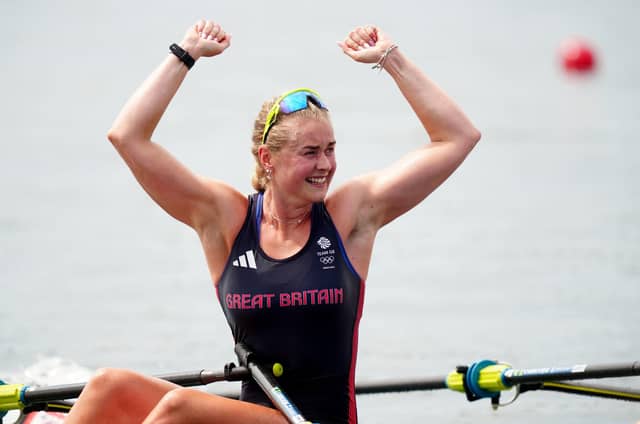
Among today’s stars are Daniel Wiffen (swimming) competing for Team Ireland, Jack McMillan (also swimming) for Team GB, and Hannah Scott (rowing) for Team GB, along with Rebecca Shorten (rowing) for Team GB and Philip Doyle (also rowing) for Team Ireland.
Sport NI states that it is committed to sport without prejudice, and is working tirelessly to promote equality of opportunity to participate in, observe, administer or develop sport regardless of political belief, opinion or cultural identity.
All the main sporting bodies are committed to working to ensure that their respective sports are inclusive.
The Irish Football Association, with the support of fans, is constantly striving to ensure that its sport is open to all and welcoming.
Irish rugby, with others such as hockey, cricket and rowing, managed, even during the worst of the Troubles, to exhibit an ability to reach out across a broad support base throughout the island and reflect an Irishness that could also be British and vice versa.
Sport also crosses the social divides in society as well as those suffering from a disability through such events as the Special Olympics and many others.
The basic fundamentals underlying team sports illustrate the concept of interdependence, which increasingly is being recognised as the most constructive model to which society should aspire.
Sport has been to the forefront in showing how, with leadership, sectarianism can be tackled.
The GAA has moved to a strong anti-sectarian position. This does not mean diluting its cultural identity but simply stating that sectarianism will not be tolerated and association rules now have strong sanctions against any member who breaches the anti-sectarian policy.
The work continues but with a sense of reality that sectarianism and racism are detrimental to sport and that tackling them brings considerable social and economic benefits.
Again, sport has done some tremendous work in reconciliation, including through such organisations as Peace Players International, which promotes better community relations through basketball under the motto ‘Those who play together can learn to live together’.
There are numerous examples of those who have promoted similar work, all the time building relationships while others were destroying them.
It is so important in striving to achieve a stable and prosperous society at peace with itself that it promotes that sense of interdependence that anyone involved in team sport realises is central to the success or otherwise of their team.
It is about the fact that teams of friends who identify a common purpose and play for each other succeed while those who play for themselves fail.
It is the challenge to any coach or manager as to how to mould together the many diverse characters on any team so that they function effectively and cohesively.
We share the space called Northern Ireland and so the challenge to our society, and particularly our politicians, is how to embrace its diversity so that it functions constructively for the benefit of all of us.
While there is understandable disappointment at the failure to agree on a shared stadium for football, Gaelic and rugby, structurally this was always going to be difficult. What can be achieved and would have a significantly greater impact on our society is the increasing sharing of facilities by all sports in our cities, towns and villages.
This has only touched on the many positive benefits that flow from sport.
As we look to find ways to deal with our past and free up the future for ourselves and our children, we need only recall some of the great sporting moments and personalities that were a bright light during those dark days: Mary Peters, Paddy Hopkirk, the Northern Ireland football team in the World Cups of 1982 and 1986, Sean O'Neill, Paddy Doherty and the Down team of 1960, 1961 and 1968, and the Ulster Heineken Cup winners in 1999.
Other notables include Barry McGuigan and Dave Boy McCauley, the late Alex ‘Hurricane’ Higgins, Denis Taylor, the late Joey Dunlop, the late Cormaic McAnallen, Graeme McDowell, Rory McIlroy and Darren Clarke – the list goes on.
Looking to the future, an increasing challenge will be to ensure that, in addition to tackling the scourge of sectarianism, all sports address themselves as to how they engage with—and capitalise upon—Northern Ireland’s growing ethnic diversity.
There is a better way to do relationships in Northern Ireland, on this island and between these islands and we need look no further than sport for examples. It can teach us how to compete without destroying relationships. It also reminds us that while at times it is right to compete with others we can only achieve our ‘goals’ by working together.
The simple concept of friendship permeates so much of what sport is about. Friendship works, so we should ensure it is the core dynamic as we continue to build our society for the future.
Trevor Ringland is a lawyer, reconciliation campaigner, former Ireland rugby international and one-time Ulster Unionist political candidate