
William Matchett: Propaganda and disinformation – terrorism’s greatest weapons
In the realm of democracy, the spread of fake news and blatant lies has not been as proficient from the days of the Reich Department of Popular Enlightenment and Propaganda.


Provisional Sinn Féin, the political arm of the Provisional Irish Republican Army, set the deceit standard in 21st century terrorism.
Just as Hitler’s invasion of Poland sparked World War II, ‘the Troubles’ began in 1969 when a few men secretly formed the Provisional IRA.
This was not the IRA of Michael Collins, but the Nazi-supporting IRA of Seán Russell, who died on a U-Boat.
Provisional Sinn Fein propagated the big lie that there was no alternative to bypassing democracy in resorting directly to violence with Sten guns and Gelignite.
Its president, Ruraí Ó Brádaigh, dismissed elections as mere public demonstrations, using the Irish term “Údaras na staire” (Authority of history) to convey the sacred mission to end British rule in Ireland through “armed
struggle,” a euphemism for mass murder.
Ó Brádaigh was part of the Border IRA, which existed between the Nazi and Provo iterations, and he paraded with it at the unveiling of Russell’s statue in Dublin.
Catholic youths believed they were joining a glorious rebellion only to find themselves in death squads murdering their Protestant neighbour.
When yearly promises of victory wore thin the leadership changed tactics.
A sunglass-wearing PIRA ‘chief of staff’, who resembled a Mafia Godfather, was arrested with a document detailing the Provo reboot. It was the “long war” plan drafted in the early 1970s.
This plan involved serialised murder over decades, which would be cashed in at the ballot box and needed propaganda to hide the glaring fact - No Provisional IRA, no ‘Troubles.’
In the paper, Provisional Sinn Fein oversaw “propaganda and publicity” under the control of the “Provisional Army Council.”
For Ó Brádaigh, who was convicted of PIRA membership in 1973, it made sense that, as PR director, he sat at the top table. He did not refute this.
In sharp contrast, his successor Gerry Adams has consistently denied being in the Provisional IRA, barring him from the hierarchy.
If we accept those grounds, who did Adams answer to and how?
In republican fascism, the term “legitimate target” announced itself in excusing the murder of “British Crown forces of oppression” (cops and soldiers) and members of their family.
Playing God was strongest for alleged informers.
The document “General Order No 1” equated informing to “treachery” punishable by death.
It was marked for “Provisional Army Council and GHQ staff” eyes only.
In 1974 it was found by police on a prominent Provo. Around 100 men, women and children suffered the penalty. Many were clearly not informers.
Bodies were dumped in public to instil fear in communities. Some victims were ‘disappeared’.
The evil spread out from Belfast and seeped into executing ‘Brit’ prisoners.
The rule prioritised and widely publicised by the Provo IRA is a war crime.
Republicans committed most murders in constant effort to incite loyalists into retaliating.
To divert attention from the significant disparity in killings, which peaked in 1985 at a ratio of 10:1, a flood of falsehoods were released to excuse the deed, praise the offenders, smear the victim and, most of all, pin reprisal murders on ‘Crown forces’.
This was on Adams’ watch. In 1985 he directed the deceit machinery.
Studies after 9/11 show that half of terrorism is propaganda and relies heavily on the media to popularise its narrative.
This crucial aspect has been neglected in the controversial legacy model of the Belfast/Good Friday Agreement, likely leading to a biased historical caseload against former police officers and soldiers that has unfairly depicted them as villains, ruining reputations.
In 2019, at the funeral of Kevin McKenna, the terror chief who virtually monopolised murder in 1985, Adams’ eulogy reinforced the ‘no alternative’ big lie.
A major flaw in the Agreement was anointing Adams and men like McKenna peacemakers without compelling them to state that the Provo war on the people was wrong and they were sorry.
Instead, to trumpet some 1,700 murders, including many that were gross violations of humanitarian law, is to be hailed a champion of peace, equality and truth; and to disagree, which the media rarely do, risks a lawsuit and being labelled disenlightened.
The propaganda war did not end on April 10, 1998. It was only getting started.
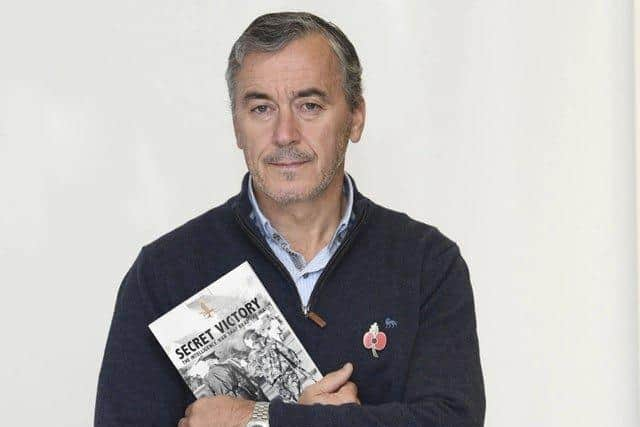
l William Matchett is author of: Secret Victory: The Intelligence War that Beat the IRA