
Esmond Birnie: The two presidents’ unseemly spat about which nation did more to win war
Early May was understandably dominated by the 80th anniversary of the end of the Second World War in Europe: VE Day.

It was impossible to prevent the present colliding with the memorialisation of the past.
A small group of Ukrainian soldiers took part in the march along the Mall. A few days later, reports suggested the Kremlin leadership appeared terrified that Ukrainian drone strikes would interfere with the military parade on Red Square.
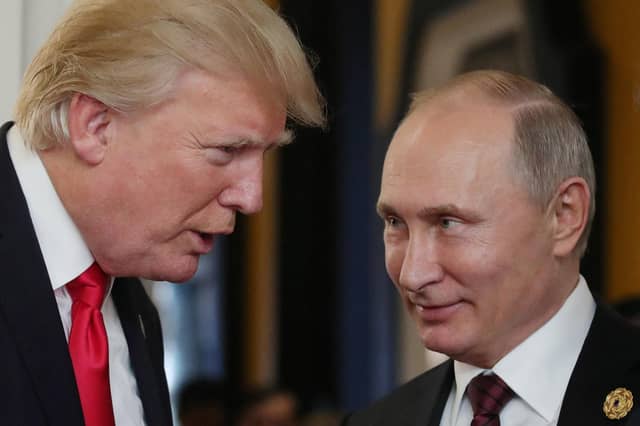
There was also a war of words between the presidents of America and Russia.
Trump was his usual inexact self as his Truth Social proclaimed, “We won both wars, nobody else was close”.
He did not explain why the US involvements in those two wars started as late as April 1917 and December 1941.
Putin provided the Russian take on things whereby it was Russia/the Soviet Union which “determined the outcome” of the Second World War.
If one uses number of casualties (deaths of military and civilians) then it is true that the evidence leans more to Putin than Trump on this one. No other country suffered more war deaths than Russia. Perhaps up to 27 million.
By comparison, the figure for the USA was 419,000 and for the UK (including Empire/Commonwealth) about 450,000.
Possibly the only statistical indicator that comes close to supporting Trump’s claim that America won the 1939-45 War is the monetary value of all the equipment manufactured by US industry.
That value certainly far out-stripped that of the British economy and probably even that of the Soviet Union.
Of course, to a large extent the Russian president is using the “butcher’s bill” from the Second World War to justify the narrative around his own foreign policy.
His view is that Russia saved itself by its own efforts during 1941-45 and must save itself again by building up sufficient defensive ramparts against the perfidious Western powers. And part of those ramparts should include some if not all of the Ukraine.
Now, it is certainly true that wartime Russia contributed massively more manpower to the defeat of Nazi Germany than either the UK or America (strictly speaking that should be “person power” given the extent to which there were female Russian snipers, tank drivers and fighter pilots).
At the same time, Putin’s analysis of the Second World War is deeply flawed.
Nothing is said about the fact that for almost two years Stalin’s Russia and Hitler’s Germany were somewhat aligned through a Non-Aggression Pact (September 1939-22 June 1941).
The current Russian narrative completely downplays the extent to which the Western Allies did provide material assistance during the war: notably 400,000 lorries and jeeps, 13,000 tanks and 14,000 aircraft.
Much of this came via the perilous Arctic convoys. (There are several Northern Ireland connections - the young Gerry Fitt, later founder of the SDLP, was a merchant sea man on one of the ships. HMS Belfast played vital role in the notable Battle of North Cape.)
Tragically, one of the reasons why so many Russians died during what they call the Great Patriotic War was incompetence or callousness on the part of their own leadership.
The Russian General Georgy Zhukov would tell the American General Eisenhower that standard Red Army approach to clearing a minefield was to send the infantry straight through it. He was probably not exaggerating.
A further point to bear in mind is that the eventual victory on the Eastern Front in 1945 was very much a result of efforts by all the people groups within what was then the Soviet Union.
For example, a disproportionate share of USSR casualties were represented by people from what is now the Ukraine.
What might we conclude? Several points.
If ever there was a just war the Second World War was such a war.
That said, some of the methods used by the Allies and especially by Russia were question begging.
The westward advance of the Red Army from Stalingrad to Berlin involved an horrendous body count (on both sides) and in the final months of the war a level of sexual violence against women (and not just German women) which may have been unprecedented in human history.
The UK played an indispensable role during June 1940-June 1941 by standing nearly alone. I say “nearly” given the contribution by the Free French, Poles, Norwegians, Czechs etc. as well as the Dominions and Colonies.
It is hard to fight wars when part of a coalition of allies but, as Churchill conceded, it is even harder fighting without allies.
We should never forget the courage and sacrifice made by millions of Russians during 1941-45 but we should also remember they were being led by a monstrous regime. A regime which in some respects was hard to distinguish from that of Hitler’s.
As the very old saying goes, if you want to live in peace, prepare for war.
As a wise Republican party president of 120 years ago, Teddy Roosevelt, said, “speak softly and carry a big stick”.
The share of UK GDP spending spent on defence needs to rise from 2.5% to well above 3%.
Dr Esmond Birnie, senior economist, University of Ulster