
Gordon Lyons: Deep historical links between Northern Ireland and the US endure today - and still strongly influence trade, tourism and cultural exchange
As the US marks 250 years of independence, I have travelled across the Atlantic for a series of events marking the historic links between our two countries.
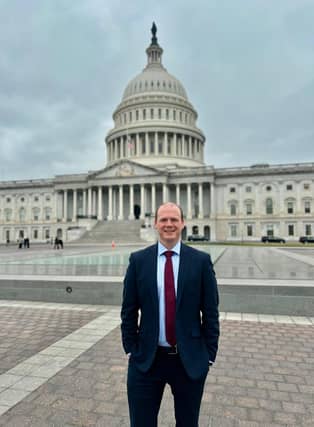

I am determined to use this year’s landmark anniversary to highlight the largely unheralded contribution that Ulster played in the Declaration of Independence.
Yesterday, I spoke at a special event in Savannah, Georgia marking the significant contribution people of Ulster-Scots heritage made to the events surrounding the signing of the Declaration of Independence.
It was a huge honour and privilege for me to address attendees at Georgia Southern University, along with my ministerial counterpart from the Republic, Patrick O’Donovan.
It was fascinating to learn about Queensborough, a pioneering Scots-Irish settlement established in the 1760s and 1770s during the late-colonial period in Georgia, on the eve of the American Declaration of Independence.
Queensborough was Georgia’s first major frontier settlement beyond Savannah and Augusta. Its early settlers were Scots-Irish Presbyterians from counties Antrim and Down, whose industry and civic leadership shaped Georgia at a formative moment.
The fact that Georgia Southern University hosted a gathering of academic leaders, public officials, and members of the diplomatic and business communities to focus on the Scots-Irish speaks to the awareness of, and continuing respect held for, the contribution made by people of Ulster extraction in this part of the world.
I have provided significant funds for projects that recognise the deep connections between Ulster and the United States. This includes: an enriched programme of events at the Ulster American Folk Park, an exhibition at Historic Royal Palace, Hillsborough Castle highlighting the visit of Benjamin Franklin in 1771; celebratory concerts including one at the Maiden City Festival of Londonderry; and partnerships that explore the role of Ulster-Scots women during the American Revolution which will link in with the Maine Ulster-Scots Project.
I have previously spoken about how several founding figures had Ulster roots. James McHenry, born in Ballymena, signed the US Constitution. Charles Thomson from Maghera was the first secretary of the Continental Congress and his name is on the first copy of the Declaration of Independence.
John Dunlap, a printer from Strabane, Co Tyrone, was responsible for printing the declaration. Hercules Mulligan, a central character in the musical Hamilton and the tailor and spy who saved George Washington’s life twice, was born in Coleraine.
These names illustrate the deep links between Northern Ireland and the US; links that endure today and still strongly influence trade, tourism and cultural exchange.
For many people in Ulster, the United States has never felt like a distant place. It has always felt more like an old friend across the Atlantic. This was as true for the early settlers, who spent eight weeks on a long and hazardous journey to America, as it is for today’s travellers who can be in the US within eight hours.
To understand how that connection began, we need to go back more than two centuries. During the 18th century it is estimated that between 200,000 to 250,000 people left Ulster for America - the Ulster-Scots or Scots Irish as they are known in the US. In many ways they did not simply come to America; they helped shape the character of the country that was emerging.
The commemorations planned throughout this year offer a fantastic opportunity for Northern Ireland to be part of this historic milestone, to strengthen relationships with the US and promote our shared cultural connections. Tomorrow night, along with the America 250 Commission, I will host an event at the US Senate in Washington DC celebrating 250 years of shared history, enduring partnership and the contribution made by people from Ulster to the founding of the United States.
Today I will attend a reception at the White House and tomorrow I will visit the National Archives and the Library of Congress.
The story of the Ulster-Scots in America is not just history. It is a living connection between our people - built on faith, education, and freedom. From the towns and villages of Ulster to the streets and squares of the US, that story has been written across the Atlantic for more than two centuries - and it continues today.
l Gordon Lyons is Stormont communities minister