
Ian Ellis: Church culture crosses denominational boundaries and greater transparency and accountability is needed
The recent resignation of Archbishop of Canterbury Justin Welby has caused serious reflection in church circles and has drawn widespread public attention.
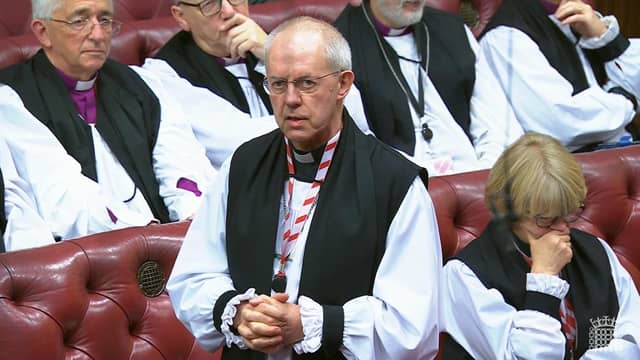

He accepted that he should have been more personally proactive in pursuing the case of serial child abuser John Smyth, and decided to stand down.
However, it has to be said that aspects of his valedictory speech in the House of Lords showed astounding crassness. Speaking of his resignation he introduced actual levity.
It was also wrong of him to suggest that only one head should roll over the matter.
He subsequently issued a statement of apology for his words, both things he had said and things he had omitted to say.
The decision to step down followed the publication of a report by independent reviewer Keith Makin, a former director of social services with more than 30 years of experience in the social care field.
It is said that as soon as members of the clergy announce that they are leaving their post, for whatever reason, the first question often is 'Who will we get next?'.
This is where Anglicanism is right now, and there are many competing interests.
Writing recently for the Religion Media Centre, journalist Andrew Brown referred to the Hurd Report, 'To Lead and to Serve', of 2001. Lord Hurd's review team, commissioned by then Archbishop George Carey, considered “the demands and expectations of the office” of the Archbishop of Canterbury.
George Carey was Archbishop from 1991-2002, so the work was done in light of the prospect of a successor being sought in the relatively near future.
Indeed, the Hurd Report pointed out that an Archbishop of Canterbury in effect does multiple jobs: leading the diocese of Canterbury and the Church of England, acting as 'first among equals' in the worldwide Anglican Communion, maintaining relationships with other Christian churches, and liaising with other faith communities.
In addition, amongst much else, as leader of an established church the Archbishop of Canterbury has state roles, not least in the coronation of a monarch and taking part in the work of the House of Lords.
In his report, Andrew Brown observed that things have only become more difficult for any Archbishop of Canterbury since 2001.
He writes: “In the past two decades the [Church of England] has lost about a third of its regular worshippers and receded into the margins of everyday life: about half as many people now are getting married or buried in church as when Hurd wrote. The Anglican Communion has split in two over homosexuality, and many of the largest African churches no longer recognise the authority of the archbishop. That split has been carried over into this country, where the faction opposing same-sex reforms does not, in practice, recognise the archbishop’s authority either.”
Nonetheless, on a more encouraging note, Church of England statistics for more recent years have shown what the denomination has described as a “bounce back” since the coronavirus crisis.
Because the Church of England is by law established, the appointment of Archbishop Welby's successor will be made by the King who holds the position of Supreme Governor of the Church of England.
But the appointment only follows an involved selection process.
A Crown Nominations Commission (CNC) will make a recommendation to the prime minister who then will advise the King.
I am informed by a reliable source in the Church of England that the convention is that the CNC sends only one name to the prime minister, but may agree on a second name as a reserve to be submitted only if the first choice is unable to take up the position. I have also been told that while the prime minister may reject the CNC's nomination and request a re-think, this has not happened since Gordon Brown was in Number 10.
The Cabinet Office has indicated that the CNC's voting membership is comprised of:
The Chair (a layperson), to be appointed by the prime minister;
A bishop elected by the House of Bishops;
The Archbishop of York or, if that person chooses not to be a member of the CNC, a further bishop to be elected by the House of Bishops;
Three representatives elected from the diocese of Canterbury by its Vacancy in See Committee (A 'See' is an ecclesiastical term for a diocese.);
Six representatives (three clergy and three lay) elected by the Church of England's general synod; and
Five representatives from other churches in the Anglican Communion - one each from Africa; the Americas; Middle East and Asia; Oceania and Europe.
There have been calls for others in the Church of England to stand down over safeguarding shortcomings.
Perhaps most prominently, Bishop of Newcastle Helen Ann Hartley has written on X (formerly Twitter) of “a crisis of trust in the episcopate”, adding that all named in the Makin review “must step back from public ministry now pending independent investigations”.
It is clear that change will be needed in terms of greater transparency and accountability over safeguarding and more widely, not only in the Church of England but in churches more generally, because church culture crosses denominational boundaries in many respects.
Canon Ian Ellis is a former editor of The Church of Ireland Gazette.