
Ian Ellis: Plea for unity is one every nation including US must heed
On the day after his inauguration as the 47th president of the United States last month, Donald Trump attended a special prayer service at Washington National Cathedral along with his family and members of his new administration, and the sermon provoked international reaction.
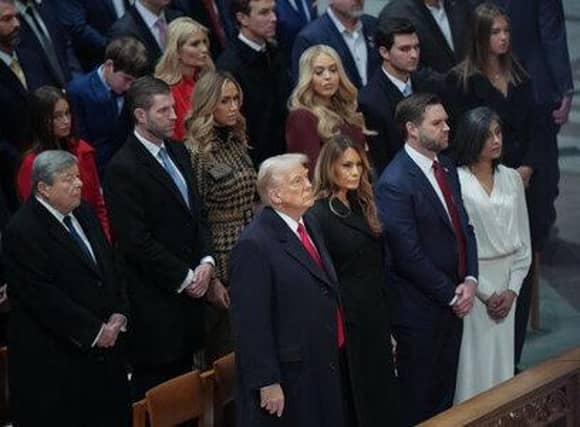

Episcopal Bishop of Washington Mariann Budde made a direct plea to the president from the pulpit to show mercy in particular to illegal immigrants and sexual minorities.
The bishop's comments had a particular edge because the groups she mentioned are directly affected by the new president's policies which include the mass deportation of undocumented migrants.
In her plea, Bishop Budde included the the following words: “Have mercy, Mr President, on those in our communities whose children fear that their parents will be taken away. Help those who are fleeing war zones and persecution in their own lands to find compassion and welcome here. Our God teaches us that we are to be merciful to the stranger, for we were once strangers in this land.”
Yet the sermon was followed by public controversy as to whether the bishop should have addressed the president in this manner directly from the pulpit.
While Bishop Budde could have made her points in another public address, rather than from the cathedral's imposing pulpit, she later commented to CNN that she had felt compelled to act as she did: “I felt that he [President Trump] has this moment now where he feels charged and empowered to do what he feels called to do, and I wanted to say there is room for mercy. There’s room for broader compassion. We don’t need to portray with a broad cloth in the harshest of terms some of the most vulnerable people in our society, who are in fact our neighbours, our friends, our friends’ children.”
She added that she had wanted to present a vision of what unity could look like in the United States, unity “transcending of differences and viewpoints and acknowledging our common humanity”.
How a preacher challenges the thinking of individuals sitting in the congregation is largely up to the preacher, within the boundaries of due decorum and doctrinal orthodoxy.
Yet, the question remains whether the Bishop Budde's direct appeal to President Trump from the pulpit will have influenced his attitude to any significant extent.
It does not seem that it did, at least at the time.
The Associated Press duly reported that after he returned to the White House, President Trump said, “I didn’t think it was a good service”, that “they could do much better”, and that later, in an overnight post on his social media site, he sharply criticized the “so-called Bishop” as a “Radical Left hard line Trump hater”, adding: “She brought her church into the world of politics in a very ungracious way. She was nasty in tone, and not compelling or smart.”
He called for an apology from both the bishop and her denomination, but Bishop Budde told Time magazine she would not apologise for asking for mercy for others, also saying: “I don't hate President Trump. I strive not to hate anyone and I dare say that I am not of the 'radical left' either, whatever that means.”
A spokesperson for the Episcopal Church issued a statement affirming that Bishop Budde “is a valued and trusted pastor to her diocese and colleague to bishops throughout our church”, adding: “We stand by Bishop Budde and her appeal for the Christian values of mercy and compassion.”
There is no doubt that there will continue to be friction between the historic Christian denominations and the Trump administration, with many of his religious supporters coming from more recently formed groupings.
Yet the controversy over Bishop Budde's sermon not only surrounded the question of whether or not during a sermon a preacher should directly and personally address a member of the congregation in such a way, but also raised the issue of mercy itself.
Christianity has many strands but perhaps one of the passages of scripture that easily appeals to all shades of its adherents is the verse in the Book of Micah: “And what does the Lord require of you? To act justly and to love mercy and to walk humbly with your God." (6:8)
These are surely compelling words for every believer.
The controversy over Bishop Budde's remarks arose precisely because her approach in the closing part of the sermon was not what is normally expected at any stage in a sermon. Such a strategy always runs the risk of the rest of what is said being eclipsed.
While the controversy arose mainly from words in the final four paragraphs of the bishop's sermon, as a whole it was an appeal for national unity.
She had said the congregation was not naïve about the realities of politics, and had nonetheless gathered "to pray for unity as a nation – not for agreement, political or otherwise, but for the kind of unity that fosters community across diversity and division, a unity that serves the common good".
The bishop emphasised the ideals expressed in the 1776 American Declaration of Independence “with its assertion of innate human equality and dignity”.
That time-honoured message is surely one that every nation must heed.
Canon Ian Ellis is a former editor of The Church of Ireland Gazette