
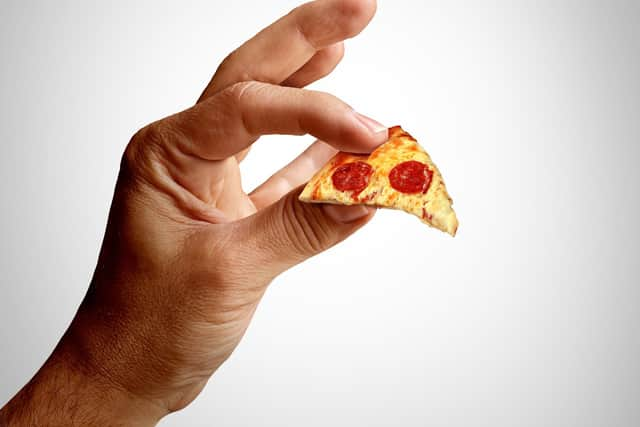
Jackie McGregor: Honey, they’ve shrunk the pizza! Food price rises while portions shrink
My eyebrows shot up in surprise at the cost of the takeaway pizza I’d just ordered, the price of food seems to rise by the week, but it was Saturday night, I didn’t want to cook, and we felt like a treat.

On arrival, there was nearly fisticuffs with the driver, because I couldn’t find the delivery code. I even showed him the order on my phone. I ended up yelling, “Just keep it!” This is most unlike me, but I was hangry, and my pizza was in a hostage situation. Finally, he reneged, muttered something not entirely complimentary and surrendered the nosh.
I rushed into the kitchen with the stack of boxes and unloaded them onto the table, where my son, husband and I, stared at the goodies, or lack of them! I’d gotten a meal deal which included a pizza meant to have “the works” on top, but the only topping visible was huge pieces of ham. The real disappointment lay in the box of chips; it appeared to have shrunk in size from when we’d ordered a few weeks back. There wasn’t enough for three people, whereas there had been before. It would be a case of every man/woman for themselves in the grab for portions. The garlic bread box size had also shrunk, upon opening, the circular bread was practically cupcake sized, significantly smaller than before. This meal deal wouldn’t have filled The Borrowers! Shrinkflation had struck again!
“Shrinkflation,” is a term for products decreasing in size, while their price remains the same, or in some cases, even creeps up. There’s also shrinkflation’s little sister, “skimpflation,” where ingredients in food are swapped out for cheaper alternatives, though the price doesn’t get any skimpier! For example, a well-known supermarket reduced the beef content in their beef lasagna from 23 percent to 19 percent, substituting mushrooms.
I’ve noticed skimpflation and price hikes in restaurants too. I ordered the 1980s favourite, Chicken Maryland whilst dining out recently. It could have been prosecuted under the trade’s description act! The “Chicken,” was practically a nugget, there was no salad, banana fritter or sausage as mentioned on the menu, I doubt it was even from Maryland! It was a meal of miniscule and absent portions with a hearty price tag.
These cunning practices by food manufacturers reduce what customers get for their money, making our budgets stretch less and less in the relentless march of rising living costs.
How will the more senior of us manage in our advancing years battling these rocketing food prices?
According to the Pensions and Lifetime Saving Association a comfortable retirement now costs a staggering £60,600 a year for a couple and even a “moderate” lifestyle needs £43,900 and that’s before tax, housing, or care costs! The price of growing older has gotten a lot higher.
Though I’ve not yet reached my 60s, I’ve begun to seriously give thought to my financial future amid the cost of soaring food prices and everything else on top, so I visited gov.uk/check-state-pension, where with proof of identity, you can get a forecast of how much you’re on track to receive and if you can increase it.
Additionally, I’ve checked the balance of my savings account and it’s just like my fridge magnet says, financially I’m set for life, provided I die next week!
WHO SHOT J.R? TODAY, WOULD ANYONE CARE? – THE CLIFFHANGER ERA IS OVER
“Mum the 1980s called they want their programme back,” said my son popping his head around the door.
“Oh, ha-ha, they don’t make them like this anymore,” I quipped, transfixed to, “Just Good Friends,” my all-time fav programme. As there’s little I enjoy watching on TV, I tend to go back, and comfort watch the old stuff.
Previously, I would watch the daytime ITV programmes between school runs, but they became so woke, I stopped pushing the on button. It’s understandable why they’ve been culling staff.
Viewing habits have changed, causing problems for traditional broadcasters. Gone are the days when the nation waited a week for the next episode of something like Dallas, when the question, “Who Shot JR?” was a national obsession. Globally it was estimated 350 million watched that episode across 57 countries, ratings broadcasters can only dream about these days.
TV programmes were something that used to connected us as a nation and as families. We now want to binge-watch shows and crave instant gratification.
My son’s generation rarely watch TV, they prefer to watch content on streaming platforms and video-sharing sites like TikTok and YouTube, often they’ll have multi-screens open with different content playing. Gen Z like their viewing in bite-sized chunks, sitting through an hour-long drama can feel like a big commitment. If broadcasters want to engage a younger audience, they need new strategies.
Older audiences were used to shaping their evenings around the TV schedule. Thursday nights were Top of the Pops and Minder, Saturday night, Starsky and Hutch, Sunday Night at the Palladium was the staple in most homes. We all watched the same things together, sat on the sofa, following the schedule. Now the only schedule viewers follow is their own.