
Jamie Bryson: The plethora of errors made by the Parades Commission in its Drumcree decision
The Parades Commission’s entire framework rests upon the procedural steps they take to reach their decisions.
If any (or, as in this case, many) of these steps are substantively (not merely technically, as has been suggested) flawed then the ultimate decision is itself unsustainable. It seems important to set out just how substantively flawed the Drumcree determination was.
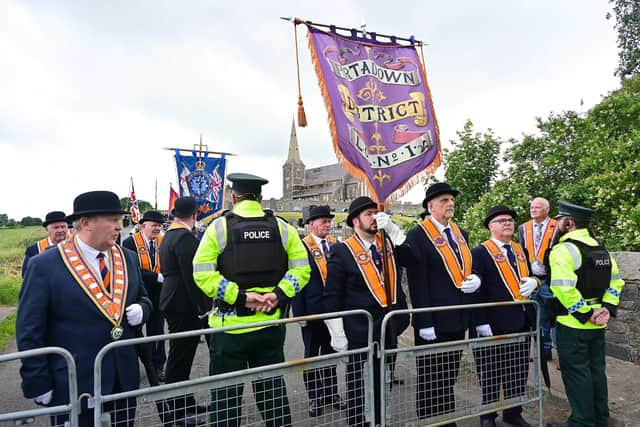

In this case, the commission made a plethora of errors. There were so many errors, Mr Justice McAlinden was unequivocal in saying that the determination was “clearly unlawful” and “simply did not hold water in any way”.
He further stated that had the commission tried to brazen this out any further, he would have had “no hesitation in marking the court’s displeasure” by further condemning them in indemnity costs (which is almost unheard of in Judicial Review proceedings in this jurisdiction).
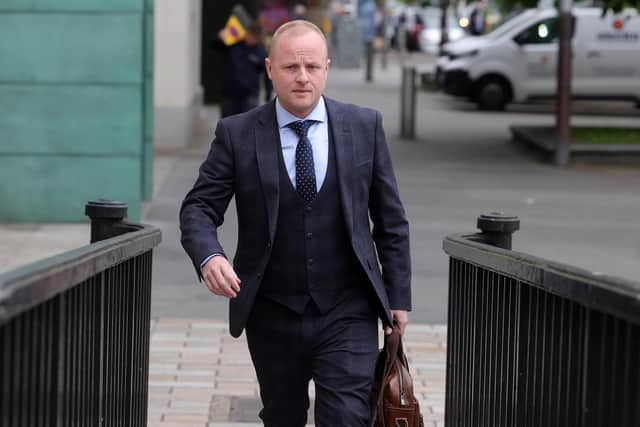
The remedy issued was a quashing order, the most severe tool available to the court. Had, as some nationalist politicians and commentators were desperately suggesting, this being merely a “technicality”, the court would never have quashed the determination, but rather would have had a range of other lesser remedies available, such as for example a declaration highlighting the error, and leaving the substantive decision intact.
There was never any question of that, because anyone who even sat through the 3 July emergency hearing could see that the commission’s determination simply didn’t pass the laugh test.
They fundamentally erred in applying the Article 11 Freedom of Assembly test, on one hand in their own determination recognising they had no material suggesting any risk of disorder or damage to property if the parade was to proceed, whilst then going on to rely upon the risk of disorder to justify restricting the rights of the Portadown District. I venture to suggest a first-year law student would get a ‘fail’ if they made such an error.
Furthermore, despite having a statutory duty to “promote mediation”, the commission developed their own “Hecklers veto”, making “dialogue” a pre-requisite to the least possibility of a parade, meanwhile – again in their own determination – acknowledging that the “residents” had refused any prospect of dialogue. Put simply, in circular fashion, they acknowledge purported residents will never engage in dialogue as they have everything they want already, so they make dialogue a pre-condition of any parade. There will be no dialogue, so the parade must be banned. It was extraordinary in its incoherence and wildly unmoored from the statutory functions of the commission. It was also clearly without any public law foundation (and McAlinden J, in terms, effectively said as much orally on 3 July).
The commission under oath then told the court – and majored on this point – that the MP for the area, Ms Carla Lockhart (who was a key person in supporting the legal challenge), had refused the offer to make submissions. It thereafter transpired that, at the time this evidence was given, the commission in fact knew they had erred with a typo in the email address, and Ms Lockhart had received no such email. She has since received a formal written apology from the chair.
This, you may think, is all bad enough. The publicly available Order 53 statement (which is a public document any citizen is free to obtain) illuminates yet further jaw-dropping issues.
Firstly, it became apparent that there were not minutes or records of any meetings. It was said meetings occurred, but these were not documented, and contrary to their own procedural rules, the evidence given to these meetings was not recorded.
Secondly, it is not the ‘decision’ to impose conditions which has legal effect, it is only the determination issued under section 8 (1) of the Public Processions Act 1998. The commission have been operating on the basis that they meet and decide whether to impose conditions, and thereafter their secretary (who is not a commissioner) drafts a decision, and the chair signs it, without any requirement for other commissioners to even read it, let alone approve its contents to ensure it reflects their reasoning. In simple terms, the commission simply ritualistically decides to impose conditions, and its left to the secretary and chair to retrospectively come up with reasons to justify that. That this is how they operate was not only not contested but accepted.
Thirdly, it became apparent that Mr Billy Gamble was urging commissioners to consider the views of an anonymous twitter user (hostile to the loyal orders) whose identity is unknown.
Fourthly, as set out in the Order 53 statement, Mr Gamble then made clear that the commission should not even flag the possibility of mediation as this was a non-starter, and he did not wish to give the loyal orders an “angle” to keep “prodding” (pardon the pun) the commission. This is not only inconsistent with the statutory duty to promote mediation, but contrary to it.
In light of the foregoing, the current constitution of the commission simply cannot survive. There should be voluntary resignations, and if not, the secretary of state should use his powers under Schedule 1 to the Public Processions Act to remove them.
l Jamie Bryson was involved in the legal challenge brought against the Parades Commission