
Jonny McCambridge: Left in the dark by Storm Eowyn – but this time the novelty has worn off
The darkness cloaks me as I sit shivering in the little room. There is a sense of being lost, disorientated, as for the first time in my adult life I have no way of telling the time.

All of the electric clocks have been dimmed, both of my phones are devoid of charge. I have long since run down the power in my laptop as I struggled to continue working and retain some link with the outside world.
My wife is away in the car at work, my son left with relatives when the power first failed many hours ago. How many hours? I’m not too sure.
I held off lighting the fire as long as I dared, trying to ensure we had enough fuel to get us through the coldest part of the night. Now the pungent smell of turf fills the room, but the small flickering flame seems puny as a defence against the winds, the frost and ice which is coming in its wake.
I consider that I could go outside. But where would I go? Every shop and café have closed their doors, the lights are off in every house for as far as I can see.
I’ve wondered if the fire and the thin candles would provide enough light to allow me to read. But I’m acutely aware of the diminished power of my eyes and struggling to make out small type on white pages may be a strain best avoided. So, I wrap a blanket around myself and sit on the sofa, staring at the crackling fire and waiting for my family to return home.
There is a truism all will be familiar with – be careful what you wish for.
A couple of weeks ago I wrote on this page about my family’s experience during a short power cut, the fun we had in the shared experience as electronic devices were set aside and we talked and laughed.
At the end of that article I told how, when putting my son to bed, we had joked about how we should have another power cut soon.
And here we are.
It is fair to say the novelty has worn off. The warmth of the shared time has been replaced by icy and bleak isolation. Where previously there had been enchantment, now everything reeks of desolation.
Once again, I know exactly the moment the power failed. 7:01am. I was at my computer writing an early story about the impact of Storm Eowyn when I became one of its victims.
Unable to file copy, I reverted back to my secondary role of trying to get powerful images of the tempest for the news bulletins and papers. I ventured out in the morning against the muttered warnings of my wife.
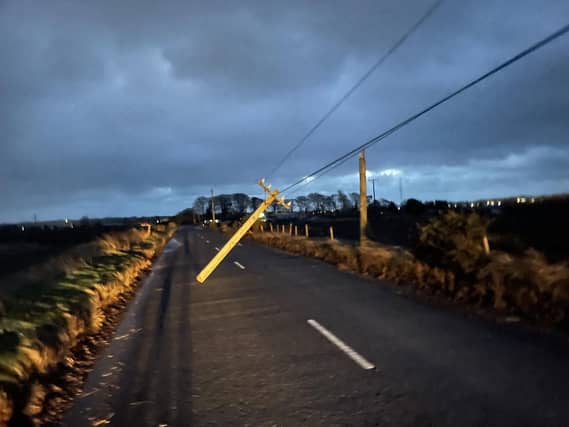
I gripped the steering wheel tightly as the gales battered the side of the small vehicle. I found a broken telegraph pole which was dancing in the air, powered by the savage wind. I clung to the side of my car, recording the dramatic footage. I had no way of viewing it myself, but I was told the clip featured in multiple national news bulletins.
I climbed over trees which had blocked a rural road near my house and spoke to a farmer who was trying to move another tree so he could feed his animals.
But soon the exertions of recording countless photographs and videos, of uploading the moving images onto the news database, was having its impact. All of the electronic devices which I had fully charged overnight, now starved of a power source, began to fail. I was sending the latest in a series of videos of fallen trees before noon when the laptop screen flickered and went dark.
Rather than hunkering down and preserving what charge I had left, I ploughed on, recording and uploading more images on my phones until they too ran out of juice. In the mid-afternoon I sent messages to family and work colleagues telling them that I would be out of contact for a bit.
Then I lit the fire and waited.
The following morning brings further disappointment that the power has still not returned. However, the family is back together, and daylight has overcome the darkness, so hope has replaced the bitterness.
We arrive for breakfast at a service station, clutching an extension lead and multiple tablets and phones to be charged. The space is full of other families doing the same thing. We laugh together as we chomp on sausage rolls and I savour my first coffee in more than a day.
Then we go to the barber shop, just for something to do to keep us away from the cold house a little longer. The tiny shop is filled with other customers who are also without power and we share our woes. Everybody has a different source of information, supposedly definitive, about when the lights will come back on.
When it is my turn for a haircut, the Turkish barber, who has young children, tells me that my family is welcome to come to his home for food and hot water. I am deeply moved by the gesture and wonder how many other people he has offered to open his home for.
Then, as we leave the shop, another woman who is waiting with her son follows us into the street. We have never met her before, but she tells us that her power has not been affected and we are welcome to come to her house, to use the shower, to stay as long as needed. We thank her warmly. I do not know her name.
After 36 hours, on the Saturday night, the power is restored. There is something close to a celebratory dance in our home, although I’m still a bit subdued. I know there are many other homes, several close to us, which are still in the dark.
As I put my son to bed that night, he whispers to me again.
“No more power cuts daddy.”
“No son, no more.”