
Ben Lowry: Brexit has merits but has been very bad for Northern Ireland’s place in UK
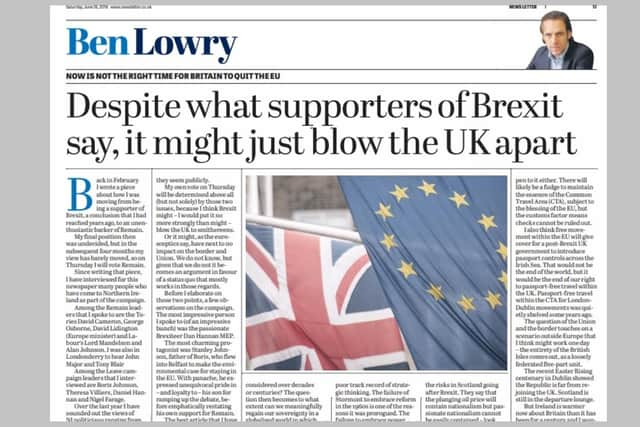
Ten years ago, on the Saturday before the EU referendum, I wrote that Brexit could blow the UK apart.
The good news for unionists is that did not happen. The bad is that the EU departure from the EU did greatly fuel Irish and Scottish nationalists, and led to constitutional change in Northern Ireland – a border with Great Britain.

A decade after the narrow UK 52-48 vote to leave the EU, we have run essays from the economist Dr Esmond Birnie who thinks the economic impact of Brexit on Britain is far less than critics say. But our Monday columnist has for years chronicled the damage the Irish Sea border has inflicted on our place in the UK.
I want, as editor of a unionist newspaper, to look back at the local context of the 2016 vote.
During the referendum campaign, unionists seemed apathetic about the coming decision. There was little debate about possible implications for Northern Ireland, with most people here following the mainland debate on TV or in national newspapers or online, where NI was rarely mentioned.
London politicians did come here, and I interviewed most of them: the then prime minister David Cameron (pro remain); his rival Boris Johnson (pro leave); the chancellor George Osborne (remain); the leave leader (Nigel Farage); the former EU trade commissioner, Peter Mandelson (remain); the Brexiteer MEP Dan Hannan; the ex Labour cabinet minister, Alan Johnson (remain). I was present when the John Major and Tony Blair said in Londonderry that Brexit would threaten peace here.
The only major visitor I did not interview was Theresa May, the pro remain home secretary. I was keen to interview her, because she had said little in the campaign, but I only learned of her visit the night before, and had an existing engagement. I thought – oh well, she is only home secretary. Soon she was prime minister …
Mrs May on that visit predicted tariffs and controls on people at the border with the Republic of Ireland if the UK left the EU. Other politicians, such as Nigel Farage, had spoken only about the risk of a people border, saying that would not happen because Ireland and UK had free movement within the British Isles, and were both outside the passport-free European zone.
By the end of the campaign, I concluded that leaving the EU risked the integrity of the UK. Click here to read my June 2016 essay, when I feared that a post-Brexit UK government would “introduce passport controls across the Irish Sea”.
This was because Ireland would still be subject to EU free movement, so that anyone from the EU could go there, even though they have to pass through Irish passport control. But they would then be able to travel on to Great Britain without passport controls. EU insistence on free movement of EU citizens was a key reason the UK voted to leave, yet after Brexit immigration into the UK surged – mostly from non EU nations.
As is well known, how to monitor trade across the Irish border became the thorniest post Brexit challenge. It held up a post Brexit UK-EU deal until in 2019 Boris Johnson resolved it decisively in Ireland’s favour, moving the border to the Irish Sea. Ironically, much anticipated people border did not materialise and the matter got no scrutiny until the recent north Belfast attack, when it emerged that the Sudanese suspect had travelled up to NI from Dublin.
The unionist apathy in the Brexit campaign had been foreshadowed by similar apathy about the Scottish referendum two years earlier. In July 2014, before the autumn poll on independence, I wrote: “There is a plausible political scenario facing Northern Ireland that is little-discussed but which would rock the Province to its core. Within three years or so it is possible both that Scotland will have let the UK, and that what is let of the UK will have quit the EU.”
Unionists in June 2014 were well ahead in Scotland – a YouGov/The Times poll found Scots opposed to independence by 54% to 35% – but I feared it might be closer. Meanwhile, a Brexit referendum seemed unlikely the Tories were in government with the Lib Dems, who opposed such a vote. David Cameron had committed to an EU In-Out vote but was not expected to win an outright majority in 2015. I thought he might win – and he did.
The 2014 Scottish vote was far narrower on the day (55-45 in favour of staying in UK) than it had been at the start of the independence campaign. The 2015 Tory victory in Westminster meant Mr Cameron was obliged to honour his Brexit vote vow.
During that EU referendum campaign, Gibraltarians knew Brexit would cause Spain to get tough with their border, so 96% of them voted to stay in EU. Unionists here showed no sense of such risk. Had they known what was coming, NI unionists would also have voted 90%+ remain.
During the campaign we discovered that so-called civic nationalism is stronger than the unionist variety. The mere prospect of a land border caused a nationalist outcry across the island. The enactment of an actual internal UK barrier to our most important trade with Great Britain met a mute response. Where were the businessmen, lawyers, academics or ex civil servants?
Brexit has been for unionists but I do not sneer at Brexit. I sympathise with the Tory MP Jeremy Hunt, who was UK health minister in 2016 and pro remain, but now supports staying out of the bossy EU. I remember how stubborn leaders in Brussels gave David Cameron almost nothing in his bid for concessions in 2016.I also see the allure of the EU dream of a borderless world, but it founders on the reality that most people have national loyalties.
But the risks of Brexit to unionism were obvious in 2016. I wrote then that “… decades of movement towards widespread nationalist acceptance of the entity of NI could unravel ...” and “… Ireland is warmer now about Britain than it has been for a century...”
Sure enough, nationalist goodwill did unravel on both sides of the order. Polling on the constitutional question here has not moved much – I estimate a 4% overall drop in support for the UK down from 60%+ to the high 50s – but unionists cannot afford such attrition.
Owen Polley wrote yesterday about the huge constitutional problems with the Irish Sea border (click here to read his essay). He was right to predict from 2016 that London would capitulate to Irish nationalist anger over Brexit.
I had followed the EU since since it was the EC in the 1980s and had studied European law at university but by the end of the 2016 campaign I had a greater understanding of the single market and customs union. Norway is in the former, not the latter, and can strike its own trade deals with the rest of the world. After Brexit, I came to think that the UK should place itself in a Norway situation for 10 years until it figured out its next move. That would have greatly alleviated the Irish border question, because there would only have been a customs frontier, not a regulatory one for goods entering the single market.
Brexit purists insisted leave the single market and customs union. NI was left behind in both. And for what? Labour is edging us back to the EU anyway.
• Ben Lowry is News Letter editor