
David Johnstone: Troubles veterans deserve our gratitude – they should not be demonised and pursued through the courts
A letter from Veterans Commissioner David Johnstone:
Twenty-seven years on from the Belfast Agreement and society here in Northern Ireland is still dealing with the controversial issue of the legacy of the terrorist campaign that resulted in the tragic loss of thousands of men, women and children.
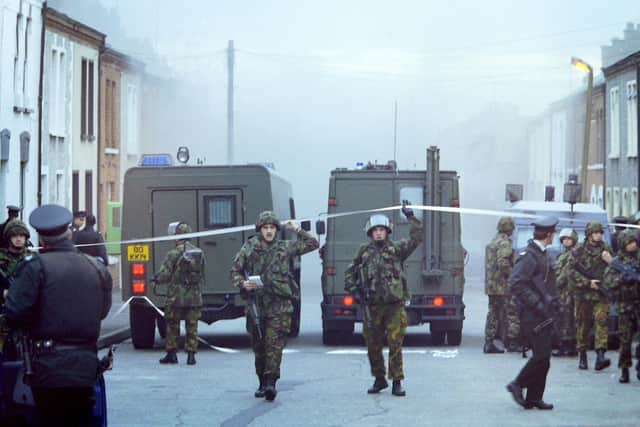

As Veterans Commissioner, I am only to aware of the detrimental impact that legacy has, and continues to have, upon those brave men and women who wore the uniform and served all of society in order to try and keep the peace and protect life and property.
The so-called “armed struggle” may be over, but almost three decades after the Belfast Agreement, veterans are now being pursued through the legal process, in what many feel is “legal warfare” in an attempt to re-write history and deflect from the facts that nine out of every 10 deaths, during the Troubles, were carried out by terrorists.
I welcomed the decision by the Ministry of Defence to challenge the recent Clonoe inquest ruling via judicial review.
As I said publicly, in the aftermath of the inquest ruling by Mr Justice Humphreys, many veterans believe there is a deliberate strategy by the republican movement to use the legal system, via inquests, to demonise the security forces.
It is my firm belief that the Clonoe inquest ruling sets a dangerous precedent that undermines the legal framework governing military operations in the context of the fight against terrorism.
Last month, a family member of an IRA terrorist killed at Loughgall was provided an assurance by the Northern Ireland Secretary of State that the inquest into Loughgall will proceed – hypothetically, in the future, should a coroner rule that Loughgall was similar to Clonoe and the UK government, via the Ministry of Defence, seeks to challenge such a ruling, does that not highlight the fallacy of the UK government actively pursuing such a scenario with the reintroduction of inquests? I would strongly contend that it does.
I recently recorded a podcast interview with an Ulster Defence Regiment veteran, Glen Espie.
In conversation, Glen relayed his dismay, hurt and anger regarding the meeting the secretary of state had with Mairead Kelly, sister of Patrick Kelly, and one of the IRA terrorists killed at Loughgall in May 1987.
Glen survived two assassination attempts on his life by the IRA in March 1978 and in March 1987 – one of the terrorists involved in the second assassination attempt was Patrick Kelly.
Mairead Kelly was given an assurance that the Loughgall inquest would proceed, yet Glen Espie (and hundreds of innocent victims and veterans like him) has had no such inquest and no terrorist was ever brought to justice for the two occasions the IRA tried to murder Glen.
Surely this one example alone highlights the imbalance, unfairness and immoral approach to legacy, particularly with the UK government’s desire to reintroduce inquests.
Our Armed Forces operated within strict rules of engagement, bound by both domestic and international law, including the European Convention on Human Rights.
They should therefore not be subjected today to legal processes that fail to recognise these protections and the context of the Troubles, while those who engaged in terrorist activities have had little scrutiny or pursuance since the Belfast Agreement.
As Veterans Commissioner, I would call on the UK government to seriously consider and implement the following key points:
- ensure clear and fair legal protections for military personnel involved in planned operations (Operation Banner) under military law;
- legislate to prevent politically motivated legal actions (ie reopening inquests and civil cases) against those who served their country with honour, while addressing the imbalance that has allowed former active members of terrorist organisations to evade justice through, for example, Royal Pardons and ‘on the run’ letters; and
- insist upon full cooperation from the Republic of Ireland government to provide all information they hold to deal effectively with the legacy of the past in relation to the Troubles.
Our military veterans and ex-security force personnel deserve fairness and recognition for their service and not to be demonised through endless legal proceedings, which has enabled a concerted effort, by republicans, to attempt to rewrite history with a skewed narrative of the facts pertaining to the Troubles.
Society owes deep gratitude to our veterans and Armed Forces personnel for their dedicated and honourable service to protect life, property and democracy on behalf of the UK government.
David Johnstone, Northern Ireland Veterans Commissioner