
Letter: A shared symbol of peace could provide the gateway to conciliation in Northern Ireland
A letter from Howard Rainey:
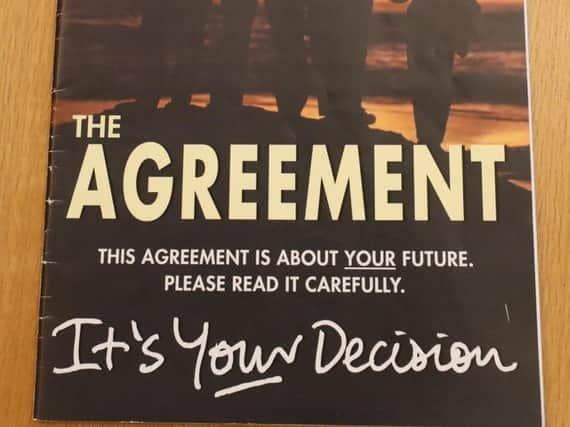

It is now over 25 years since the Belfast/Good Friday Agreement was negotiated and, thankfully, we still live with the many benefits arising from peace.
Recently, three influential figures have reminded us that as time passes and memories of the bloodshed here fade for many, we should not become complacent about the peace settlement achieved nor its maintenance.
Rev Harold Good, senator George Mitchell and Daniel Libeskind are the figures involved.

Rev Good recently had his memoir, ‘In Good Time’, published, in which he recalls his life and contribution to peace.
Many will know of his role in decommissioning, but not be aware of his work in the mid-2000s facilitating negotiations between DUP and Sinn Fein around the time of the St Andrews Agreement. At the heart of his book and work is a commitment not just to peace-making- initial agreement – but, to peace-building – continuing on the journey to peace.
Senator Mitchell chaired the talks that led to peace here and recently exhorted the next generation to become peace-builders - “The peace we have created and enjoyed since 1998 must evolve. The work is constantly unfinished.”
Daniel Libeskind, designer of the proposed peace centre at the Maze, reminded us recently of the importance of having such a building as a means of dealing with our past in a proactive, creative and respectful way. The location of such a centre may be in dispute, but not the need for it.
The creation of a shared symbol of peace has the potential to promote a positive approach to peace, acting as a reminder of the need for peace-building and copper-fastening our common commitment to non-violent political action.
As senator Mitchell notes, “We must acknowledge the past but not become beholden to it. It is our job to become continually new.”
We owe it to future generations to take a different path than that followed in Spain and the south of Ireland after their civil wars.
Respectively, the ‘pact of forgetting’ and the ‘noble silence’ were introduced in times when problems were swept under the carpet in the hope they might go away and yet we only have to look at the make-up of political parties in the south to see the influence of the past and what president Higgins has referred to as “bogus amnesia”.
Let us have no regrets about addressing the conflict which occurred here, whilst consolidating our commitment to peace-building and the prosperity that can arise from that.
A shared, public symbol of peace could provide the means by which to build substantive commonality and be a gateway eventually to conciliation.
Surely, in a land full of emblems and flags with an extensive history of artistic brilliance we could find such a ‘key’ to unlock both the past and the future away from our current visceral paralysis.
(This letter refers to men, but, it is not designed to ignore or underplay the significant role played by women in the lead up to, negotiation of and sustaining of peace here.)
Howard (Íomhar) Rainey, Omagh