
Letter: Could an IMF crisis finally force Northern Ireland’s economic reform?
A letter from Brian Pope:

Britain’s national debt is now approaching £3 trillion, raising increasingly uncomfortable questions about the sustainability of public spending across the United Kingdom.
While a full IMF bailout of the UK remains unlikely, growing fiscal pressure on Westminster should prompt serious reflection in Northern Ireland about how long repeated financial rescues can realistically continue.
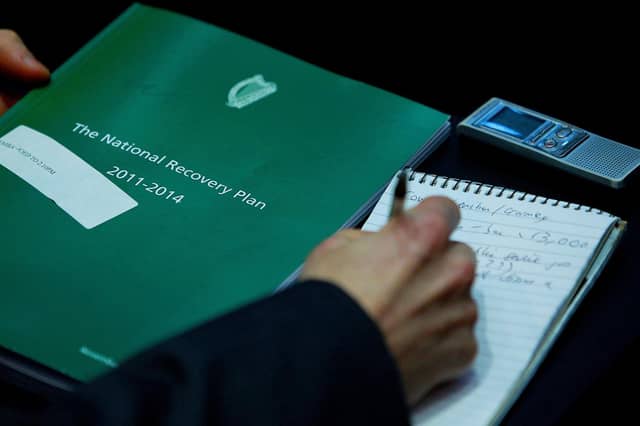
Against that backdrop, it may be worth revisiting a lesson much closer to home: the Republic of Ireland’s remarkable economic recovery following its financial collapse and international bailout.

Today, the Republic is one of Europe’s strongest-performing economies. Budget deficits have turned into surpluses, foreign investment remains strong, and Ireland continues to rank highly for international competitiveness. Yet it is easy to forget that in 2010 the country was forced into an €85 billion EU-IMF bailout after the global financial crisis devastated its public finances.
Ireland’s recovery is often attributed to low corporation tax, multinational investment and EU membership. These factors undoubtedly mattered. But they tell only part of the story.
The more important question is what created the conditions that allowed those economic advantages to succeed.
Arguably, the answer lies in the reforms imposed during Ireland’s bailout programme.
The conditions attached to Ireland’s rescue package did not themselves create economic growth. Instead, they forced political leaders to confront difficult realities that had long been avoided. Fiscal discipline, tighter spending controls, structural reform and stronger financial oversight helped restore international confidence in Ireland’s economy. In short, the bailout created the environment in which growth became possible.
The lesson matters because Northern Ireland faces many of its own structural economic weaknesses.
Public finances remain under severe strain. Infrastructure constraints are holding back development. Water capacity issues continue to frustrate housebuilding and investment. Planning reform moves too slowly, skills shortages persist, and difficult decisions on competitiveness are too often postponed through political caution or short-term thinking.
Stormont has become increasingly dependent on Westminster to bridge the financial gap. But as Britain faces mounting debt pressures of its own, the assumption that extra funding will always arrive looks increasingly fragile.
That is why future financial agreements with the UK Government should not simply involve plugging budget gaps. They should come with clear conditions designed to unlock long-term economic growth.
This could include a roadmap for infrastructure investment, reform of water funding, planning improvements, greater investment in skills, measures to improve productivity and a serious discussion about how Northern Ireland becomes more competitive for business and investment.
None of these are easy conversations. Reform inevitably creates political discomfort. But maintaining the status quo is no longer a serious economic strategy.
Unlike Ireland in 2010, Northern Ireland begins from a position of strategic advantage. Through post-Brexit arrangements, we have unique access to both the UK internal market and the EU Single Market — an opportunity few regions in Europe can match. Yet we continue to underperform because we too often lack the political courage to implement the reforms needed to capitalise on that position.
Ireland’s experience shows that growth after crisis is possible — but also that economic pressure can sometimes force the reforms needed to create the conditions for growth.
Whilst a full IMF bailout of the UK remains unlikely, any serious fiscal warning from the IMF — or mounting pressure on Westminster to impose tougher spending discipline — should finally be the moment to press the reset button. Not merely to stabilise Northern Ireland’s finances for another few years, but to put in place the conditions that can genuinely transform our economy for the long term.
Brian Pope, chartered civil engineer and expert witness, Banbridge