
Letter: Government must do all in its power to fight Clonoe inquest ruling
A letter from Alan Chambers:

When considering the circumstances surrounding how inquest hearings deal with historic events that occurred during the dreadful period we refer to as The Troubles, it is important that those of us who lived through those dangerous times remind ourselves of just what that period of our history looked and felt like.
During the darkest days every news bulletin seemed to carry a report on the latest killing or bomb attack on property that caused death or life-changing injuries to those caught in the blast.
The victims of many of these cowardly murders were members of the security forces, killed in front of their families.
Another group of victims were members of the legal profession, again many in front of their families with even a place of worship stained with innocent blood.
Jury trials of terrorist crimes had to be suspended because of the security situation of the time, and judges - and their families - needed bodyguards as they carried out their duty of dispensing justice.
I had the privilege of serving for 15 years in the 1970s and 1980s alongside the brave officers of the Royal Ulster Constabulary as a part-time member of the Royal Ulster Constabulary Reserve.
I saw at first hand the many sacrifices these officers made to hold the line.
Children’s birthdays, school events, quality time and outings with family missed and long shifts that kept them away from home.
They sacrificed the things the rest of us took for granted.
Added to this was the constant 24/7 threat that a cowardly terrorist would rob them of their life, while in or out of uniform.
What a fear that must have been for anyone to carry or live under.
Many of them still carry the mental and physical scars they suffered.
A friend, now passed, who served in north and west Belfast at that time as a detective sergeant, shared with me that he and his detective constable partner had the files of ten unsolved murders on their desk that they were charged with investigating.
If a single sentence of a witness statement needed clarified he had to give the army 48 hours’ notice to secure their protection to enter certain areas to obtain that clarity.
Was that not an unavoidable recipe to miss investigative points of minutia?
Fast forward forty plus years and it is easy for others to reopen old files in the comfort of a cosy office and make general criticisms of the alleged failures and gaps of historic police investigations into various atrocities.
It is easy for some to toss the unjustified word of collusion around, the use of which stains the reputation of all who bravely served.
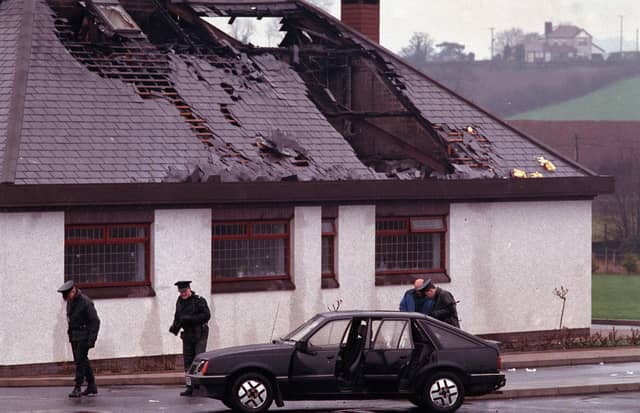
We now have the recent coroner’s ruling in the case of terrorists killed at Clonoe by an army patrol engaging with a heavily armed terrorist gang who had murder in their minds.
This was after they carried out an attack on Coalisland police station - an attack that had no regard for either police or civilian lives.
We often hear the phrase used that someone was the author of their own misfortune.
Surely the members of the IRA team who conducted that attack on the police station were aware of the consequences of potentially encountering a military patrol during their murderous mission.
I have not heard much condemnation of the actions of those heavily armed terrorists’ intent on murder and mayhem and who would have eliminated anyone who got in their way.
The justification for the soldiers opening fire in that car park on that dark and cold February evening was that they feared their lives were in danger.
The judge in the coroner’s court ruled that this was not the case and that the soldiers were therefore not justified in deploying lethal force.
Minutes before the arrival of the lorry, mounted with a heavy-duty machine gun capable of bringing down an aircraft, the soldiers in poorly defended positions would have heard the 60 heavy duty shots being discharged at Coalisland police station.
They would have had no knowledge of how many terrorists were involved or how many casualties had been created.
The arrival of the lorry at the car park was not a Sunday School outing arriving but rather an unknown number of terrorists with perhaps blood already on their hands.
I struggle with the concept that the soldiers would not have been fearing for their lives.
It will represent one of the worst examples of throwing members of our armed forces under the bus if the government and the Ministry of Defence do not fight this inquest ruling with every legal instrument at their disposal.
It will come as no surprise if compensation claims for those terrorists who lost their lives at Clonoe now emerge.
An unintended consequence of the inquest ruling will have assisted that possibility.
Alan Chambers, Ulster Unionist Party MLA for North Down