
Letter: Joint Framework Agreement between British and Irish governments doesn’t address needs of vast majority of people affected by Troubles
A letter from Padraig Yeates:
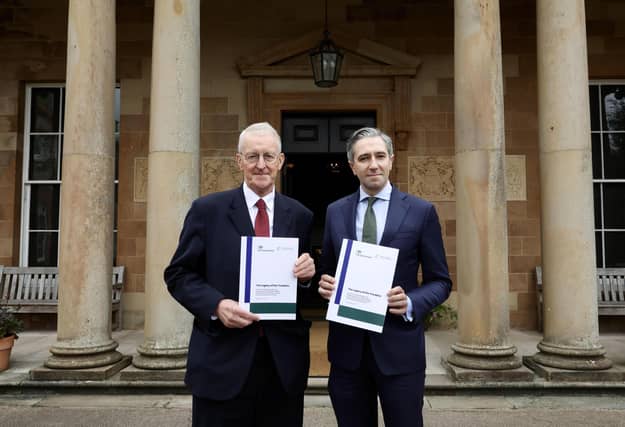

The main advantage of the joint framework agreement between the British and Irish governments on the legacy of the Northern Ireland Troubles is that both commit to reciprocal co-operation on legacy investigations.
This follows the ill-conceived 2023 Legacy Act of the last British administration that was rejected by every political party on this island and led to the Irish government taking a case to the European Court of Human Rights.
The new approach commits both governments to the ‘shared goal’ of ‘securing truth, accountability and, as far as possible, justice for victims, families and survivors and for society’.

That said, two glaring defects continue to dog any possibility of achieving these objectives.
It only addresses the needs of those affected by the 3,500 plus deaths that occurred, not to mention the estimated 47,000-plus other victims directly affected by bombs and shootings.
Also, where there are ‘no evidential leads capable of leading to a possible prosecution’ all that is being offered is a family report based on a ‘balance of probability threshold’.
This means that the vast majority of people directly affected by the Troubles, not to mention many others whose lives were affected in significant ways, will not find their needs addressed.
The absence of alternative structures to the courts and reliance on a prosecutorial approach leave little scope for including the needs of wider society and precludes the possibility of effective mediation between individuals and communities when it comes to finding a resolution to their problems.
Unless a process is developed through which people can reach agreement on the facts of what happened there can be little hope of resolving anything else. To reach such a point will, in most instances require some degree of immunity, protected disclosure and, or, amnesty that establishes a ‘safe space’ in which the truth can be told.
The Joint Framework Agreement does not provide for such an alternative. The dominant theme remains that of the past 27-plus years, ‘I will see you in court’. That may meet the needs of some - and we are not suggesting it should be removed - but with the passage of time other routes are urgently required as most of those with information on the earliest and bloodiest years are now in their 70s or 80s.
Of course there are significant reforms to UK legislation in the new framework that meet key concerns of victims campaigners, such as lifting the prohibition on inquests and the ban on Troubles-related civil cases.
A new Legacy Commission will replace the existing Independent Commission on Reconciliation and Information Retrieval (ICRIR).
It will can carry out investigations leading to prosecutions; overhaul of the governance of the ICRIR, with a statutory Independent Oversight Board, a Victims and Survivors Advisory Group, and an independent appointments panel advising on senior appointments.
A new judge-led mechanism will allow for public hearings with effective participation by bereaved families.
There is also the promise of a separate Information Commission similar to the Independent Commission for the Location of Victims’ Remains.
This will allow people to come forward with information on past killings, confident that such information cannot be used for prosecutions. It will be modelled on the 2014 Stormont House Agreement.
However, this is only a 'framework'. It needs to be implemented in both jurisdictions, something that cannot happen before 2026 at the earliest. Department of Foreign Affairs sources say “a lot of work” remains to be done before it appears on the statute books.
Confidence in the framework has not been helped by the British prime minister, Sir Keir Starmer, insisting that proposals include protections for British Army veterans, but not former paramilitaries.
Simon Harris stressed that any new joint approach to legacy needs to meet two tests: “compliance with the European Convention on Human Rights” and ability to secure the support of those most affected, especially the families of those killed, before the Irish government's case to the European Court of Human Rights will be dropped.
The Truth Recovery Process group acknowledges the efforts being made to offer a new inter-governmental framework. However, we believe our proposals provide for greater disclosure and, most importantly, the possibility of reconciliation between perpetrators and victims.
In a divided society such as Northern Ireland, the danger is that litigation can, as in the past, trap individuals and society in a traumatic past instead of looking towards a reconciled future. We believe that reconciliation and the use of the courts are mutually contradictory.
All the evidence is that legal proceedings aggravate conflict, which is why the British government in 1922 and the Irish government in 1924 went the total amnesty route. Otherwise we might have been dealing with the detritus of those conflicts for decades more as well.
Padraig Yeates, Secretary, Truth Recovery Process