
Letter: Michael D Higgins offers us a masterclass in the curation of historic resentment
A letter from John Gemmell:
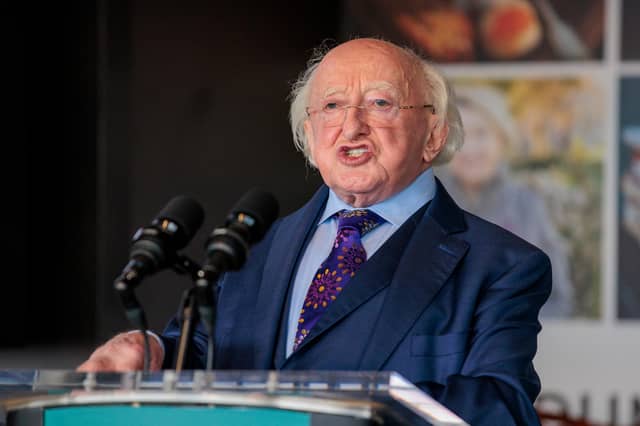

I have thought carefully about raising this issue, but it pertains to the future, not just the past.
I was recently reminded why I never admired former Irish president Michael D Higgins and always viewed him as unfriendly towards our country. I will explain.
But before turning to Mr Higgins, it is only fair to note that, despite her far-left politics, the new president strikes me as someone with whom we can work. I have priced-in president Connolly's agenda. It doesn't trouble me as it is offset by more positive qualities.
I know that is easy for me to say, writing from afar, as I am not subjected to the pressure from the Republic that many unionists experience. But I do think that there is scope for her to be a bridge-builder - if she thinks things through. Time will tell.
But now to Mr Higgins. Our own King is meticulously respectful towards the Irish Republic, but we did not always receive the same consideration from president Higgins. The problem, I think, was his general attitude of mind.
A few days ago I was looking on YouTube for videos of St John's Cathedral in Malta - odd, I know, but sadly true!
I found a video of the former president's state visit to Malta in May 2022, placed by the Irish presidency.
I listened to the entire mind-numbing speech. He probably wrote much of it himself. The president managed to insert a reference to both Ireland and Malta being "republics", which had a shared experience of "struggling for independence, post-colonialism". Then, for good measure, he mentioned the famine.
It was a contrived reference, only made possible because he was able to find a prominent Irishman, Richard More O'Ferrall, who was governor of Malta "at the time of the Irish famine".
The UK was later discreetly rebranded as "Britain", in this instance probably aiming to detach NI - an old Joe Biden trick.
The speech was a masterclass in the mean-spirited but subtle curation of historic resentment and a textbook example of the Higgins modus operandi.
Let me be clear about the famine - it represents the most terrible failure of any West European government in the mid-19th century. Even greater sins unfolded further afield and far worse came later.
Regrettably, this disaster belongs entirely to the cruel era of laissez-faire capitalism - a period that also devastated the lives of the urban working class in Great Britain.
History is full of sorrows, but we do not have to diligently rehearse centuries-old wrongs. We should remember them but strip away the grievance.
Michael D Higgjns never rose to that challenge, the grievance was always with him, lovingly nurtured as you would the dying embers of a fire.
Mr Higgins will know of a famous Pre-Raphaelite picture by Ford Madox Brown in Birmingham Museum and Art Gallery called ‘The Last of England’, showing the pain of emigrants leaving England's shores forever, albeit in different circumstances from those leaving Ireland at roughly the same time. But the sadness and loss would have been similar.
No one country has a monopoly on historic suffering - but Mr Higgins dwells on his own version of it, and that is unproductive. The generational inheritance of grievance seems to be growing in the Republic, where he has set young people a bad example, but it may be fading in NI.
Having endured conflict, the citizens of NI, despite enormous challenges, are more focused on safeguarding their communities, and preserving and improving their way of life. In that sense, counter-intuitively for some, they are the more modern people.
John Gemmell, Wem, Shropshire