
Letter: Whatever the future holds for Northern Ireland, it desperately needs a process concentrating on reconciliation
A letter from Truth Recovery Process (CLG):

The Truth Recovery Process (CLG) has decided to end its campaign for conditional amnesties.
When we began in 2018 it was on the basis that there were former combatants willing to provide information to victims and their families in order to promote peace and reconciliation in the wake of the 30-year long Troubles conflict.
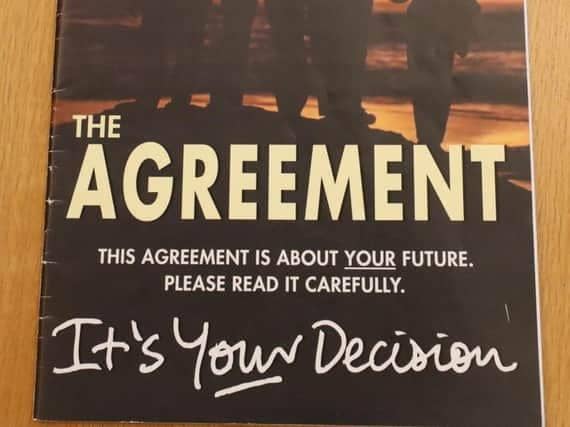
It was proposed to provide an additional dimension to the peace and reconciliation process initiated through the Belfast/Good Friday Agreement.

We felt, and still do, that it is important to develop alternatives to the courts for those who wish to address the very real divisions caused by decades of conflict between rival traditions on this island through means other than a very adversarial criminal justice system that often pits communities against each other.
It was patently obvious that relying on the courts to deal with the legacy of over 3,500 dead and over 45,000 injured by the conflict was not only a totally inadequate approach but counter-productive in many cases.
We were also encouraged by the positive response of some former combatants from both loyalist and republican organisations to the proposal and by the success of the Independent Commission for the Location of Victims’ Remains (ICLVR), which provided for protected disclosures to be made by former combatants, and other people with relevant information to victims’ families seeking the recovery of their loved ones, without facing prosecution.
We felt, and still believe that the narrow ground between protected disclosure and conditional amnesty could have been bridged by appropriate legislation. But neither the British or Irish governments have shown any interest in exploring this alternative to the tortuous and expensive process of criminal prosecution in the courts.
With the benefit of hindsight we have to accept that the Truth Recovery Process was probably initiated much too late. It was something that many of us had assumed would have emerged naturally in the initial aftermath of the 1998 agreement.
Like others, we failed to realise that the priority for most of the politicians involved in the B/GFA would be to consolidate the positions of their parties in the new constitutional dispensation rather than address the underlying causes of recurring conflict.
Rather, we were encouraged by the work done by former combatants on reconciliation through bodies such as the Messines Fellowship.
A number of former combatants committed in a personal capacity to participating in the Truth Recovery Process if it could be established.
They had participated in the earliest and bloodiest years of the conflict and were conscious that time was running out to address the issues involved and to engage, not just with victims and their families, but the wider communities affected in Northern Ireland.
Our initiative may have been a case of too little, too late.
In the intervening period almost all of the former combatants with whom we were in contact have died.
Instead of meaningful progress we have witnessed a series of forthcoming trials, public inquiries and tribunals being proposed that will seek to address a handful of outstanding cases.
Miscarriages of justice where people were wrongly convicted of serious crimes will probably never be addressed and future generations, like their predecessors, will be left with a very flawed legacy of the past as the basis for navigating a better future.
Successive recent British secretaries of state haven’t lasted long enough to complete their learning curve in dealing with the legacy of the Troubles. Irish governments have no such excuse for their inertia and lack of ambition.
The one redeeming initiative has been the Shared Island initiative by taoiseach Micheal Martin, which is to be welcomed, but it does not address legacy issues.
Resolving these legacy issues requires the two sovereign governments to remove the shackles of ‘national security’ and stop hiding behind ‘public interest’. They need to open their records and induce other participants to reveal the truth as well.
Almost 30 years on from the B/GFA two of its biggest weaknesses prevent Northern Irish society from functioning normally. One is the D’Hondt method (exacerbated by the St Andrews Agreement), which means that there is no real political accountability.
The other is acceptance of multiple narratives that ensure myths and misconceptions reinforce existing divisions between nationalists and unionists.
Reconciliation is dependent on establishing the facts - the whys and the hows - leading to apologies and forgiveness. It is not going to happen all the time but as countless truth and reconciliation programmes have shown, the journey is as important as the outcome.
Whatever the future holds for Northern Ireland, be it part of a united Ireland or United Kingdom, or as its own state, it desperately needs a process concentrating on reconciliation. The two governments seem happy to kick this can down the road blithely ignoring the forever damage it causes.
We would like to thank Michael Lynn SC and Ceile Varley BL for their legal opinion on the compliance of the Truth Recovery Process with the ECHR, to Proinsias de Rossa and to Jack O’Connor for their generous support, and to Archbishop Eamon Martin and Archbishop John McDermott for their interest in our project.
Harry Donaghy, Northern chair; John Green, Southern chair; Liz McManus, vice chair; Padraig Yeates, secretary – on behalf of the Truth Recovery Process CLG