
Owen Polley: Unionist parties need to set out a vision for Northern Ireland, not just tactics
Last week, two unionist leaders, Gavin Robinson of the DUP and Mike Nesbitt of the UUP, set out some of their plans for the new political term.

They represent two of the three strands of unionism at Westminster and Stormont. The third, of course, is Jim Allister’s TUV.
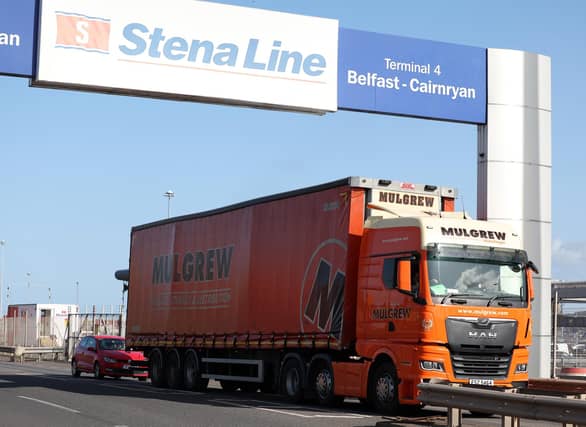
In the House of Commons, the North Antrim MP was attacking the UK’s ‘loss of sovereignty’ over immigration in Northern Ireland, due to the Irish Sea border. And that intervention summed up his party’s view of unionism’s biggest challenge, which remains the protocol and its effects.
Things are more complicated for the DUP. Mr. Robinson raised the same issue in an email to members and claimed that one of his party’s aims is to ensure that, “Northern Ireland is part of a UK-wide immigration policy that works.”
Unfortunately, the DUP previously claimed it had resolved issues like this through its Safeguarding the Union agreement. And the TUV pointed out that Mr Robinson seemed preoccupied with removing the Rwanda Act, rather than admitting that the protocol and framework were the underlying problems.
Perhaps its leader was acknowledging that contradiction, when he wrote that the party has ‘some difficult lessons’ to learn from its general election performance.
When the DUP claimed to have effectively removed the sea border, the party political cost was its own credibility. That damage was not easy to repair and it seems to have endured, judging by recent poll results.
Voters could only assume that the DUP exaggerated deliberately, or that it was hoodwinked by the government. It is much easier to lose the public’s confidence than to win it back – which may be the lesson Mr. Robinson was hinting at.
Meanwhile, on taking up his new job, the new UUP leader, Mike Nesbitt, claimed he was focussed on policy and, in particular, Northern Ireland’s prosperity.
His logic was that if, “the maximum number of people… enjoy their quality of life and their standard of living,” they will not be inclined to campaign for constitutional change.
That’s a laudable enough thought, but no doubt voters have vastly different ideas about what this ‘good life’ might look like, never mind how to achieve it.
Mr Nesbitt often uses the phrase ‘making Northern Ireland work’, which is a sentiment almost anyone here can support.
Indeed, it formed part of the ‘Vote Mike, Get Colum’ pitch that he crafted with the SDLP during his previous spell as leader.
Unfortunately for the UUP leader, that electoral overture was badly timed. It coincided with the nationalist party’s lurch into vicious anti-Britishness, in the wake of Brexit, and it hastened the end of his first spell in charge.
Every pro-Union person, at least, wants Northern Ireland to work. In recent times, though, the phrase has sometimes been used to imply that our constitutional links to the rest of the UK are less important than the internal workings of devolution. In particular, it was used to play down problems with the Irish Sea border.
Many unionists believed a short time ago that ‘parking’ issues around sovereignty worked in their favour, but that theory has been weakened in recent years, as the protocol diluted our place in the Union.
It now takes skill to deploy this line without slipping into Alliance-like thinking, which portrays Northern Ireland as some kind of hybrid, constitutionally between the UK and the EU, or even between the UK and the Republic.
On that theme, some of Mr Nesbitt’s own positions in the years since the Brexit referendum have been puzzling.
For example, he told The Australian newspaper that Northern Ireland would not be worse off in an all-Ireland state, though he later recast that remark as a warning.
He also supported a court challenge to automatic British citizenship in Northern Ireland. And he was involved in an event, at Stormont, that supported Irish passport holders here gaining votes in European Parliamentary elections.
For a prospective unionist leader, you might say that reads more like a charge sheet than a glittering CV. And if you tried to find a unionist rationale for those positions, you could only suppose that they were intended to buy off nationalists, by watering down our place in the Union.
That raises another question – if Northern Ireland is allowed to become gradually unrecognisable as a normal part of the UK and grows ever closer to the Republic, at what point does our constitutional status become meaningless?
I’ve seen some Alliance supporters and others argue that this is exactly the situation that we want to reach. For unionists, though, surely the ideal is still that we become more closely integrated with the rest of our nation and increasingly involved in every aspect of its political, social and economic life?
In Mr Nesbitt’s defence, he made his interventions in the wake of Brexit and after the end of his previous term at the helm of the UUP. You would expect him to take a less controversial course as leader, representing the views of his party membership more accurately, and avoiding campaigns that cause it to recoil.
Mr Robinson is still new to leading the DUP and Mr Nesbitt has just started his latest term. They both offer chances for their respective parties to rethink their tactics. Perhaps the more important challenge for every type of unionist, though, is to spell out more clearly how they ultimately want Northern Ireland’s future in the UK to look.