
Owen Polley: President Michael D. Higgins was a reminder that the ‘new Ireland’ is as anti British as was the old one
The Republic of Ireland recently elected its second hard-left president in a row.
That means that Michael D. Higgins, arguably the most controversial, anti-British head-of-state for some decades, is stepping down this coming week.
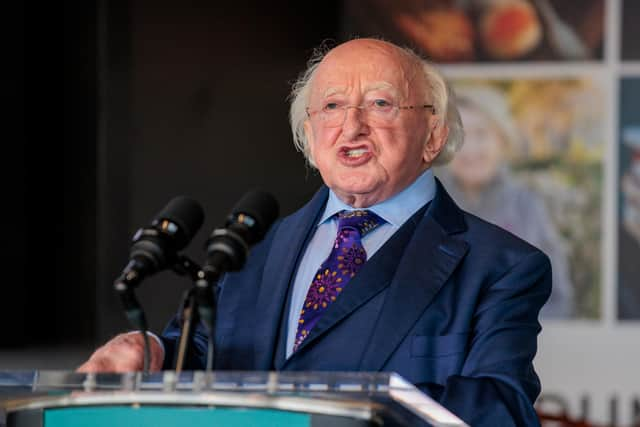

Unfortunately, he will be replaced by Catherine Connolly, who is even more aggressive and is supported by Sinn Fein. Nevertheless, Higgins will be remembered for politicising an office that was supposed to be ceremonial.
The divisive way he conducted himself gained plaudits from nationalists in Northern Ireland. An SDLP councillor from Newry, Mourne and Down council thanked the Republic’s president for his commitment to “equality, inclusion, human rights, and civic ethics, often speaking out on social justice and global solidarity”.
This list of left-wing buzzwords will have appealed to Higgins’ self-image. Many unionists, though, agreed instead with the DUP councillor, Henry Reilly, who described the southern president as, “a nasty, condescending little man”.
Infamously, in 2021 Higgins refused an invitation to a multi-denominational church service, organised to ‘reflect’ on Northern Ireland’s centenary year. It carefully avoided being cast as a celebration, in order not to offend Irish separatists. The guest-list featured prominent figures from the UK and the Republic, including both nations heads’ of state, reflecting this ‘all things to all people’ sensibility.
The event was, if anything, overly sensitive to nationalists’ anti-Northern Ireland views, but that was not enough for an unreformed republican like Higgins. He alleged that the title of the service ‘of reflection and hope’ marking “the centenaries of the partition of Ireland and the formation of Northern Ireland,” was a political statement. And he claimed he had the right, “to exercise discretion as to what I think is appropriate”.
For many unionists, the service should have done more to celebrate Northern Ireland’s achievements in industry, culture, sport and the military. Was it too much to ask that the majority, who are happy to call Northern Ireland home, could express their pride?
For an ideologue like Higgins, no amount of apologetic language could overcome his hostility. He snubbed the service and in effect the Queen (she was ill and the lord lieutenant attended on her behalf) and other leaders including the UK prime minister.
Unionists were shocked by Higgins’ bitterness and rudeness. It seemed at odds with his claims to represent everyone on the island and promote the idea of an inclusive ‘new Ireland’. Tellingly, he received the strongest support for his stance from Sinn Fein. The party’s southern leader, Mary-Lou McDonald, defended Higgins on the basis that “the partition of Ireland was a catastrophe for our people and our country”.
What the southern head of state seemed to object to most strongly, though, was being referred to as the “President of the Republic of Ireland” as opposed to the “President of Ireland”. He later clarified that this perceived slight was not, as he had implied, on the official invitation. It was language used by DUP politicians and the organisers had treated Higgins with courtesy and formality. He did not respond in kind. But then the president's softly spoken style, and his pretensions to being a poet, often disguised uncompromising views and disdain for political opponents.
Some parts of the national media were shocked when he accused British academics and journalists of historical ‘amnesia’, in a pompous column for The Guardian newspaper at the start of 2021. Higgins claimed that Irish citizens engaged in ‘ethical remembering’ of history, while British people failed to confront ‘uncomfortable aspects’ of their past.
This was an odd generalisation, given that it is increasingly difficult to persuade historians and commentators in the UK to defend their country’s history. On the day that the column was published, Churchill College at Cambridge University staged a discussion examining the ‘racial consequences’ of the war-time prime minister’s time in office. According to a panel, at the institution bearing his name, Churchill was a ‘white supremacist’, who led an empire that was ‘worse than the Nazis’.
From the National Trust to the Church of England, once proud pillars of the establishment have competed to purge themselves of symbols linked to ‘imperialism’. The idea that Britons were unwilling to confront their history was just another deliberate insult from Higgins. While he used coy language about commemoration, and tried to give the impression of a thoughtful critique, he was simply repeating Irish nationalist cliches that blame Britain for Ireland’s problems, past and present.
Since 2016 and the Brexit referendum, there has been a resurgence of anglophobia in the Republic. This was compounded by politicians like Leo Varadkar and Simon Coveney, who used increasingly confrontational language during negotiations between the EU and the UK. It was also reflected in the rehabilitation of the IRA in youth culture, with a surge in incidents of young people chanting ‘Ooh, Ahh, Up the ‘Ra’ in public.
The president has contributed to this atmosphere, rather than challenging it. On the surface, The Guardian column was a plea to thoughtfully examine the events that led to the partition of Ireland 100 years ago. In fact, it showed ill-disguised contempt for unionists’ perspective on the formation of Northern Ireland. “Six of the nine counties remained in the United Kingdom,” Higgins wrote, “and the rest of the island opted for self-determination.”
Of course, unionists view the creation of Northern Ireland as their act of self-determination, while the formation of the Irish Free State is seen as a regrettable consequence of Irish separatism. While the parliament at Stormont was not an ideal outcome for pro-Union people, it was accepted as the best way to protect our British identity and affiliation to Westminster.
You would not expect Higgins to accept this interpretation. In an article that appealed for a more sensitive look at history, though, he could at least have shown some understanding that not everyone subscribes to the Irish nationalist version of the past.
Then again, for the southern president and many like him, reconciliation and remembering seem only to entail Britain repeatedly flagellating itself for its history, while Irish nationalists need show no contrition for their crimes and bad behaviour.
The myth that the British inflicted uniquely brutal oppression on Ireland has fed the Republic’s sanctimonious modern view of itself. This exaggerated sense of victimhood can be detected in Irish nationalism’s obsession with the Israeli-Palestinian conflict, which, in the aftermath of the October 7 atrocities, led Jerusalem to accuse Dublin of ‘extreme anti-Israel policies’. The president caused particular outrage when he used a Holocaust commemoration to lecture Israel on its conduct in Gaza.
The Israeli foreign minister, Gideon Saar, accused President Higgins of a ‘cheap, despicable provocation’. Many Irish Jews at the event were so outraged by the president’s attempts to draw parallels between the Holocaust and Israel’s war in Gaza, that they turned their backs on his speech, or left the building.
Like Israelis, many unionists will say, ‘good riddance’, as Higgins leaves Aras an Uachtarain (the president’s official residence in Dublin). He was almost dementedly left-wing. He was also desperate to appear high-minded and progressive, but remained mired in romantic nationalist myths and anti-British cliches.
These flaws, though, are by no means unique to Higgins. As if to underline this point, as the recent Irish election campaign intensified, one of the candidates to replace the president, Heather Humphreys, was castigated in southern newspapers for her family’s links to the Orange Order. She had already described herself as a convinced republican, who wanted the Republic to absorb Northern Ireland. Yet her Ulster Protestant background was still a source of embarrassment and abuse, in a country that pretends to be generous and inclusive.
Michael D Higgins may have aggravated and offended unionists, but he was a useful figure too. He reminded us that, for all the rhetoric about a ‘new Ireland’, the Republic is still steeped in anti-British, anti-unionist prejudices and he provided a one-man rebuttal to naive arguments that those attitudes have changed.
His successor, Catherine Connolly, looks even more likely to act as a warning against accepting nationalist arguments.
• Owen Polley writes for the News Letter every Monday