
Owen Polley: Sinn Fein is the darkness at the heart of Stormont, and our MLAs have failed to expose it
During the DUP’s boycott of the executive, we were told repeatedly that it was overwhelmingly important to get Stormont back. Its return was portrayed as a solution to all kinds of problems and, for many politicians and commentators, devolution became the yardstick of whether Northern Ireland ‘worked’.
In February, power-sharing was duly restored, but it is already in something of a crisis, thanks to the antics of Sinn Fein.
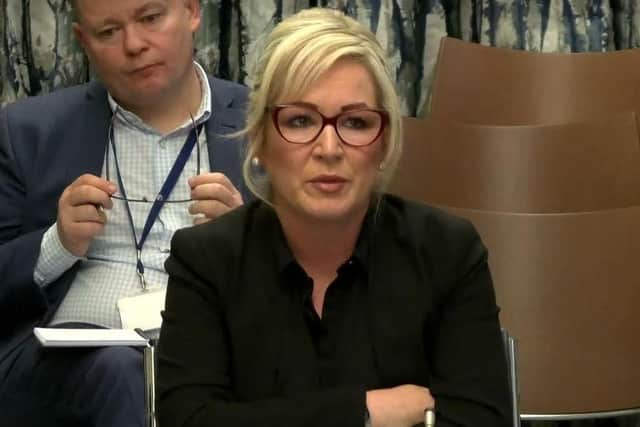

Last week, Michelle O’Neill faced the Executive Office committee, supposedly to account for her conduct during those controversies. The farce that followed highlighted many of the flaws of our devolved institutions, and their consistent failure to hold decision-makers to account.
Among the many questions raised by the O Donnghaile and particularly the McMonagle scandals, were issues relating directly to the first minister’s integrity and trustworthiness.
What did she really know about her former press officer’s employment after he left Sinn Fein? Why did he appear to have several jobs at a time while working for the Shinners, some of which were not declared properly? And how are the executive’s functions affected by having a secretive party, allegedly directed by a paramilitary army council, at its heart?
The committee had a chance to press O’Neill on these matters, but it wasted its opportunity dismally.
Before the session, the first minister claimed that she would be transparent and open, but she blocked all the most searching questions by claiming that they were ‘party political’ and did not relate to the functions of her department.
To justify this position, she cited ‘legal advice’, which she wrongly implied constrained the committee from asking certain questions and prevented her from answering them.
Many of the MLAs proved incapable of challenging that tactic. They struggled to reword their queries in a way that referenced the executive office or exposed O’Neill’s strategy as a conceit.
When the TUV’s Timothy Gaston threatened to make the session uncomfortable for O’Neill, by tying his inquiry directly to the ministerial code and pressing that point, the committee chair, Paula Bradshaw, intervened, on the basis that the witness might feel ‘badgered’ by this interrogation.
Ms Bradshaw had already caused controversy by meeting the first minister before the session began. The TUV was furious about that decision, and asked her to step aside, while the UUP and the SDLP also expressed dismay at her conduct. Whether or not the pre-meeting was within the rules, it was incredible that the chair thought it was appropriate and did not conclude that it could undermine her committee’s work.
The entire sorry affair left the impression that there is widespread confusion at Stormont about rules and procedures, ministers who do not feel the need to account for their behaviour, MLAs who are seriously out of their depth and a culture of cosiness that does not lend itself to accountability.
In the Irish Republic, decision-makers certainly have a hypocritical attitude to Sinn Fein that jars on unionists. They are horrified and revolted by the prospect of a party linked to abuse, crime and terrorism forming part of the Dublin government; while unionists are demonised and patronised if they do not accept the same thing in NI.
That said, TDs from Fine Gael and Fianna Fail attack Sinn Fein with a directness that pro-Union politicians struggle to match. During recent scandals some southern TDs were effective in holding republicans to account, even if their critics would have liked them to go further. By contrast, in Northern Ireland many of our MLAs were either reluctant to do the same or lacked the necessary political skills.
The absence of competent devolved government in NI has so many causes that it would be impossible to list them all. You could choose to highlight, for instance, the small pool of talent from which we choose our politicians, the prevalence of groupthink at Stormont, the effects of the St Andrews Agreement on competitiveness or the flaws of devolution itself.
By far the biggest problem, though, is that the system is designed to keep Sinn Fein – an organisation that is intrinsically chaotic, secretive, conspiratorial and rabidly aggressive – at the heart of power-sharing.
This is a party whose leaders are conditioned to respond to difficult questions with evasiveness and hostility. And Sinn Fein is at the centre of a subculture where scrutiny and criticism by the media are dismissed as the result of plotting by shadowy British agents or the southern ‘elite’.
In any case, whatever its current crop of politicians get up to today, the heroes of that movement have always done far, far worse in the past.
Sometimes openly and sometimes tacitly, it became accepted in Northern Ireland that shedding too much light on Sinn Fein was damaging to the ‘peace process’ and could destabilise our politics. Unlike previous Shinner controversies, though, the recent spate of scandals shows no sign of abating, no matter how hard the party and its supporters try to imply that the stories are overblown or scurrilous.
The Republic’s forthcoming general election means that Sinn Fein could soon suffer a demoralising defeat. Its true believers will blame that on a hostile ‘elite’, rather than their own flaws, but they will still be shaken and damaged.
That does not mean that voters in Northern Ireland are set to turn against the party any time soon. But MLAs at Stormont discredit themselves and the institutions they represent when they fail to scrutinise properly the disrepute and darkness in their midst.