
Owen Polley: Unlike the bag complainers, Rory is the very best of Northern Ireland
Two news stories last week illustrated some of the best and worst things about Northern Ireland.
At the Augusta National golf club in Georgia, our global superstar, and the current BBC Sports Personality of the Year, Rory McIlroy, won a second US Masters title in a row, strengthening his claim to be recognised as the best European golfer of all time.
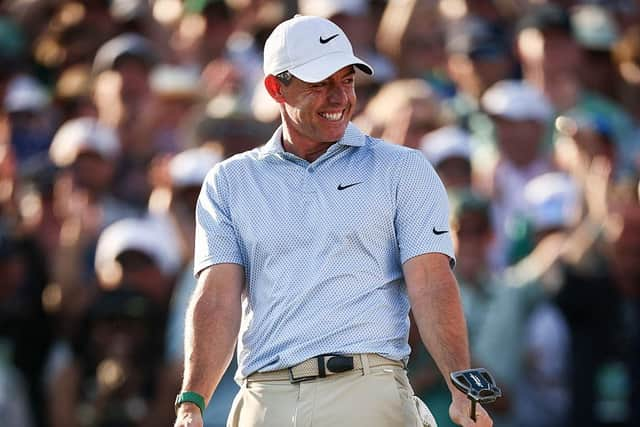

This was just the latest example of a competitor from Northern Ireland, populated by fewer than two million people, overachieving in world sport and it sparked celebrations across the province.
Back in McIlroy’s native Co Down, though, the atmosphere was not so joyful everywhere. At the Sprucefield retail park near Lisburn, a Marks and Spencer food hall confirmed that it had removed the company’s distinctive Union Flag carrier bags, after receiving complaints from Irish nationalist shoppers.
One customer told a journalist, “I wouldn’t want to be seen walking down the street with that,” while another claimed, “It was triggering for me”.
This was just the latest separatist tantrum about British symbolism in Northern Ireland, whose place in the UK is based on the preference of a majority of its population and underpinned by the Belfast Agreement. These rows have also involved shopping before.
The supermarket Asda, for example, previously advised its stores to remove the flag to avoid offending separatists during the Queen’s jubilee, while poppy sellers were targeted by republican ‘protestors’ in several branches of Tesco.
The Sprucefield incident was a striking example of pettiness and hypocrisy, from people who were clearly unwilling to miss out on goods from an iconic British brand, but could not accept the imagery on some of its bags.
This is the kind of small-mindedness that McIlroy has taken care to avoid during his career. Indeed, he has tried hard to sidestep political debates altogether and concentrate on his golf game.
That has not prevented him from receiving abuse for mentioning his British identity on occasion and celebrating victories with the ‘Ulster banner’.
In 2012, the golfer offended many nationalists by explaining that he felt “more British than Irish”, despite owing a debt to Irish golf, which is organised on an all-Ireland basis.
After this comment caused an intolerant but predictable backlash, McIlroy wrote an open letter about his identity, acknowledging that he was a “product of Irish golf and the Golfing Union of Ireland (GUI)”. He emphasised that he was “also a proud Ulsterman who grew up in Northern Ireland, which is part of the United Kingdom. That is my background and always will be.”
This was, to many people, an unremarkable statement and a convincing explanation of the layers of identity that most of us feel in Northern Ireland.
The furious reaction, though, probably influenced his decision to represent Team Ireland rather than Team GB at the 2020 Olympic games, after he opted out of competing at Rio 2016. It was clear that some Irish critics were going to treat him like a traitor, if he decided otherwise.
In fact, as in many sports, the decision was not as simple as it was portrayed.
Many sports governing bodies operate on an all-island basis but also select Irish competitors for the Olympic Games. Under the Olympics’ rules, though, teams are very clearly linked to nation states and the Irish team therefore specifically represents the Republic of Ireland. It does not, like the separate Irish rugby, cricket or indeed golf teams, represent both jurisdictions on this island.
Northern Irish athletes are eligible for the Olympics team only because they are entitled to southern Irish citizenship, under Dublin’s nationality laws.
This is not a distinction that nationalists tend to highlight, when they attack Ulster sportspeople who choose to compete for the UK, or even, like Rory McIlroy, express feelings of Britishness, but eventually opt to play for ‘Ireland’ for sporting reasons.
You cannot help notice that there has been a distinct chilliness towards the golfer from some parts of the community in Northern Ireland, despite his stellar achievements.
Before the Masters, for example, he was criticised for failing to support the Irish food industry, by declining to include traditional recipes in the ‘Champions’ Dinner’, organised by the previous year’s champion prior to the tournament.
He exacerbated this crime by joking that he chose more internationally influenced cuisine because, “I want to enjoy the dinner too”. One columnist wrote that she was, “starting to wish he’d lost that sudden-death play-off to Justin Rose (which secured his 2025 Masters win)”.
Meanwhile, to no unionist’s surprise, Mark and Spencer buckled immediately to nationalist sensitivities. The company assured shoppers that only a small number of Union Flag bags were distributed at its Sprucefield outlet, by ‘mistake’.
This only made it more remarkable that some customers had time to get offended.
The irony is that while many Irish nationalists cannot tolerate any hint of British symbolism, despite living in part of the UK, they often assure unionists that, in an all-Ireland republic, their identity would be respected.
The continuing coolness towards Rory McIlroy in some parts of society in Northern Ireland suggests otherwise. You cannot help feeling that this detachment is less about Irish food (or any other flimsy excuse), and more because he seems the type of guy who wouldn’t mind carrying his groceries in a Union Jack carrier bag.