
Roamer: Just one parachute descended from doomed two-man plane
Armistice Day and Remembrance Sunday’s poignant commemorative events were headline news earlier this week but there were innumerable less-recounted memorials.

“I only rediscovered this story a couple of weeks ago,” regular contributor Hugh McGrattan explained in his recent email.
As author, journalist and former editor of the Coleraine Chronicle, he has stories for every occasion.
The rest of this page is Hugh’s:
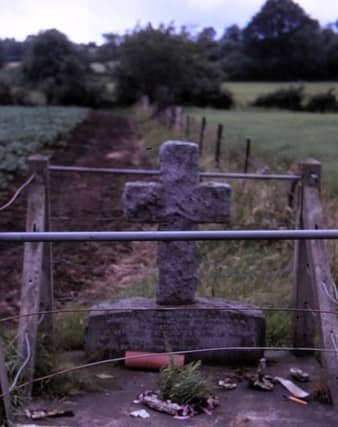
In a field close to the tiny hamlet of Mayoughall in County Londonderry stands a lonely grave, marked by a granite cross and surrounded by a protective fence.
It is the resting place of a Canadian airman who died when his aircraft smashed into the boggy ground here nearly 70 years ago.
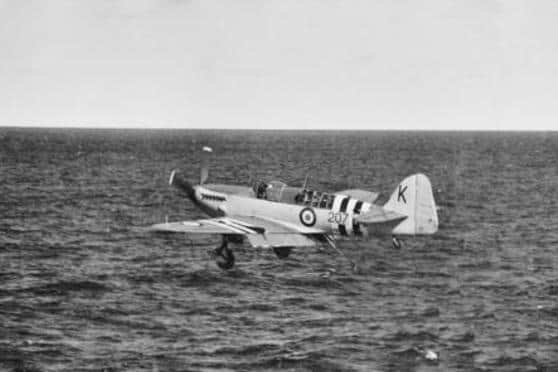
The aircraft was a Fairey Firefly naval fighter, a type that had served with distinction in the Second World War.
But this was the latest and most potent version of the Firefly, the Mark IV, and it had just entered service with Canadian Squadron Number 825.

The Canadians were then based at Eglinton Royal Naval Air Station for training, but an aircraft carrier, HMCS Magnificent, was on its way and in a few weeks the aircraft would be taken on board at Belfast before returning to Canada.
Meanwhile the two-seater Firefly was a familiar sight in the skies over the north coast.
On the evening of 4 November 1947 Firefly TW736 was carrying out aerobatic manoeuvres high above the fertile fields of Ulster.
But something went wrong and suddenly an out-of-control Firefly was plunging earthwards.
As it fell, the pilot jumped clear and parachuted to safety.
He landed about a mile from his crashed aircraft, in the townland of Caheney, and his first words to local people who ran to help him were: “Did you see another parachute?”
But no one had.
The cockpit behind the pilot was normally occupied by a navigator or observer and this second airman had failed to get out in time.
Frantic efforts by local people, the police and naval personnel to free the body of the airman from the wreckage were in vain, for the Firefly quickly disappeared into the swamp into which it had crashed.
Some of the rescue equipment sent by the Royal Navy from Eglinton was slow in arriving after it got bogged down in soft ground on the mountain road.
Eventually, efforts were abandoned and the site became an airman’s grave.
But local people were never to forget the young man who lost his life that day.
The members of the Women’s Section of the Royal British Legion at nearby Garvagh were chiefly responsible some six years later for having the memorial cross and surround erected at the site, which had become something of a place of pilgrimage for many people on Remembrance Sunday and at Christmas.
On the base of the memorial is inscribed the name of the dead airman - James W. McDonald of Newcastle, New Brunswick, who ‘Lies Here With The Plane In Which He Crashed.’
A letter of appreciation was sent to the Garvagh Legion President by his mother, Mrs Laura McDonald, at the time the memorial was dedicated.
The tragic story then emerged that she was twice widowed and had now lost all three sons, one as a soldier in Italy, the other in a drowning accident less than a year previously.
Said Mrs McDonald: “I would like you and your Legion members to know what comfort you brought me…
"It seemed to have filled an empty place in my heart, knowing that my dear son was being remembered and knowing that his last resting place was amongst friends.
"It makes the burden much easier to know that he has a grave.”
To this day the memorial is attended on the day before Remembrance Sunday, when a wreath is placed and the Act of Remembrance carried out by branch officers.
One intriguing question about the tragedy remains.
James W. McDonald was not in a flying branch of the Canadian Navy yet was occupying a rear seat in an operational aircraft that day.
But it has also been stated that he and the pilot were personal friends.
Is it possible that it was through that friendship that he was in the second seat that day?
We may never know, but it demonstrates the fact that although not being air crew, he was willing to fly when asked to.