
Roamer: Reaching for the sky and other novel uses for wooden pallets
The first written reference to a ‘banefyre’ (or ‘bone fyre’) was in the late 15th century and whatever way it’s spelt there were lots of them here on Thursday night, more are expected next month and there are countless global variations
The ancient Dali Torch Festival in China’s Yunnan province boasts crowds of people brandishing enormous beacons of fire and throwing pine resin into the flames to create fireballs.
The Burning Man brings tens of thousands of sightseers to Nevada’s Black Rock Desert on the eve of Labor Day to watch an enormous wooden effigy of ‘The Man’, burning.
The Japanese city of Fukuoka celebrates a 1,600-year-old festival in January when six massive 1,200 kilogram torches are lit with ‘devil fire’.

The preferred combustible in Northern Ireland is the wooden pallet, piled high and ignited, though we don’t hold exclusive rights.
According to the Norwegian Tourist Board one of the world’s most famous pallet bonfires is lit annually on Saint John's Eve in Ålesund. At almost 156 ft 6 in tall it was awarded the Guinness World Record in 2016, overtaken in 2019 by a 198 ft 11in bonfire in Lustenau, Austria.
On Wednesday the builders of Larne’s Craigyhill fire announced that it was 205 ft 6 in tall, a new world record.
Acclaimed technology and science writer Tom Vanderbilt hails the wooden pallet as “the single most important object in the global economy” and there are apparently five billion of them in use worldwide.
According to an article in a 1931 American railway trade magazine, it took three days to unload a boxcar containing 13,000 cases of ‘unpalletized’ canned goods. With the same goods on pallets or ‘skids’ it took only four hours. And the word ‘skids’ is hugely significant, because that’s how pallets started.
Archaeologists working in Khorsabad in northern Iraq in 1936 unearthed stone-built ruins from around 706 BC. The eminent British academic Peter Roger Stuart Moorey cites the Khorsabad discovery - “several blocks of stone were found lying in the courtyard awaiting their final positions in the pavement of interior rooms. Remains of timber, the lengths laid upon the pavement parallel to one another, suggests ‘skids’ upon which they were moved.”
Those ancient ‘skids’ were adapted to suit forklift trucks in 1915 and the first patent for a pallet was registered in 1925 in the USA by Howard T. Hallowell who named it a ‘Lift Truck Platform’.
Apart from their benefits to business and bonfires, pallets can have an infinite variety of other functions - an online DIY supplier suggests over 600 different roles in the home, garden and workplace. Last April this page recounted the innovative use of pallets in the St James’ Community Farm in West Belfast.
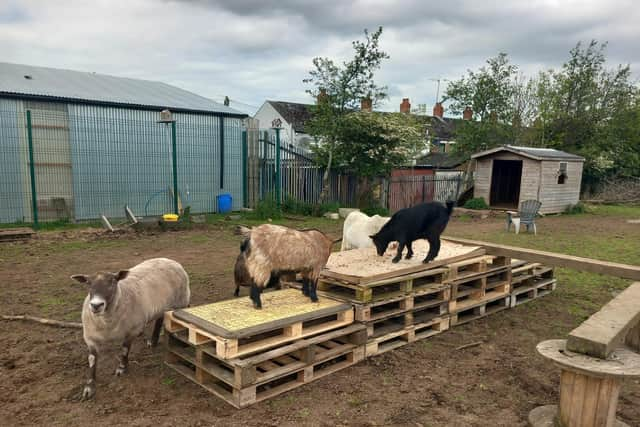
Earlier this week the farm’s community engagement officer Damien Lindsay showed me their goats on a ‘play frame’ made of wooden pallets, which were also the main material for gates, chairs, animal pens, raised flower beds and much more!
“When we first started here everything was made out of pallets,” Damien told me “there was nothing else.”
They first began using them when “they were left beside the farm from an August anti-internment bonfire,” Damien continued, “it’s not just one side that’s burning them!” The farm has two Facebook slogans - ‘build not burn’ and ‘pallets for profit’.
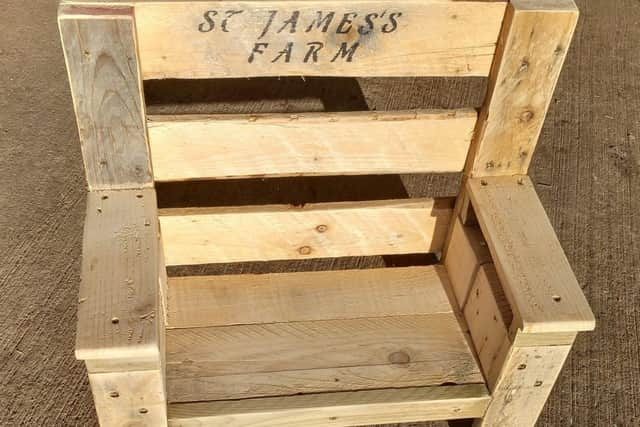
Damien listed the St James’ range of items - “Window boxes, seating, wee chairs for kids and wooden tables, all from pallets. The work’s all done here on the farm. Train sets and trucks, tractor and trailer window boxes.”
And the St James’ window boxes are all-year-round. “We make them for Halloween with pumpkins in them,” Damien outlined, “and for Christmas with a wee Santa scene in them. At Easter we put straw in them and a big Easter Egg. And for summer there’s flowers in them.”
The wooden items are sold to defray running costs, with the Workforce Training Scheme helping along - “training young people, sixteen and eighteen year olds,” Damien explained “they’ve been brilliant. They made us our big chair, for group photos - the kids love it!”
The pallets are also make raised vegetable beds “for people who can’t bend over or have pains. They grow potatoes, tomatoes, peas, lettuce and all sorts of flowers,” Damien continued “and about 600 hanging baskets have sold out!”
For visiting and events - see St James’ Community Farm on Facebook.