
Trevor Ringland: Accepting that murdering your neighbour was wrong and unjustified is the only basis for reconciliation in Northern Ireland
A letter from Trevor Ringland:
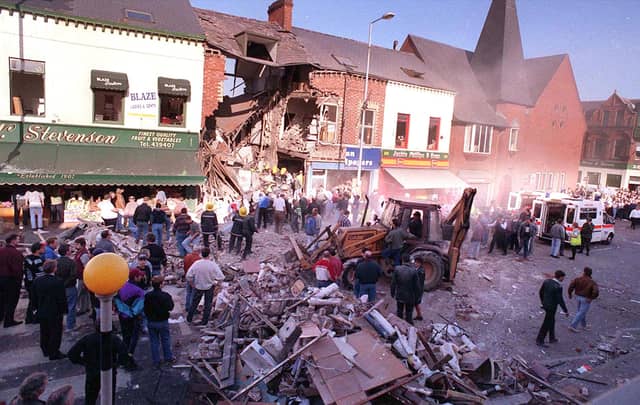

When you murder your neighbour during a terrorist campaign, you often end up living beside your neighbour’s family when the violence recedes.
This is the reality of what happened in Northern Ireland during the period we too casually call ‘the Troubles’. It is made worse when the murders or the murderers are celebrated, as we see constantly with paramilitary commemorations and the republican movement's attempts to gain retrospective support for its violence.
If there is one issue that exposes the moral compromises that were asked of people in Northern Ireland, and particularly the innocent victims of the crimes committed, it is the definition of ‘victim’ imposed by the two governments. The common-sense definition would be limited to someone who has suffered harm or loss as a result of a criminal act.
Instead, in Northern Ireland, a victim is defined as someone who has suffered harm or loss as a result of a conflict related incident. This often equates the genuine victim with the perpetrator. To take a particularly grotesque example, the people who were bombed on the Shankill Road are equated with the bombers.
The definition is insulting and bizarre. One outworking is it is used by some to attempt to give credence to the argument that IRA terrorists had ‘no alternative to violence’ and allow the republican movement to claim the respect for its unnecessary campaign that it so craves.
Most loyalists I talked to over the years were more brutally honest and accepted that, rather than being victims, they made them. Unfortunately, the republican example has encouraged some to go down the victimhood path, on the basis of an argument little deeper than, “they killed us, so we killed them”.
The definition has political consequences too. It encouraged the idea that we should be grateful to the ideologues who previously supported violence for giving us peace. In reality, there was always a strong majority across our society who refused to take the violent route and built and maintained relationships.
Their position was backed up by the security forces. Although there were regrettable exceptions, the police and army overwhelmingly showed restraint and applied the rule of law. It is a tragedy that violence did not stop when the military was deployed on our streets in 1969, but soldiers helped prevent an outright civil war.
Rather than arguing that there was no alternative to violence, we should look to the words of the late Maurice Hayes, combined with those of the late Queen Elizabeth. We could paraphrase these as the basis for relations on this island and East-West. Namely, “In our history there were things that we wish we had done differently or not at all. But we agree that nothing was achieved by violence that could not have been achieved by peaceful means.”
The only genuine basis for reconciliation is accepting that murdering your neighbour was wrong and unjustified. Until now, we were asked to forgo truth and justice, in the hope that it would result in political stability. Unfortunately, in many instances, this process did not result in a shred of contrition from the chief perpetrators of murder or their apologists.
The ICRIR, as it was originally conceived, at least has the potential to deliver an honest appraisal of the chances for truth and/or justice in most cases. The involvement of former RUC officers promises only to add effectiveness to the investigation process.
Officers from that organisation, after all, previously solved 50% of loyalist murders (1050) and 33% of those committed by republicans (2139). The force charged around 12000 republicans and some 8000 loyalists (including the so-called Glenanne Gang and the Shankill butchers) with terror offences. It is astounding that some, who should know better, do not appreciate the significance of these statistics or constantly try to distort it.
As we perhaps start dealing with legacy murders and the crimes of the past in a proper and balanced way, we should continue to work pragmatically with those who felt such actions were necessary.
That degree of practical reconciliation does not mean we need to be their best friends, nor to stop challenging a narrative that attempts to justify that there was no alternative to the use of violence, but enables cooperation to continue if they are now prepared to work for the betterment of all the people here, on this island and these islands
Trevor Ringland, Bangor