
Owen Polley: Jon Burrows will face a bulging in-tray after his coronation as leader of the Ulster Unionist Party
The Ulster Unionist Party will not hold a leadership election after all and its next leader will be Jon Burrows.
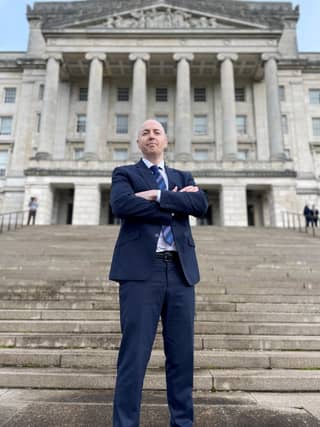

Nominations for the post closed last Thursday and no new contenders emerged. The appointment should now be ratified at an extraordinary general meeting at the end of January.
What kind of leader of the UUP will Mr Burrows become, and what challenges will he face?
First of all, he has immediately encountered suggestions that his MLAs are divided about backing his leadership.
The only declared support for his bid at Stormont came from Diana Armstrong, the Fermanagh South Tyrone MLA, who will now become his deputy leader.
To add to the impression of discontent, Robbie Butler, who was thought to be Burrows’ main rival for the job, issued a cryptic statement confirming his intention not to run.
It was full of vague words about “confident, positive, modern unionism with a strong social conscience,” and Mr Butler pledged to, “understand the direction and focus of any new leadership team”.
It did not however contain congratulations for the new leader, or indeed any reference to him at all.
This sent an unfortunate message, even though Mr Burrows responded with a gracious statement about Mr Butler’s contribution to the party.
It would be understandable if veteran UUP politicians felt miffed by Burrows’ rapid progress through the party. He only became North Antrim MLA in August and has not fought an election yet.
At the same time, if they were opposed to his leadership bid, they should have put themselves forward for election and articulated counter-arguments in a campaign.
Of course, every political party contains ambitious people, who sometimes clash, form rivalries or feel resentments.
If the UUP, though, was full of high-achievers who deserved to be ahead of Mr Burrows, he would not so quickly have emerged as a leadership contender.
The other suggestion about the incoming leader is that he is some sort of hardliner, who signals a retreat from liberal unionism. That is equally silly.
In his time at Stormont so far, Mr Burrows has not articulated any argument that a moderate unionist would not be likely to accept, to my knowledge at least.
Indeed, at any other time in Northern Ireland’s history, he would have been considered a liberal. It is just that, now, that term seems to have changed its meaning.
The only evidence that Burrows is hardline seems to be the fact that his style at Stormont has been more robust than some of his colleagues.
That does not mean that he has been intemperate, unfair or rude, never mind remotely sectarian.
It is probably fair to say, though, that he does not seem interested in being everyone’s best friend.
Instead, Mr Burrows has established a reputation for criticising ministers for bad leadership and stupid decisions. He has attacked the way Stormont does business too, taking issue, for example, with its habit of debating international issues that are none of its concern.
Burrows has been direct, rather than evasive, in the language he uses.
When have any of these qualities been bad or illiberal?
It is understandable that nationalists, and Alliance MLAs, who have been challenged by Mr Burrows, like to encourage the idea that he’s a rabid hardliner, or that he will destroy the UUP. It is rather more baffling that some unionists try to imply the same thing.
None of this is to say that Mr Burrows will necessarily prove a successful leader.
He’s spoken well so far about important issues. But there are gaps, and it is easier to make good, direct interventions as an MLA than as the head of a party who has to keep fractious colleagues on board.
Mr Burrows emphasised his commitment to the Union during the brief leadership campaign, describing himself as an ‘evangelist’ for the benefits of the United Kingdom.
He has also acknowledged the importance of the Irish Sea border, and the challenge it presents to our constitutional status.
As if to emphasise that this will remain the biggest issue facing unionists, last week the assembly debated a new EU parcel levy, that could in theory add €3 to every small internet purchase we make from Great Britain requiring a postal delivery.
There are differences of opinion among unionists about what to do about the sea border, even if the claim it no longer exists has collapsed completely.
Mr Burrows has made it clear that he will not support collapsing Stormont as a tactic against the framework and suggested on the Stormont Sources podcast that he would work to ‘salami-slice’ its effects.
It is becoming even clearer, though, that the sea border is a kind of wasting disease for the Union that will forever eat away at our ability to play a full role in the UK. For that reason, Mr Burrows may need a bolder stance on opposing it.
Unless the UUP overtakes the DUP, he will also have to decide, either now or after the next election, whether it is better to remain in the executive, being implicated in decisions by larger parties, or lead the opposition.
This was a dilemma he understandably put off during the leadership contest, but it is likely to become pressing very soon.
These will be difficult questions, but the UUP, and unionism more widely, must hope that Jon Burrows is equipped to answer them.