
A blue plaque is placed in Crawfordsburn village to the 19th century landowner and politician William Sharman Crawford
William Sharman Crawford, who in the 1800s was a Westminster MP both from Ireland (Dundalk) then England, has been honoured with a plaque.
As a huge landowner in Co Down but also a backer of the Tenant Right Custom (essentially improving the lot of tenants) he had friends and enemies.
A Belfast News Letter in April 1852 described him as “...the upholder of a desperate democracy, a striker at the roots of property, a secularist in education, a papist in disguise and besides all a man in his dotage”. But that same year, one of my predecessors as editor of this title James McKnight (MacKnight), said Crawford was an aristocrat, “richer a great deal than four fifths of the titled persons around him, came forward nobly to advocate the abolition of the great social grievance which he saw destroying his native country.”
Thus Crawford, who was born in Moira Castle in 1780 and died in Crawfordsburn in 1861, was disliked by his social class..
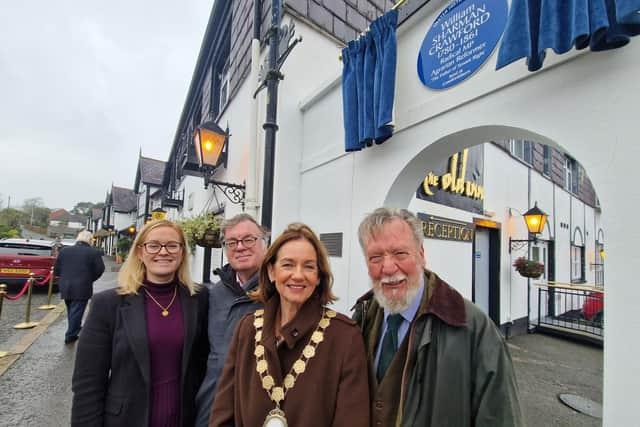

The Ulster History Circle (UHC) blue was unveiled on a wall on the Old Inn in Crawfordsburn village, near to his home (a grand house on Belfast Lough which was demolished in the early 1900s, and replaced by another mansion that is now divided into luxury flats). The UHC described Crawford as someone who “sometimes been unjustly overlooked in the history of Ulster radicalism. He was a member of the landed elite, but wanted to give power to tenant farmers in the face of overmighty landlords. “At the time of the Great Famine, he castigated the British government and his fellow landlords for ‘exterminating’ the rural poor of Ireland.”
A curtain in front of the plaque was pulled open by the Mayor of Ards and North Down, Gillian McCollum. She stood alongside Crawford’s biographer, Professor Peter Gray of Queen’s University, who then gave a talk about Crawford from inside the Old Inn.
Also present was Dr Peter Collins, of the Ulster History Circle, the former BBC broadcaster Seamus McKee, and Lynsey Gordon of Galgorm Collection, which owns the Old Inn.
Chris Spurr, chairman of the UHC, said: “William Sharman Crawford is remembered as a benevolent landowner who charged moderate rents and never evicted a tenant. The Ulster History Circle is pleased to commemorate this radical reformer with a blue plaque in Crawfordsburn near to where he lived.
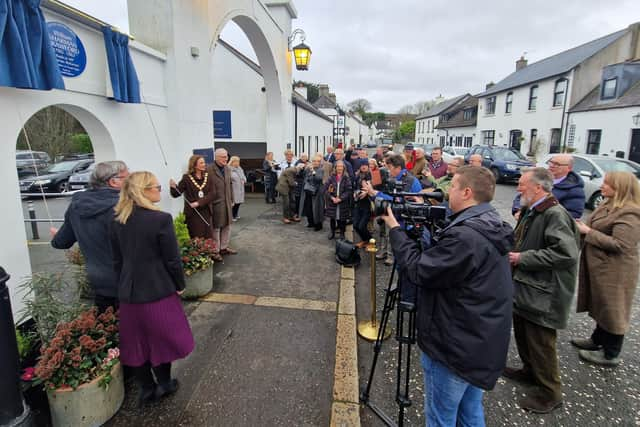
"The circle is grateful to Ards and North Down Borough Council for their financial support towards the plaque and to the management of The Old Inn for their kind assistance.”
Crawford, while an Anglican, supported Catholic Emancipation and was elected an MP at Westminster for Dundalk in 1835, with the support of the Irish Catholic leader Daniel O’Connell – but they soon fell out and Crawford would resign his seat in 1837.
In the early 1840s he returned to the House of Commons in London when he became an MP for Rochdale with the support of radicals in England. In Westminster he campaigned for an end to slavery in the British Empire and in the United States.
Crawford was wealthy both from his father was Colonel William Sharman, who bequeathed his son land in Ulster and Meath, and his wife, Mabel Crawford, whose father had an estate in Crawfordsburn in Co Down.
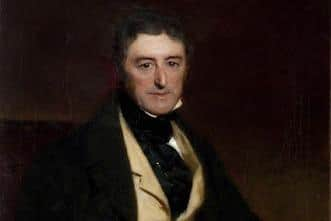
Crawford, influenced by his father Sharman senior, believed in reform, not revolution, and neither man was involved in the 1798 rebellion. Crawford had a reputation for fair treatment of his tenants, setting rents at lower levels than those of fellow landowners. After he got into House of Commons for the first time in 1835 Crawford worked to put rent reform and tenant rights into legislation.
The Irish famine of the 1840s heightened his radicalism. In one pamphlet he asked fellow MPs if they would “be the instruments of exterminating that people over whom you hold the power, in order to carry into effect your favourite theory of consolidating the lands of Ireland for the use of capitalist farmers, and converting the Irish peasants into the hired labourers of these monied masters?”. Crawford, for all his radicalism, opposed Irish separation from Britain, but rather self-government within it.
According to the UHC, Daniel O’Connell said, wrongly as it turned out: “Believe me that, when men of his [Crawford’s] rank, fortune, talents and high character take the lead in seeking for ‘the repeal’, the national restoration of Ireland is at hand.”
In the 1852 election he did not stand for re-election for Rochdale but instead was a Westminster candidate in Co Down but, opposed by the local landed families and the Orange Order, lost. He had previously failed to be elected in Down and Belfast two decades earlier, in 1831 and 1832.
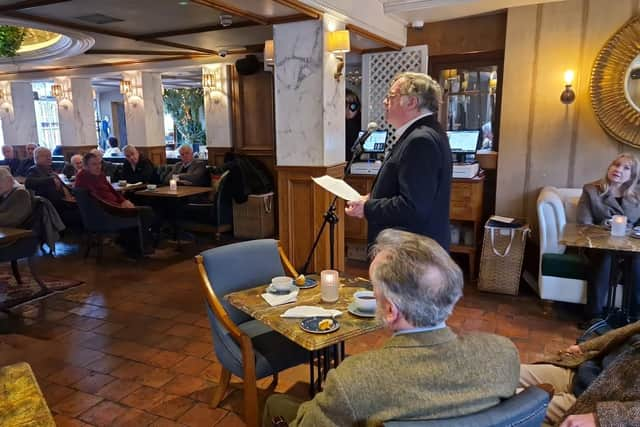
Professor Gray believes that the radicalism of Crawford can be traced through to the Ulster Liberal Party of the 1950s and 60s and liberalism today: “It is not unreasonable to see Sharman Crawford as a distant ancestor of these political developments…His attempts to find a pragmatic settlement to the Irish constitutional question that respected different communal and national identities and fears ..continue to have evident resonances in contemporary Northern Ireland and beyond.”