
Adam Smith's 'The Wealth of Nations', the basis for modern economics, was published 250 years ago
Although overshadowed by celebrations surrounding the 250th anniversary of the Declaration of Independence, this year also marks the 250th anniversary of the publication of Adam Smith’s ‘An Inquiry into the Nature and Causes of the Wealth of Nations’, usually referred to by its abbreviated title ‘The Wealth of Nations’.
Smith was one of the giants of the Scottish Enlightenment, a philosopher and an economist and is widely regarded as ‘the Father of Economics’.
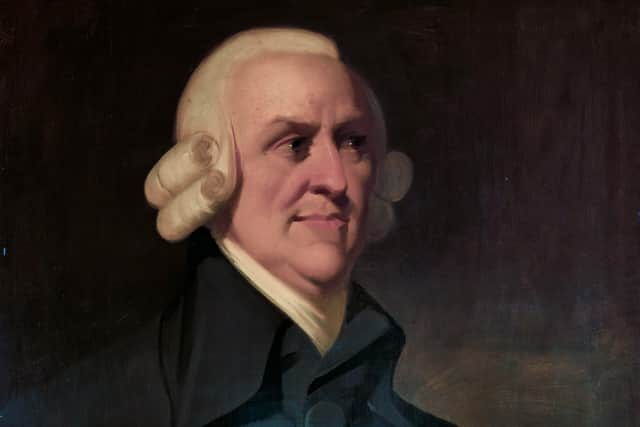

While his exact date of birth is unknown, he was baptised in Kirkcaldy’s Old Kirk on June 5 1723, which is often celebrated as his birthday.
Francis Hutcheson, the Ulster-born Professor of Moral Philosophy at the University of Glasgow from 1729 to 1746 who is widely regarded as ‘the Father of the Scottish Enlightenment’, was a profound influence on Smith. Smith referred to his mentor as ‘the never to be forgotten Hutcheson’.
Smith's father, also called Adam Smith, a local customs officer, died shortly before Smith was born. Smith’s mother, Margaret Douglas, was the daughter of Robert Douglas of Strathendry, a wealthy landowner.
The widowed Margaret Douglas raised Smith alone and never remarried, forming a close bond with her son which would continue throughout his life.
Smith displayed academic promise from an early age. He studied mathematics, history, Latin and writing at the Burgh School of Kirkcaldy from 1729 to 1737.
Smith entered Glasgow University at the age of 14, where he studied logic, metaphysics, maths, Newtonian physics, and moral philosophy, before going to Oxford. Although Smith remained in Oxford for six years, he was not impressed by the teaching style and its antiquated curriculum. Unlike Glasgow, Anglican Oxford failed to stimulate his mind.
In 1751, Smith returned to the University of Glasgow as a Professor of Logic, but quickly became a Professor of Moral Philosophy, which was more closely aligned with his interests. In addition to courses in philosophy and jurisprudence, Smith also lectured on literature, language and history.
Smith was both popular with and respected by his students. His international reputation attracted students from Switzerland, Russia, and the American Colonies to attend his lectures.
His final connection with Glasgow University came in 1787 when he became Rector. Although a largely ceremonial role, Smith took the position extremely seriously, ensuring that he kept up to date with meeting minutes. In a letter of thanks for the honour he wrote that he remembered his professorial days at Glasgow University as ‘by far the most useful and therefore as by far the happiest and most honourable period of my life’.
Three publications form the basis of Smith’s enduring fame and legacy: ’The Theory of Moral Sentiments’, ’The Wealth of Nations’, and his incomplete ’Lectures on Jurisprudence’.
‘The Wealth of Nations’ is by far and away the most important of these.
The product of 17 years work, it is one of the most influential books ever published, rejecting feudalism and mercantilism and providing the theoretical foundation for capitalism – although he never used the term.
Karl Marx described ’The Wealth of Nations’ as ‘the true Bible of the classical political economy of the 18th century’.
Dr Eamonn Butler, the director of the Adam Smith Institute, helpfully has identified its most important themes.
‘The first theme is that regulations on commerce are ill-founded and counter-productive. The prevailing view was that gold and silver was wealth, and that countries should boost exports and resist imports in order to maximise this metal wealth. Smith’s radical insight was that a nation’s wealth is really the stream of goods and services that it creates. Today, we would call it gross national product. And the way to maximise it, he argued, was not to restrict the nation’s productive capacity, but to set it free.
‘Another central theme is that this productive capacity rests on the division of labour and the accumulation of capital that it makes possible. Huge efficiencies can be gained by breaking production down into many small tasks, each undertaken by specialist hands. This leaves producers with a surplus that they can exchange with others, or use to invest in new and even more efficient labour-saving machinery.
‘Smith’s third theme is that a country’s future income depends upon this capital accumulation. The more that is invested in better productive processes, the more wealth will be created in the future. But if people are going to build up their capital, they must be confident that it will be secure from theft. The countries that prosper are those that grow their capital, manage it well, and protect it.
‘A fourth theme is that this system is automatic. Where things are scarce, people are prepared to pay more for them: there is more profit in supplying them, so producers invest more capital to produce them. Where there is a glut, prices and profits are low, producers switch their capital and enterprise elsewhere. Industry thus remains focused on the nation’s most important needs, without the need for central direction.
‘But the system is automatic only when there is free trade and competition. When governments grant subsidies or monopolies to favoured producers, or shelter them behind tariff walls, they can charge higher prices. The poor suffer most from this, facing higher costs for the necessities that they rely on.
‘A further theme of “The Wealth of Nations” is that competition and free exchange are under threat from the monopolies, tax preferences, controls, and other privileges that producers extract from the government authorities.’
Smith died in 1790, two years after his mother, and was buried in the nearby Canongate Cemetery.
The Adam Smith Institute is one of the world's leading think tanks. It exists to promote neoliberal and free market ideas.
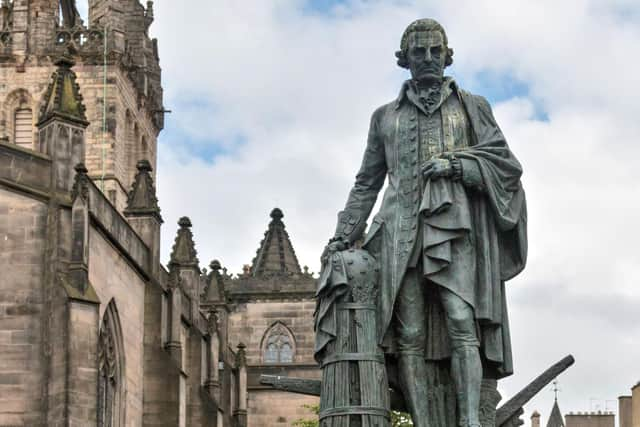
On July 4 2008, the Adam Smith Institute unveiled the world's first major public monument to Adam Smith which takes the form of a 10-foot bronze statue on a massive stone plinth, and sits on Edinburgh's Royal Mile.
The statue's position – in an ancient marketplace – could scarcely be more appropriate. The monument is within view of the statue of Smith’s friend David Hume, looking downhill to the Canongate (where Smith lived and is buried), towards the harbour of Leith (the port of Edinburgh), and over the sea to Fife, where Smith was born.