
Alexander Armstrong – from surgeon on perilous quest for North-West Passage to physician to Queen Victoria
Alexander Armstrong was born in 1818 but where is unclear. Some accounts, including the Canadian Dictionary of Biography, give his place of birth as Co Donegal and others as Co Fermanagh.
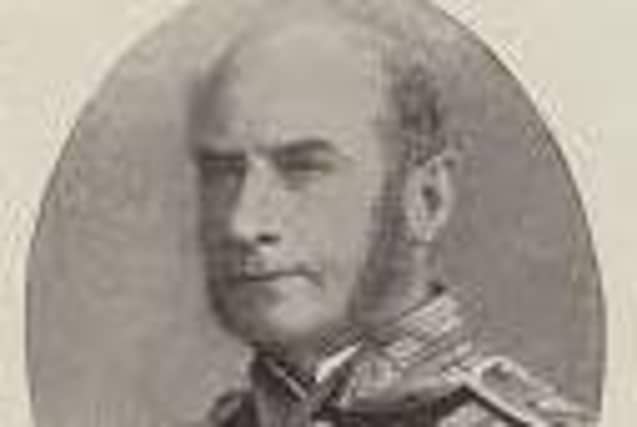

Consulting ‘Who was Who 1897-1916’ would normally provide a conclusive answer but not in this case. Entries in ‘Who’s Who’ are provided by the individual concerned but Armstrong for whatever reason chose not to enlighten us. However, he was the son of Alexander Armstrong of Croghan Lodge, Co Fermanagh.
By descent the Armstrongs were Reivers from the Anglo-Scottish borders. Major-General John Armstrong, one of Alexander’s ancestors, was a military engineer and aide-de-camp to John Churchill, 1st Duke of Marlborough.
Alexander studied medicine at Trinity College, Dublin, and Edinburgh University, joining the Royal Navy medical service as an assistant surgeon in1842. He was promoted to surgeon in 1849.
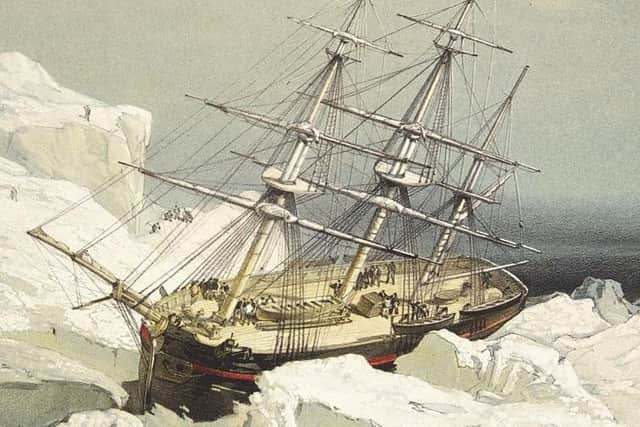
Alexander served in various parts of the world, including five continuous years in the Arctic. The purpose of the Arctic posting was to find out what happened to Sir John Franklin and the Banbridge-born Francis Crozier who had set out to find the North-West Passage but had disappeared without trace.
Alexander served as surgeon and naturalist aboard HMS Investigator, one of the expedition’s two ships, the other being HMS Enterprise.
Robert John Le Mesurier McClure commanded HMS Investigator. McClure, who was born in Wexford, was rash and impulsive and entered Arctic waters without waiting for the Enterprise.
McClure coasted eastwards, discovered Prince of Wales Strait, and, crossing it, came in sight of Viscount Melville Sound, which had already been explored from the east by William Edward Parry in 1819. McClure thus completed the tracing of the North-West Passage between the Pacific and Atlantic oceans through the Canadian archipelago.
Investigator was eventually forced back down the strait by gale-driven pack-ice, thrown over on her side, and almost wrecked.
In the summer of 1851 McClure rashly attempted to round Banks Land along a coast which Armstrong described as ‘without parallel for the dangers of its navigation in any part of the world’. Almost crushed against rocky cliffs, the ship escaped through a channel so narrow that her yard ends scraped against the towering ice walls that hemmed her in.
McClure finally reached Mercy Bay on the northern shore of Banks Land, where the Investigator spent the winters of 1851–52 and 1852–53 trapped in ice. Her men, on half rations for many months, were on the verge of starvation when they were rescued in April 1853 by Lieutenant B C T Pim.
Pim had come by sledge from Resolute, commanded by Captain Henry Kellet, which was then in Viscount Melville Sound. McClure was determined to get his ship out but Kellett ordered that it be abandoned. Armstrong’s plant and animal collection perished with the ship, but he managed to keep his journal despite McClure’s orders to his officers that their records were to be left on board.
After further mishap and another winter in the Arctic, the men returned to London by way of Barrow Strait in September 1854 aboard the supply ships of another expedition in the Franklin search.
The party had in effect traversed the North-West Passage by sailing on three different vessels in succession and making two intermediate sledge treks covering hundreds of miles over the frozen seas.
During the first winter spent in the Arctic, his fellow officers subjected him to such vicious horseplay that a Moravian missionary, who accompanied the party as interpreter to the Inuit, expressed great surprise that McClure did not think it appropriate to intervene.
This may well account for Armstrong’s intense dislike for McClure. Nor did McClure have the wit to appreciate the value of Armstrong’s medical skills.
Perhaps ‘the clever young doctor was too conscious of his superior endowments to be popular with his brother officers’.
The crew, on the other hand, fully appreciated his close attention to their welfare.
Through the excellence of Armstrong’s medical care, only six of the 66 men, who faced starvation and scurvy for much of the time, died during the entire voyage. On their return to England, the petty officers and crew thanked Armstrong for his care of them.
There are three published accounts of the expedition but by far and away the best was Armstrong’s ‘Personal Narrative of the Discovery of the North-West Passage’ which was published in London in 1857.
In the Canadian Dictionary of Biography L H Neatby has described the book as ‘a lucid and straightforward, although somewhat ponderous, account of the phenomena, animate and inanimate, which came under the author’s observation. It furnishes moving descriptions of appalling peril in the wind-driven pack-ice, along with a candid exposure of the condition to which the crew were reduced, thereby contradicting McClure’s arrogant and preposterous claim [in McClure’s self-serving account] that he could have saved the men’s lives without external aid.’
Armstrong made a convincing case for the proposition that no travel 'more thoroughly tests man's powers of endurance, both morally and physically' than travelling in the Arctic. He also noted that lemon juice was a most effective remedy against scurvy.
Armstrong’s narrative was awarded the Gilbert Blane gold medal for the best journal kept by a surgeon of the Royal Navy.
During the Crimean War Armstrong served in the Baltic. He was present at the bombardment of Sweaborg, the complex of fortifications protecting Helsinki, and two night attacks with a flotilla of rocket-boats, for which he was gazetted. (The Grand Duchy of Finland was part of the Russian Empire until the Russian Revolution.)
Between 1859 and 1864 Armstrong served as superintendent of the naval hospital in Malta. In 1863 he was appointed honorary surgeon to the Prince of Wales and in 1870 honorary surgeon and physician to Queen Victoria. The following year he was knighted. Between 1869 and his retirement in 1880 he was director of the Medical Department of the Royal Navy.
Sir Alexander Armstrong died on July 4 or 5 1899.
In addition to his ‘Personal Narrative of the Discovery of the North-West Passage’, Armstrong wrote his much admired ‘Observations on Naval Hygiene’ (1858).