
Battle of Mons showed BEF could punch above its weight
On August 4 1914 the United Kingdom declared war on Germany. Between August 9 and 22 the British Expeditionary Force, commanded by Field Marshal Sir John French, was safely transported across the Channel.
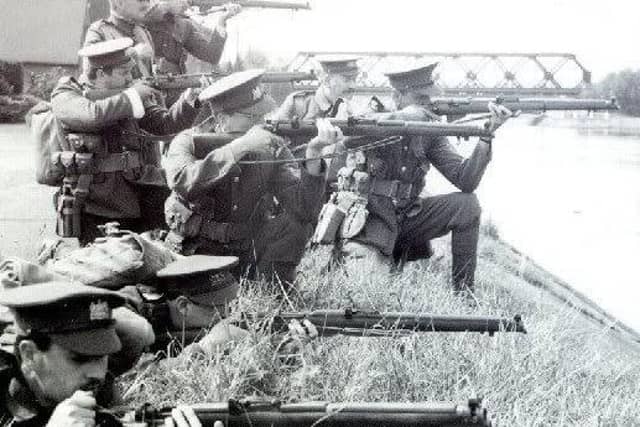

The BEF – the official war history described the BEF as ‘incomparably the best trained, best organised and best equipped British army which went forth to war’ – consisted of two corps or four divisions (100,000 men).
The British Army was small and professional compared to the huge conscript armies of continental Europe. If Kaiser Wilhelm II did – allegedly in an order dated 19 August 1914 – refer to the BEF as a ‘contemptible little army’, he did at least have a valid point with respect to its size. However, within days the BEF would demonstrate its superb professionalism.
Sir John French’s orders from Lord Kitchener, the new war minister, were to ‘coincide sympathetically with the plans and wishes of our ally’. Thus, the BEF was concentrated in between Maubeuge and vicinity of Le Cateau, to the left of the General Lanrezac’s French Fifth Army. At Marshal Joffre’s request, the British Expeditionary Force moved into Belgium in support of Lanrezac’s advance towards Namur (August 21).
A corporal in the 4th Dragoon Guards fired the first British shot of the war on the morning of August 22 when British and German cavalry clashed on the road to Brussels, at Casteau, just outside Mons.
The following day, General Sir Horace Smith-Dorrien’s II Corps of the BEF was struck by the full weight of Alexander von Kluck’s First German Army near Mons. While von Kluck was aware that elements of the BEF were on the continent, the presence of the BEF in southwest Belgium came as a considerable surprise to him. Two British divisions faced six German across the Mons-Condé canal just north of Mons.
Although heavily outnumbered the British fought back stoutly. With rapid rifle-fire the BEF held the Germans at bay. British troops were expected to be able to fire ‘fifteen rounds a minute’. Many could do better. Marksmanship was encouraged by extra pay and an issue of free ammunition to enable men to perfect their skill in their spare time. The Germans were convinced that they were confronted by machine gun fire.
Cpl John Lucy of 2nd Royal Irish Rifles recalled the impact of British rapid fire on the advancing Germans: ‘For us the battle took the form of well-ordered, rapid rifle-fire at close range, as the enemy field-grey human targets appeared, or were struck down. The enemy advanced … in ‘column of masses’, which withered away under the galling fire of the well-trained and coolly led Irishmen.
‘The leading Germans fired standing, “from the hip”, as they came on, but their scattered fire was ineffective, and ignored. They crumpled up – mown down as quickly as I tell it – their reinforcing waves and sections coming on bravely and steadily to fall over as they reached the front line of slain and wounded … such tactics amazed us, and the shock of seeing men slowly and helplessly falling down as they were hit, gave us a great sense of power and pleasure. It was all so easy.’
British casualties amounted to 1,600 killed, wounded or missing. Two regiments – the Middlesex Regiment and the Royal Irish Rifles which had borne the brunt of the fighting – accounted for 50% of the casualties. German casualties, never fully disclosed, must have reached nearly 5,000. Richard Holmes has suggested that German losses may have been as great as 6,000 and possibly even as high as 10,000.
Sir John French was prepared to continue the fight the next day but the retreat of Lanrezac’s Fifth Army from the Sambre left him without support and dangerously exposed. Sir John French had no option but withdraw. Thus began ‘the retreat from Mons’ to Le Cateau – scene of a much bigger battle on August 26 – and beyond to the Marne.
Men were very tired in the immediate aftermath of the Battle of Mons. John Lucy thought that he had covered ‘75 miles in five days and a battle into the bargain’. In 13 days the men of the BEF were to march 200 miles in 13 days. Often they had only had four hours’ sleep. Some men had less.
Not surprisingly, John Lucy recalled: ‘Our minds and bodies shrieked for sleep … Every cell craved rest and that one thought was the most persistent in the minds of the marching men.’
On September 5 – at the close of the retreat – the BEF had 20,000 men fewer than its original strength. However, when rejoined by stragglers, the BEF’s losses were something of the order of 15,000 killed, wounded or missing. The Duke of Wellington lost a similar number of men at the Battle of Waterloo, albeit from a much smaller army. The British army lost slightly fewer men during the Crimean War.
According to John Terraine the Battle of Mons demonstrated ‘that the British regular was a first-rate soldier, more than a match for the Germans in shooting and manoeuvring ability. It indicated to the thoughtful that great care should consequently be taken over how he was used, since there were not many of him’.
Mons was not a costly battle in Great War terms but before the end of the year – as a result of subsequent engagements – the original BEF virtually ceased to exist. In the Battle of First Ypres between October 16 and November 16 the BEF lost some 58,000 men. Its losses by the end of 1914 amounted to 95,654.
John Lucy gives an immediacy of what this meant with respect to his own battalion – the 2nd Royal Irish Rifles – when it was relieved in Flanders on November 19 1914: ‘This time only forty men of my regiment were able to march away. The rest were killed or wounded. Forty-four left out of two hundred and fifty, and only about three weeks ago there were only forty-six left out of an entire battalion. I searched my mind for total figures and roughly reckoned that in three months ninety-six men out of every hundred had been killed or wounded. I was too weary to appreciate my luck.’