
Battle of Stormberg event in Belfast recalls 120 killed in pre-apartheid war in South Africa
A commemoration takes place in Belfast on Sunday in memory of 120 men who died in a South African battle which was partly fought against the racist ideology which produced apartheid.
The London Irish Rifles Memorial Service will take place at the South African War Monument in the grounds of Belfast City Hall at 2pm on Sunday - where it has taken place annually since 1904.
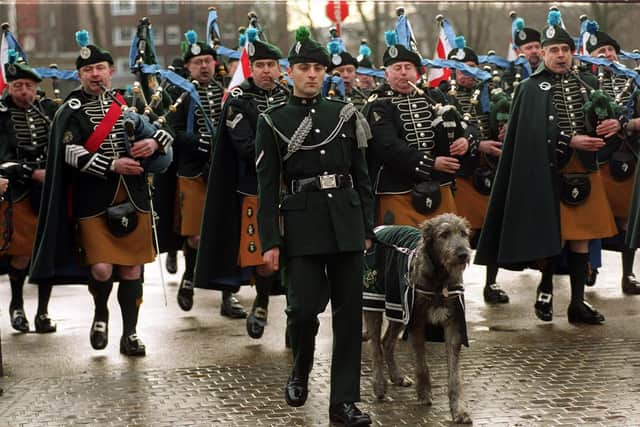

The ceremony marks the Battle of Stormberg, which took place on 10 December 1899, during the Second Boer War in South Africa.
This event honours the regiment’s service alongside the 2nd Battalion Royal Irish Rifles, with 14 London Irish Riflemen memorialised on the Royal Irish Rifles at the South African War monument.
The roots of the Boer wars began between 1835 and 1845, when 15,000 people of Dutch origin moved out of the British Cape Colony into the interior of South Africa.
Their exodus was partly a rejection of the British policy of equalisation between black and white people - and against what they saw as political marginalisation they suffered under British rule.
In the subsequent Boer Wars, the British Army employed thousands of Africans as wagon drivers, spies, guides and eventually soldiers. They were armed for self-defence against the Boers, who executed them when captured.
In the 20th century, the Afrikaaners took control of South Africa and resolved to become independent of British influence, later implementing the policy of apartheid (racial segregation).
The fighters in the 1899 Battle of Stormberg were predominantly white descendants of Dutch, German, and French settlers in South Africa, collectively known as Afrikaners or Boers (farmers).
The British lost some 230 who were killed, with 1,000 wounded and over 1,500 captured or missing.
Major Ant Maher, of the London Irish Rifles Association, said the ceremony is important to honour all those who gave their lives in the battle.
"There's 120 men named on the monument from all over Ireland," he told the News Letter.
"The monument at City Hall is 121 years old, and commemorates men from all over Ireland that volunteered to go and fight in South Africa. So it's part of our shared history.
"Ostensibly, the Afrikaner Boers were eventually beaten by the British, but it was a sort of fighting withdrawal out of South Africa.
"The Stormberg battle, which we commemorate on Sunday, was a dismal failure for the British. However we celebrate defeats just as willingly as we do successes, in order to remember all of those who paid the ultimate sacrifice."
The London Irish Rifles, who hold the Freedom of the City of Belfast, will gather at the South African war monument at City Hall on Sunday to pay tribute to their fallen members.
The monument was unveiled at the City Hall in 1904 to the memory of officers and men of The Royal Irish Rifles who died in the Boer Wars.
It features the bronze figure of a Rifleman in khaki uniform, his rifle with bayonet at the ready as he stands on a large rock, sculpted by Sydney March.
Some 80 participants are expected, including Regimental Standards, a Piper, a Bugler, and four uniformed Royal Irish soldiers with a guard commander from 2nd Battalion Royal Irish
Up to 15 army cadets will assist as ushers.