
Battle of the Bulge: Americans stopped Hitler’s final gamble of WWII, but at huge cost
Before the end of 1944 Hitler planned to take the Allies completely by surprise with an attack through the wooded Ardennes, a thinly held sector of the Allied front, driving a wedge between the American and British forces and then advance on Antwerp.
This, together with German divisions based in Holland attacking towards the south, would cut the Allies’ lines of communication and result in the encirclement and destruction of the British 21st Army Group and the 9th and 1st US Armies.
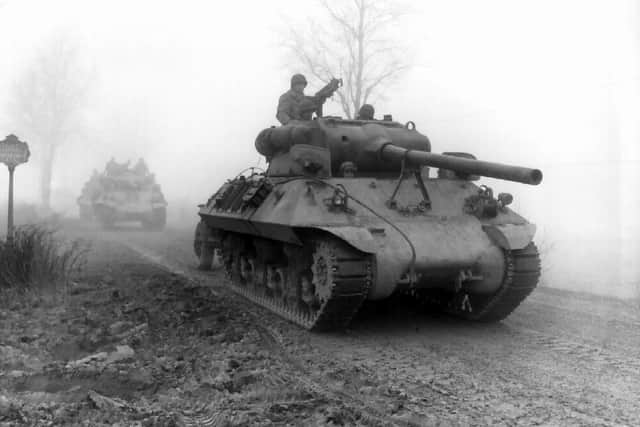

It was an extremely ambitious plan. None of the German field commanders entrusted with planning and executing the offensive believed it was possible to capture Antwerp. However Hitler believed that the resolve of the western Allies would crack under the weight of such a mighty blow. He also expected it to precipitate the break-up of what he considered to be the unnatural coalition of capitalist states and the Marxist USSR arrayed against him.
The Germans achieved tactical surprise when they attacked early on December 16 because bad weather temporarily deprived the Allies of the advantages of their air superiority. Although the Allies, through ULTRA, knew the Germans were massing their forces, they assumed it was for defensive rather than offensive purposes, a perception deliberately reinforced by the operation’s original codename, ‘Watch on the Rhine’.
General Omar Bradley had thought a German attack in the Ardennes was ‘only a remote possibility’ and Montgomery had believed the Germans incapable of mounting ‘any major offensive operations’.
The initial stages of the German offensive were so successful that early German optimism seemed justified. In the south General Manteuffal’s 5th Panzer Army made spectacular progress, taking between 8,000 and 9,000 prisoners and punching a 30km gap in the Allied front.
English-speaking German troops wearing US uniforms and driving American vehicles behind Allied lines achieved a level of havoc and confusion, causing US units to distrust each other.
In the north poor roads and stiff resistance resulted in General ‘Sepp’ Dietrich’s 6th Panzer Army making slower progress.
The savagery of the eastern front was imported into western Europe. Members of SS-Panzer Regiment I murdered 84 American POWs near Malmedy on December 17, one of only many atrocities. In response some US officers gave verbal orders that ‘no prisoners were to be taken’ and on this basis troops of the 11th Armoured Division are alleged to have killed 60 German soldiers at Chenogne on January 1 1945.
The Germans encountered stiff resistance at Bastogne from the US 101st Airborne Division and part of the 10th Armored Division. The Germans had to take Bastogne if they were to cross the Meuse, never mind advance on Antwerp.
On December 19 Eisenhower halted offensive action along the rest of the front in order to rush reinforcements to the Meuse.
As early as December 23 Field Marshal Model told Speer that the offensive had failed. General Guderain reached that conclusion the following day.
The weather had cleared by December 22, allowing the Allies to deploy their aerial superiority over the Luftwaffe. The Allies relentlessly pounded the German supply lines so that they could no longer bring in reinforcements of men and materiel.
On January 1 1945 the Luftwaffe retaliated with an all-out attack on Allied airfields and inflicted considerable damage on the Allies, but at a cost the Germans simply could not afford.
Most accounts of the battle tend to be highly critical of Montgomery’s tactlessness and vanity. Many, perhaps even most, American officers had come to dislike Montgomery because they saw him as an overly cautious commander, arrogant, and rude towards Americans.
On January 7 Montgomery tried to redeem himself, not altogether successfully, by paying tribute to the ‘courage and good fighting quality’ of the American troops, characterising a typical American as a ‘very brave fighting man who has that tenacity in battle which makes a great soldier’, and went on to talk about the necessity of Allied teamwork, and praised Eisenhower, stating, ‘Teamwork wins battles and battle victories win wars. On our team, the captain is General Ike [Eisenhower].’
In Montgomery’s defence it is worth quoting Manteuffel of the 5th Panzer Army: ‘The operations of the American 1st Army had developed into a series of individual holding actions. Montgomery's contribution to restoring the situation was that he turned a series of isolated actions into a coherent battle fought according to a clear and definite plan. It was his refusal to engage in premature and piecemeal counter-attacks which enabled the Americans to gather their reserves and frustrate the German attempts to extend their breakthrough.’
There is no consensus on casualties. According to the US Department of Defense, American forces suffered 89,500 casualties including 19,000 killed, 47,500 wounded and 23,000 missing.
The German High Command estimated that they lost between 81,834 and 98,024 men in the Bulge between December 16 1944 and January 28 1945.
British casualties totalled 1,400 with 200 deaths, underscoring Churchill’s observation in the House of Commons on January 18 1945 that US troops had ‘done almost all the fighting’ and ‘suffered almost all the losses’.
The key to the Allied retrieval of the situation was the incredible mobility of the US army. For example, George Patton re-orientated his army northwards at breakneck speed and relieved Bastogne and disrupted the German advance.
In four days the Americans were able to double their manpower and triple their armour in the Ardennes.
Churchill described the Battle of the Bulge as ‘undoubtedly the greatest American battle of the war’ and observed that it would ‘be regarded as an ever-famous American victory’.
The Battle of the Bulge was Hitler’s last gamble in the west. The Luftwaffe was effectively finished. The Wehrmacht had lost 80,000 irreplaceable troops, vast quantities of armaments (especially tanks and aircraft) had been destroyed and fuel supplies were almost exhausted.
Defeat was now inevitable but Hitler refused to openly admit it. Privately, he was resolute that he would never capitulate. As he told his Luftwaffe adjutant, ‘We can go down. But we’ll take a world with us.’