
British defeat at Battle of Yorktown in 1781 ended the American Revolutionary War
The Battle of Yorktown took place between September 28 and October 19 1781, resulting in the British surrender to the American Revolutionaries ending the American Revolutionary War.
The Continental Army was led by George Washington with the support of French troops.
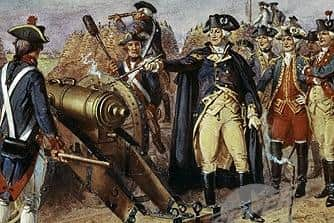

In terms of numbers 8-9,000 British (a third of which were German) fought nearly 20,000 American and French forces.
In August, British Admiral Sir Thomas Graves led a fleet from the Province of New York to attack de Grasse's fleet. Graves did not realise how large the French fleet was, and neither did General Charles Cornwallis. The British fleet was defeated by de Grasse's fleet in the Battle of the Chesapeake on September 5 and forced to fall back to New York.
On August 19 Washington marched toward Yorktown and laid siege to the townb.
On September 29 Washington moved closer to Yorktown but was fired upon by British artillery. General Washington continued to make visits to the front, despite concern shown by several of his officers over the increasing enemy fire.
On October 7 the British saw the Continental Army digging new trenches out of musket fire range. Over the next two days, the allies completed the gun placements and dragged the artillery into line.
The British fire began to weaken when they saw the large number of guns the allies had.
By October 9 all French and American guns were in place threatening the British. Among the American guns there were three 24 pounders, three 18 pounders, two eight-inch (203 mm) howitzers and six mortars, totalling 14 guns.
At 3pm, the French guns opened the barrage and drove the British frigate HMS Guadeloupe across the York River, where she was scuttled to prevent capture.
At 5pm, the Americans opened fire. Washington fired the first gun. Legend has it that this shot smashed into a table where British officers were eating.
The Franco-American guns began to tear apart the British defences. Washington ordered that the guns fire all night so that the British could not make repairs. All of the British guns on the left were soon silenced.
The British soldiers began to pitch their tents in their trenches and soldiers began to desert in large numbers. Some British ships were also damaged by cannonballs that flew across the town into the Harbor.
By October 14, the trenches were within 150 yds (140 metres) of Redoubt No. 9 and 10 and Washington ordered that all guns within range begin blasting the redoubts to weaken them for an assault that evening. He intended to use the moonless night as cover and demanded silence from his troops to maintain an element of surprise.
The Americans captured of Redoubts Nos 9 and 10 and Washington was able to have his artillery shell the town from three directions and the allies moved some of their artillery into the redoubts.
The artillery fire was continuous on the British and was heavier as new artillery pieces came into use. Cornwallis spoke with his officers, and they agreed that their situation was hopeless.
On October 17 a drummer appeared followed by an officer carrying a white handkerchief. The officer was blindfolded and the bombardment ceased. Negotiations began at Moore’s House with Major Alexander Ross representing the British.
At 2pm on October 19 the British paraded out of Yorktown allegedly playing the tune ‘The World Turn'd Upside Down’.
Cornwallis refused to attend the surrender ceremony, claiming that he was ill. Instead, Brigadier General Charles O'Hara led the British army onto the field.
O'Hara first attempted to surrender to Rochambeau (French forces), who shook his head and pointed to Washington. O'Hara then offered his sword to Washington (American Revolutionary), who also refused and motioned to Major General Benjamin Lincoln, his second-in-command. The surrender finally took place when Lincoln accepted the sword of Cornwallis's deputy.
The British then marched out and laid down their arms between the American and French Armies.
The British Army suffered from malaria, with about half of the army ill and unable to fight. The Continental Army used this to their advantage given that most of their army had grown up with it and were therefore immune.
The British Army were considered prisoners of war with Washington refusing to allow them parole.
Some of the terms were:
l Article one surrendered the land forces to the Americans and the Navy to the French.
l Article two surrendered artillery, arms, accoutrements, military chests and public stores to heads of American departments appointed to receive them.
l Article three surrendered the Redoubts to the American and French Forces.
l Article four allowed officers to hold onto their sidearms.
l Article five related to where the soldiers would be detained. Regiments were to be kept together as and where possible. Washington rejected the provision that British or German soldiers could be returned to their native countries.
Following the surrender the American and French entertained the British officers to dinner. Cornwallis did not attend the dinner, citing illness. During dinner the French were charmed by the British, something that worried Washington presumably because of future British-French relations.
After the British surrender, Washington sent a report of the victory to Congress. After a difficult journey, he arrived in Philadelphia, which celebrated for several days.
The British Prime Minister, Lord North, is reported to have exclaimed ‘Oh God, it's all over’ when told of the defeat. On March 4 1782, a motion to end “further prosecution of offensive warfare on the continent of North America” – effectively a no confidence motion – passed in the British House of Commons. Lord North and his government resigned on March 20.
Yorktown Day is held annually every October 19.