
Edgar Allan Poe … a tangled life and aptly mysterious death
Edgar Allan Poe, the American writer, poet, author, editor and literary critic, was born in Boston on January 19 1809.
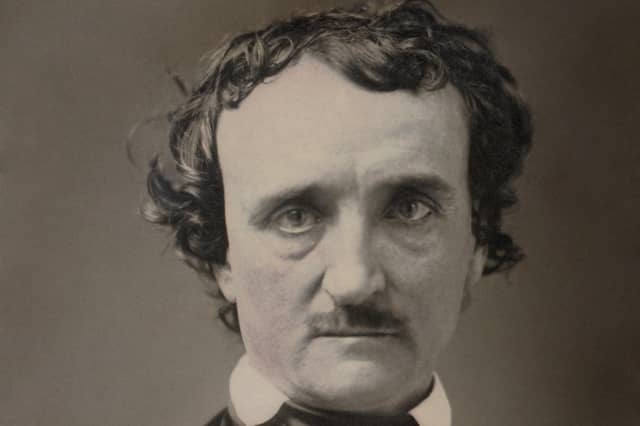

Best known for his poetry and short stories, particularly his tales of mystery and the macabre, he is the most important practitioner of Romanticism and Gothic fiction in American literature.
His great-great-grandfather, David Poe of Dring, Co Cavan, was a tenant-farmer. His son John married Jane McBride from Ballymoney. They emigrated to Lancaster County, Pennsylvania, in time for their eldest son David to participate in the War of Independence.
David acquired the nickname ‘General Poe’ because of his friendship with the Marquis de Lafayette, the French aristocrat who served with the Continental Army and was a friend of George Washington.
David's own son, also called David, had an unsatisfactory relationship with his father, abandoned his legal studies to become an itinerant actor, and married an actress.
David Jr abandoned his wife and family in 1810. Edgar's mother died of TB soon after. The same disease would also claim his foster mother, Frances Allan, to whom he was close, and later his beloved wife, Virginia Clemm. Their deaths provide an obvious explanation for the recurring theme of the ‘death of a beautiful woman’ in his work.
Effectively orphaned, Poe soon found a home with John Allan, a wealthy Richmond merchant, who gave him the name ‘Edgar Allan Poe’ and brought him up but without formally adopting him. In his dealings with his ‘foster son’ Allan oscillated between indulgence and harsh discipline.
In 1815 the Allans moved across the Atlantic to the UK and for a brief period Poe attended a grammar school in Irvine in Ayrshire, where Allan was born.
The following year, Poe rejoined the Allans in London and studied at a boarding school in Chelsea until 1817. He subsequently attended Bransby’s Manor House School in Stoke Newington.
Poe entered the University of Virginia in 1826 but quarrelled with Allan over the inadequacy of the funds for his education. In a bid to make good the shortfall he gambled heavily but only managed to run up huge debts which drove a deeper wedge between him and Allan.
Poe enlisted in the US Army to support himself and served in Boston and South Carolina with considerable distinction under an assumed name. He entered the Military Academy at West Point in 1830, but soon afterwards engineered his dismissal for insubordination – presumably because he was determined to become a full-time writer.
For several years he worked for various literary journals and periodicals in Baltimore, Philadelphia and New York. In the mid-1830s he was editor of the ‘Southern Literary Messenger’ in Richmond and claimed to have increased its circulation from 700 to 3,500.
In 1836, when he was 27, he married Virginia Clemm, his 13-year-old cousin. At the Presbyterian ceremony, a witness falsely attested to the bride being 21. Nevertheless, it was a happy marriage and Poe was greatly distressed, and possibly unhinged, by her death in 1847.
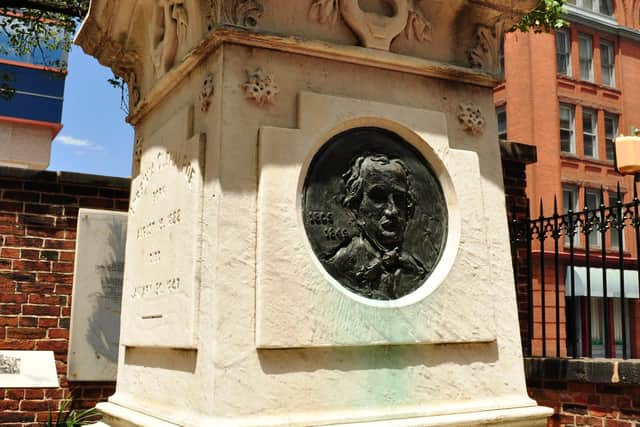
On the cusp of launching his own journal, he died in Baltimore on October 7 1849, five days after having been found semi-conscious and ‘in great distress, and ... in need of immediate assistance’.
Poe was not lucid long enough to explain his dire plight and why he was wearing clothes that were not his own. He is said to have repeatedly called out the name ‘Reynolds’ on the night before his death, though it is unclear to whom he was referring. According to the doctor attending him, Poe's final words were, ‘Lord help my poor soul’.
As the relevant medical records have been lost, including the death certificate, the exact cause of his death remains, perhaps appropriately, a mystery. It has been variously attributed to alcoholism, heart failure, epilepsy or a combination of these. And there are other possibilities.
Like so many great authors, he died tragically young. For example, the Brontë sisters: Charlotte, Emily and Anne died at the age of 38, 30 and 29 respectively. The poets Byron, Shelley and Keats died at 36, 29 and 25 respectively. Maupassant, another practitioner of the short story, died aged 42. Franz Kafka died at the age of 40.
As Poe packed a great deal of memorable work into his brief life, it is poignant to consider what else he might have achieved if he had lived longer.
During his lifetime, Poe’s reputation was primarily regarded as a literary critic. His often caustic reviews earned him the reputation of being a ‘tomahawk man’. A contemporary critic frivolously suggested that he used prussic acid rather than ink to write.
Today he is principally remembered for his poems, especially ‘The Raven’, and his short stories, pre-eminently ‘The Fall of the House of Usher’.
‘The Raven’, published in 1845, was an immediate success and made Poe a household name almost overnight. (Even today, Baltimore’s football team is known as The Ravens in honour of the city’s most famous one-time resident and poet.)
In ‘The Fall of the House of Usher’, which appeared in 1839 and 1840, an unnamed narrator visits his ill friend, Roderick Usher. Roderick’s twin sister Madeline is also ill with this unknown disease and Roderick believes that his house is sentient. The death and burial of Madeline are the catalyst for a series of disturbing supernatural events, culminating in a grand finale which leaves the narrator fleeing from the house as it comes crumbling down.
Poe is credited with contributing significantly to the emergence of science fiction. Jules Verne was a life-long admirer and his own work was greatly influenced by Poe. When he wrote ‘The Murders in the Rue Morgue’ in 1841, Poe virtually created a new literary form: detective fiction.
In five stories P D James, ‘the late Queen of Detective Fiction’, credits him with anticipating every type of detective story – a view shared by Arthur Conan Doyle.
Chevalier C Auguste Dupin is a cerebral detective, a man who solved crimes not by acts of egregious bravery or spectacular cunning, but by observation and reason.
Sherlock Holmes was at least partially inspired by Poe’s Dupin.