
Edward Carson was a Dubliner but a state funeral and burial in Belfast was exactly what he deserved as a founding figure of NI
Edward Carson, one of the founding figures of Northern Ireland, had contracted bronchial pneumonia in June 1935 but by July he was out of danger.
During this period Dr Charles D’Arcy, the Church of Ireland Archbishop of Armagh and Primate of All Ireland, paid a visit to see a fellow Dubliner.

Carson confided to the primate: ‘I have seen much to shake my faith and what remains with me is no more than I learned at my mother’s knee: “God so loved the world that He gave His only begotten Son …”’. The archbishop assured Ned, his old friend, that John 3:16 was ‘enough’.
While Carson recovered, his health was nevertheless fatally weakened. By the early autumn his strength began to ebb away and at 8am on October 22 1935 at Cleve Court, a Queen Anne house in the Isle of Thanet, Kent, Carson died.

Carson had left no instructions in his will as to where he wished to be buried but in conversation with Lord Craigavon he had expressed a desire to be buried in the land, in Craigavon’s words, for which ‘he fought so long, so valiantly and so successfully’.
In a broadcast the prime minister announced that the Northern Ireland government would provide a state funeral and that Carson would be buried at St Anne’s Cathedral.
Craigavon introduced special legislation in the Northern Ireland House of Commons to enable the burial to take place in the cathedral. The legislation passed through all its stages there and in the Senate in one sitting.
HMS Broke conveyed the body to Belfast and the funeral took place on Saturday October 26 1935.
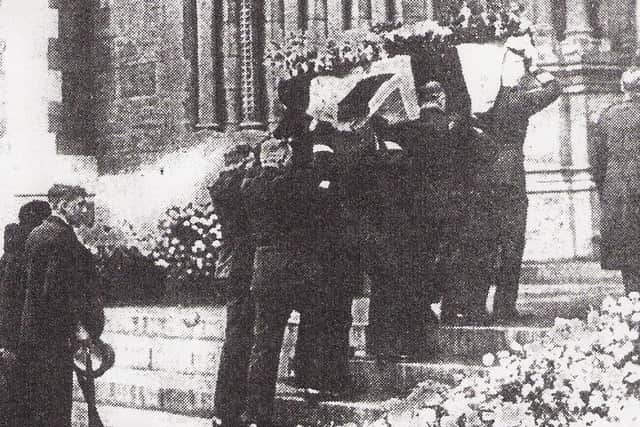
Thousands of shipyard workers stopped work and bowed their heads as the warship steamed slowly up Belfast Lough, with Carson’s flag-draped coffin sat on the quarterdeck. Two petty officers and six ratings carried the coffin ashore. It was placed on a gun-carriage and pulled through the streets of Belfast which were thronged by silent crowds.
Lady Carson, Carson’s second wife, and her 15-year-old son led the family mourners. The funeral procession paused twice: outside the Old Town Hall, the headquarters of Ulster unionist resistance to Home Rule in the years before the Great War, and the City Hall, where Carson had signed the Ulster Covenant.
The coffin was carried through the great West Door of the cathedral by Lord Craigavon, Wilfrid Spender, Fred Crawford, Dawson Bates and Lord Londonderry, men who had shared Carson’s great struggle to preserve the Union.
Primate D’Arcy conducted the funeral service. He told the congregation: ‘Here in Belfast is most truly the place where his mortal remains should rest. It was nobly and rightly done to bring them here.’
The coffin was lowered into the tomb. From a silver bowl, soil from each of the six counties of Northern Ireland and the City of Londonderry was scattered on to his coffin. Buglers sounded the Last Post and Reveille and the congregation sang ‘O God our Help in Ages’, the battle hymn of Ulster unionism.
In 1953 H Montgomery Hyde, the then MP for North Belfast, concluded his biography of Carson with the observation, ‘Ulster’s “Sir Edward” had come home to his people’.
This was not entirely true because Carson’s background – by birth, family background, upbringing, education and early professional career – was firmly located in southern Irish society. He never lost his Irish brogue.
Before 1910 or 1911 he had little or no experience or contact with Ulster society. Carson was the leader of Ulster Unionism from February 1910 to February 1921. Carson was MP for Trinity College, Dublin, for 26 years and MP for the Belfast constituency of Duncairn only from December 1918 to May 1921. Thus, the greater part of his life was spent far removed from the concerns of Ulster. Ulster was the focus of his political life for only 11 years but the people of Ulster had taken Sir Edward to their hearts.
In 1938 Shane Leslie of Castle Leslie, Glaslough, Co Monaghan, speculated that Carson died of ‘a broken heart’. Leslie was an intelligent and thoughtful Nationalist. In the years before the Great War, Shane slipped out by the backdoor of Castle Leslie to drill with the Irish Volunteers while Sir John, his father and the commander of the UVF in Monaghan, went out the front door of the castle to inspect the progress of the Ulster Volunteers in the county.
Leslie contended: ‘He [Carson] made the best bargain he could over the treaty but he was not strong enough to hold out against his own people for the ‘clean cut’ of Ulster. He allowed the grandees and shopkeepers of Belfast to throw out the three counties of Cavan, Monaghan and Donegal. He was too great a gentleman and fighter not to have felt the abandonment of his friends too bitterly for words.’
While Leslie inaccurately conflated the Government of Ireland Act of 1920 and the Anglo-Irish treaty of December 1921, his assessment of Carson’s feelings were close to the mark as scrutiny of his speech to the Ulster Unionist Council in February 1920 and his maiden speech in the House of Lords in December 1921 attests.
When Carson formally relinquished the leadership of Ulster Unionism on February 4 1921, he did so proffering sound advice: ‘From the very outset let us see that the Catholic minority have nothing to fear from the Protestant majority. Let us take care to win all that is best among those who have been opposed to us in the past. While maintaining intact our own religion let us give the same rights to the religion of our neighbours.’
James Craig made strenuous efforts to follow Carson’s sage advice. It is a matter of great regret that the nationalist community found it so difficult to reciprocate.