
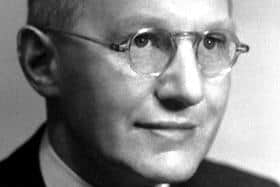
Ernest Walton, son of a Methodist minister, helped 'split the atom' but believed in banning the bomb
The 1951 Nobel Prize in Physics was awarded jointly to John Cockcroft and Ernest Walton ‘for their pioneer work on the transmutation of atomic nuclei by artificially accelerated atomic particles’ two decades earlier.
They successfully ‘split the atom’ using a high-voltage particle accelerator they built themselves.

Working at the Cavendish Laboratory in Cambridge, Cockcroft and Walton designed the first particle accelerator capable of achieving artificial nuclear disintegration. In 1932, they used this device to bombard lithium atoms with high-energy protons. This collision split the lithium nucleus, transforming it into helium nuclei and proving that human-controlled artificial nuclear transmutations were possible.
Ernest Walton was born on October 6 1903 in Dungarvan, Co Waterford, the son of John Walton (1874-1936), a Methodist minister from Cloughjordan, Co Tipperary, and Anna Sinton (1874-1906) from Richhill, Co Armagh.
In those days, Methodist clergy moved from one congregation to the next every three years. Thus, the family led a peripatetic existence, living in 13 different locations in Ireland between 1901 and 1995, eight of which were in counties that became part of Northern Ireland.
This is reflected in where he received his education. After kindergarten in Banbridge, he attended Cookstown Academy for a period before boarding at Methodist College, Belfast, where he excelled in science and mathematics.
In 1922, Walton won scholarships to Trinity College, Dublin, for the study of those subjects, and would go on to be elected a Foundation Scholar in 1924. He graduated in 1926 with a double first and a large gold medal in experimental science.
He remained in Trinity for a further year to pursue a master's degree in hydrodynamics, and was duly awarded an M.Sc.
Walton was accepted as a research student by Trinity College, Cambridge, in the autumn of 1927 under the supervision of Ernest Rutherford, the director of the Cavendish laboratory.
Walton’s research fellowship was funded out of the profits of the Great Exhibition of 1851.
At the end of the 1920s there were four Nobel Prize laureates on the staff in the Cavendish laboratory and a further five were to emerge, including Walton and John Cockcroft. With its 34 Nobel laureates, Trinity College, Cambridge, has more Nobel Prizes than most countries in the world (excluding only a handful of nations like the US, UK, Germany, and France).
Walton was awarded his doctorate in 1931 but remained at Cambridge as a researcher until 1934.
In August 1934 he married Freda Wilson, a former school colleague at Methody and daughter of the Rev Charles Wilson and Annie Wilson (née Elliott). Their four children Alan, Philip, Marion, and Jean all pursued careers in science.
Although any number of prestigious laboratories throughout the world would have welcomed him with open arms, he returned to Trinity in 1934 where he was elected to Fellowship without exam on the merit of his published work and appointed professor in Experimental physics soon after. He became the 18th Erasmus Smith’s professor of Natural and Experimental Philosophy in 1946.
Despite inadequate public funding for research, Walton transformed the study of physics at Trinity. An excellent teacher, he had the gift of explaining complex topics in comprehensible terms. New undergraduate syllabuses were created in the late 1950s, including nuclear physics, acceleration of charged particles, and modern solid-state physics.
The number of students in the department grew, so that lectures had to be duplicated. In 1950 Walton and Robert Elliot built a Van de Graaff accelerator in Trinity, however its success was limited by available resources and damp weather.
A committed Methodist, Walton’s professional and personal life was guided to the very best of his ability by Christian principles and values.
Walton was invited to participate in scientific work during the Second World War both in the UK and the US. The latter invitation was to join the Manhattan project, which led to the development of the atomic bomb.
Walton's reluctance to participate in war work was not based wholly on Christian and pacifist principles. He often said that he would like to be a pacifist but candidly conceded he would find difficulty with pacifism in certain circumstances.
Being always alert to the ethical and social dimensions of his scientific work, he was strongly committed to minimising the threat of nuclear war by banning the bomb. Accordingly, he was a member of the Pugwash Group (and president of the Irish section), a society of scientists concerned about the threat of nuclear weapons to humanity.
He gave lectures to international audiences on the relationship between science and religion and contended: ‘One way to learn the mind of the Creator is to study His creation. We must pay God the compliment of studying His work of art and this should apply to all realms of human thought. A refusal to use our intelligence honestly is an act of contempt for Him who gave us that intelligence...’
Although he retired from Trinity College, Dublin, in 1974, he maintained his association with the Physics Department until his final illness. (In retirement he was a frequent visitor to the department’s tearooms. Visitors to the university were mesmerised by the thought that the quiet and self-effacing man in the corner sipping his tea had ‘split the atom’.)
Shortly before his death he marked his lifelong devotion to his alma mater by presenting his Nobel medal and citation to the college.
Ernest Walton died on June 25 1995 in Belfast at the age of 91. He is buried in Dean's Grange Cemetery in Dublin.
A blue plaque erected by the Ulster History Circle at Methodist College commemorates his achievements and his attendance at the school between 1915 and 1922. It was unveiled by his daughter, Marion on October 6 2003.