
Gallipoli was a failure, but future WWII premier Winston Churchill learned valuable lessons
As First Lord of the Admiralty since October 1911, Winston Churchill was political head of the Royal Navy. Although, vigorous, imaginative, eloquent and brimming with self-confidence, he was also rash and impulsive and not the great military strategist he fondly imagined himself to be.
On November 25 1914 Churchill first raised the possibility of the Royal Navy forcing the Dardanelles, sailing through the sea of Marmara and shelling Constantinople (now Istanbul) or occupying it. While the idea attracted interest, it did not gain sufficient support in the War Council.

In the first four months of the war the British and French suffered nearly a million casualties in the grim stalemate on the Western Front, prompting Churchill to ask in a memorandum to Prime Minister Asquith (dated December 29 1914): ‘Are there no other alternatives than sending our armies to chew barbed wire in Flanders?’
Simultaneously, Churchill was feeling under pressure to use the Royal Navy to deliver a significant naval victory.
In early January 1915 Grand Duke Nikolai, the Russian commander-in-chief, asked for British and French action to divert the Turks from the Caucasian front.
Despite Churchill writing in 1911 that it was no longer possible to force the Dardanelles and that no one should expose a modern fleet to that risk, the considerations just stated by made the concept strategically attractive.
In February 1915 an Anglo-French fleet failed to force a passage through the Dardanelles. The Turks managed to sink three battleships, severely damage three others and inflict seven hundred casualties on the Anglo-French fleet.
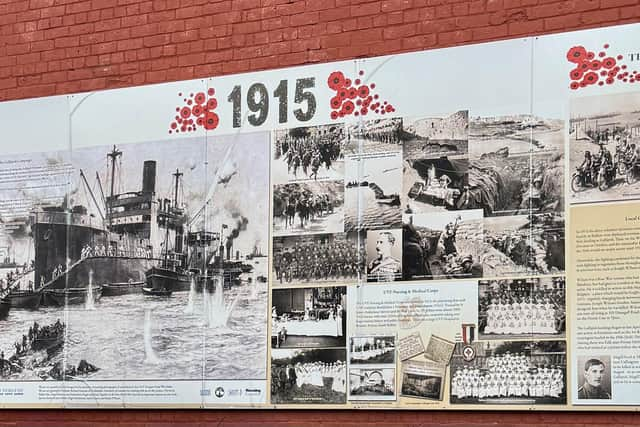
Amphibious landings on the Gallipoli peninsula began in April 1915. They too were a failure and degenerated into a bloody stalemate even worse than that of the Western Front.
Gallipoli was one of the inhospitable places on the face of the planet. In the summer months the heat was unbearable. Men sweltered in the daily increasing heat, assailed by huge black swarms of fat flies which had feasted on rotting corpses; they were half choked by the fearful stench, they were short of water, ridden with disease and dysentery, tormented by lice.
By contrast, in the winter the Gallipoli experienced sub-zero temperatures, heavy snow and flash floods. As a result of the great storm of November 27-30 1915, for example 200 soldiers were drowned and 5,000 were found to be suffering from frostbite. Men even froze to death in their trenches.
In January 1916, after eight months' fighting, the land campaign was abandoned. Brilliantly executed, the evacuation proved to be only successful aspect of the entire campaign.
The Allies committed about half a million men to the campaign, of whom about half became casualties. About 25,000 British servicemen (from every part of the United Kingdom), almost 10,000 French, 7,300 Australians, 2,400 New Zealanders and 1,700 Indians lost their lives.
The notion that the Royal Navy would pass through the Dardanelles, bombard Constantinople and knock the Ottoman Empire out of the war, and thereby strengthen Russia and weaken Germany, and shorten the war, relied almost completely on wishful thinking.
It failed to take account of at least three important considerations. First, Turkey was propped up by Germany rather than the other way round. Secondly, the Ottoman Empire was huge and the proposition that the capture of Constantinople would be enough to knock Turkey out of the war was dubious. Finally, even if a supply route could be opened to Russia, Britain and France lacked sufficient munitions to supply their own armies and had none to spare to send to Russia.
The Russian railway system was too primitive for the Russians to send grain to Britain and France (which was another Allied miscalculation).
During the 19th century Turkey had been regarded as ‘the sick man of Europe’ and there was a not unreasonable assumption that the defeat of Turkey would be a pushover. Furthermore, Turkey’s military performance in the Balkan Wars (1912-13) had been singularly unimpressive.
However under the direction of the immensely talented German commander, Liman von Sanders, the Turks had embarked on an astonishingly impressive programme of military reforms.
By 1915 the Turkish Army was a formidable fighting force. Both its equipment and training were improving all the time. In Mustafa Kemal Atatürk, the 34-year-old commander of the 1st Turkish Division (and creator of modern Turkey), the Turks possessed an outstanding soldier. Furthermore, the Turks would also be defending their homeland and would enjoy the advantages of having shorter lines of communication. Both Sanders and Atatürk had no difficulty in correctly identifying where the Allied landings would take place and organised their defences accordingly.
The historian Robert Rhodes James claimed Gallipoli ‘ended in a tactical draw’, an assessment which errs on the side of generosity, but appreciated that ‘considered strategically it was a major defeat for the Allies’.
A Royal Commission under Lord Cromer was appointed in 1916 to investigate the failure of the Gallipoli campaign. Its findings in 1917 concluded that the operation had been ill-conceived and ineptly executed, and losses were not justified. ‘Success in the Dardanelles, if possible, was only possible on condition that the [British] Government concentrated their efforts up on the enterprise and limited their expenditure of men and material in the Western theatre of war’. This condition was never likely to be met.
Gallipoli brought about the downfall of the UK’s last exclusively Liberal government in May 1915 because Asquith was obliged to bring the Conservatives into a coalition government. They insisted on Churchill’s removal from the Admiralty. He was demoted to Chancellor of the Duchy of Lancaster.
Although Gallipoli hung like an albatross around his neck for decades to come, Churchill embraced Gallipoli as a brilliant failure: ‘The Dardanelles might have saved millions of lives. Don’t imagine I am running away from the Dardanelles. I glory in it’.
Interestingly, a 32-year-old Captain Clement Attlee, who served at Gallipoli, always maintained that ‘the strategic conception was sound’.
Upon becoming prime minister in May 1940, Churchill claimed, ‘All my past life had been a preparation for this hour and for this trial’. And to be fair, Churchill learned many invaluable lessons from the Gallipoli fiasco which served him and the country well in the Second World War.